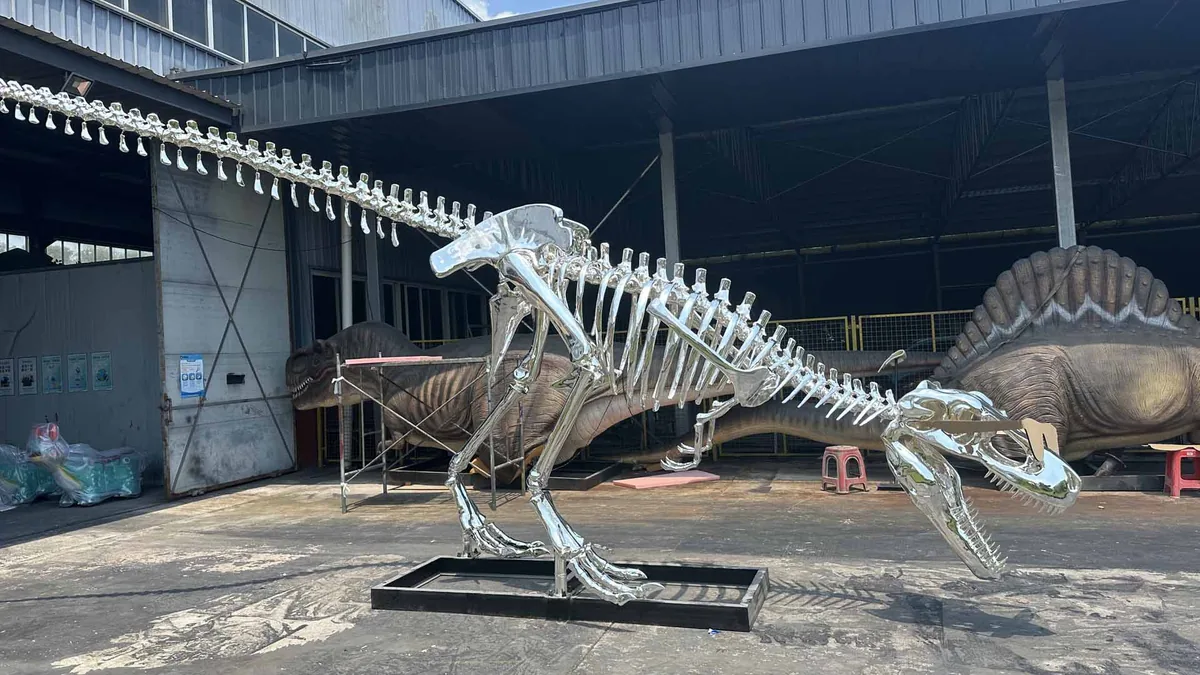
A dinosaur skeleton replica is bought for one reason: proportion. There is no skin to hide behind, no paint to suggest mass, no motion to distract the eye. A hip set ten centimetres too high disappears on a finished animatronic and is obvious on a mount the moment a visitor walks past it. That is why museums treat the skeleton as the honest version of an animal — and why the casting work is judged far more harshly than anything we build with skin on it.
We have cast skeletons, skulls, single bones and fossil plates for natural history halls, science centres, shopping malls, national parks and school loan programmes. The questions buyers ask are remarkably consistent, and almost none of them are about species. They are about scale, frame, transport, and what happens in year five when a bracket works loose. This guide walks through those decisions in the order you will actually face them.
Why a Cast, Not a Fossil
The obvious answer is that real specimens are not available. The useful answer is that even where they are, they are the wrong object for a public building. A mounted original is irreplaceable, cannot be touched, cannot travel, and cannot be exposed to the light levels a visitor attraction needs. A dinosaur fossil replica can be handled by a school group, re-rigged for a new hall, and repainted after a decade of flash photography.
There is a second reason that matters more to curators. A cast can be mounted in a pose the original matrix does not allow. If the fossil was preserved flat, crushed, or with half the ribcage missing, the cast becomes a reconstruction — and the quality of that reconstruction is where suppliers separate. Ask which specimen the mould came from, and whether missing elements were mirrored from the opposite side or modelled from a related species. A good supplier answers immediately and in detail. A trader answers with a species name.
The word fake dinosaur skeleton gets used dismissively in this trade, usually by someone who has not stood next to a good cast. A cast is not a fake. It is a documented reproduction of a specific specimen, made from a mould taken off that specimen, and it carries the same information as the original — which is why the best of them sit in the same halls as real material, labelled as casts.
What “Museum-Grade” Actually Means
A museum-grade dinosaur skeleton replica is not a marketing tier. The phrase is used loosely across this category, so it helps to break it into three things you can check with your own eyes on a sample or a photograph taken at close range.
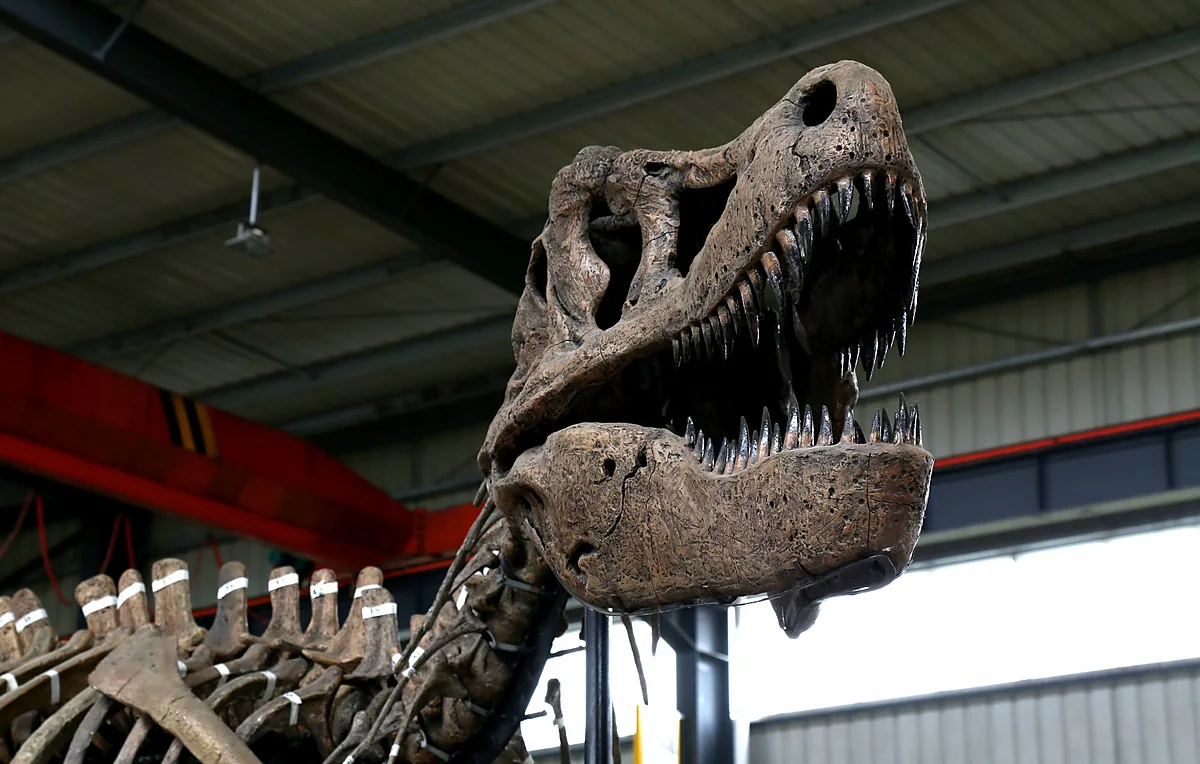
Suture lines. Real bone is a jigsaw. Skull plates meet along interlocking seams, and those seams are visible. Low-end casts sand them flat because they are difficult to reproduce and easy to fill. If a skull looks smooth across the top of the cranium, the mould has been smoothed, and the piece has lost the single most recognisable feature of a fossil.
Surface differentiation. Cortical bone — the hard outer shell — takes a different surface from trabecular bone at a joint or the spongy interior of a broken shaft. Casts that use one texture across the whole piece read as plastic from two metres away. Look at the ends of a long bone and at the interior of a rib.
Contact points. Every bone in a mount is held by a bracket. On a good mount, the bracket sits where a ligament would have been, or is hidden inside the bone shell. On a cheap one, the cradle is visible from the public side, or the bone is drilled through. This is the detail that separates a specimen from a sculpture, and it is almost always the first thing a curator photographs during a supplier visit.
Resin, Fiberglass or Silicone: Which Cast Holds Up
Three materials appear in this category and they are not interchangeable. The choice is driven by size, handling and whether the piece is static.
| Material | Where detail matters most | Where it falls short | Typical use |
|---|---|---|---|
| High-density resin with mineral pigment ageing | Skulls, teeth, claws, claw sheaths, small plates — sub-millimetre surface holds | Brittle at large spans; heavy per unit area | Single pieces, education sets, skull replicas |
| Fiberglass composite | Long bones, ribs, plates, whole-mount bone shells at 9 m and above | Slight shrinkage in deep undercuts; sanding removes fine sutures if overdone | Full mounts, large skeleton casts |
| Patented moulded silicone (ZL 2022 1 0224489.5) | Skin texture, folds, soft tissue, anything that flexes | Not a structural material — cannot carry a mount | Animatronic bodies, not skeletons |
The confusion usually starts when someone compares a fiberglass dinosaur skeleton to a silicone-skinned animatronic and concludes the fiberglass is the cheaper, worse option. They are solving different problems. Silicone exists because a moving animal needs a skin that stretches over a servo-driven joint. A skeleton does not move, so the material question is only about surface fidelity and span. Where a bone needs both — a large skull with fine crest detail — we cast the detail in resin and build the span in composite.
If a supplier quotes you a dinosaur skull cast without telling you which of these three it is, that is the answer to a different question: they have not made the decision, or they are reselling.
Scale: 1:1, 1:2 and 1:4
Full size is not always the right answer, and the reason is rarely budget. It is the building.
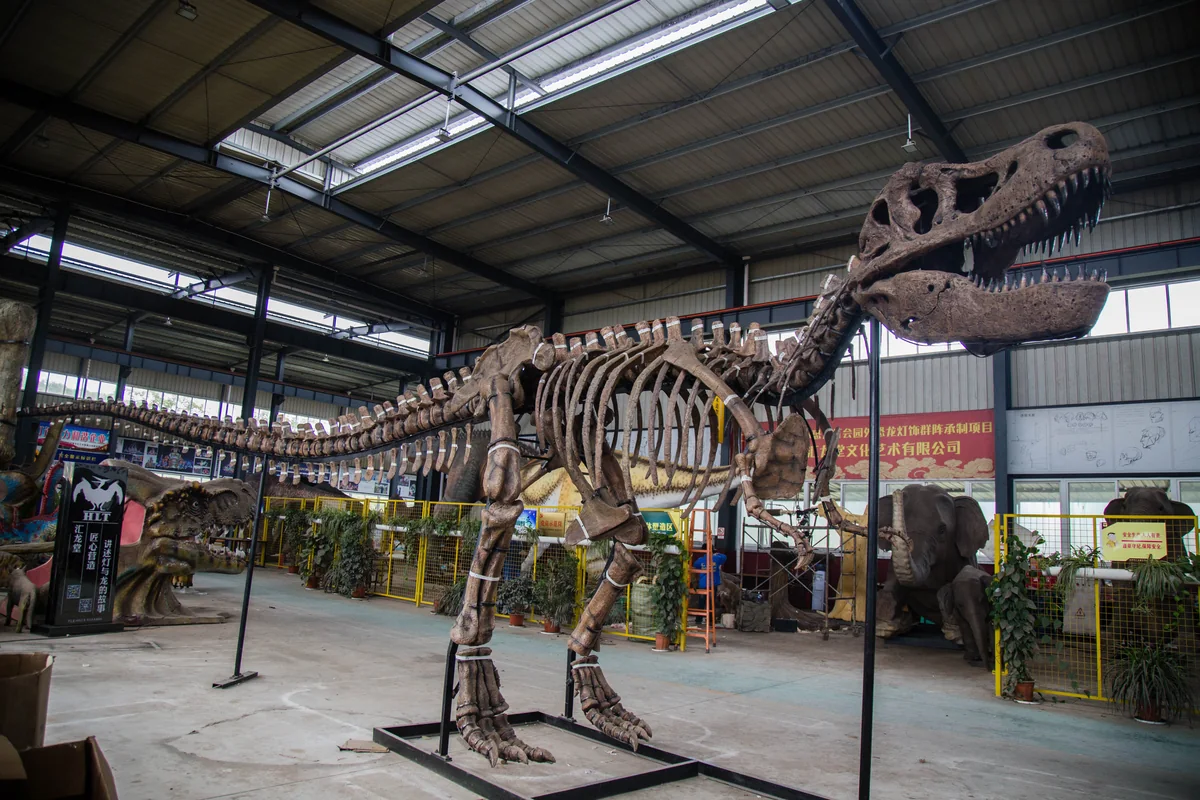
A life-size T-Rex skeleton replica runs 12 m nose to tail and about 5 m at the hip. At 1:2 that becomes roughly 6 m and 2.5 m — still a two-person lift per section, still needing a hoist for the pelvic block, but it fits through a standard double door and under a 3 m ceiling. At 1:4 it becomes an education object: one person can carry a crate of it, and it can sit on a 2 m plinth in a corridor.
Note that a replica t rex skeleton at 1:2 is not a scaled-down copy of the 1:1 version. Section count drops, the frame section drops, and the hoist requirement disappears — which is why the two are priced on different build sheets rather than on a size multiplier. The museum-grade mount in our range is built to the species at full size unless a client specifies otherwise, and the scale decision is usually driven by the room rather than by preference.
The decision sequence we use with clients:
- Measure the visitor distance, not the room. A 1:1 mount needs about 1.5 times its own length in viewing distance to be read as a whole animal. If the closest a visitor can stand is 4 m from a 12 m mount, they will experience ribs and knees, not a dinosaur. A 1:2 mount in the same space reads correctly.
- Check the ceiling at the highest point of the pose. A rearing or head-down pose adds 1–2 m over the standing height, and that head is usually the part that gets damaged first.
- Check the door and the lift. This is where projects fail. A full size dinosaur skeleton replica arrives in sections; the largest section is normally the pelvic block, and it does not compress.
- Decide the touch policy. If visitors will touch it, a 1:1 mount at floor level needs replaceable elements at hand height — usually a cast tooth set or a dedicated touch bone rather than the mount itself.
Skulls, Teeth, Claws and Single Bones
This is the end of the range that sells in volume, and it is where most first-time buyers start. A dinosaur skull replica is the cheapest way to put something unmistakably prehistoric into a room, and it photographs better than anything else in the catalogue. A t rex skull replica full size is 1.5 m long with more than fifty individually cast teeth; at 1:2 it is a tabletop piece for a school.
What separates a good skull from a bad one is the jaw and the teeth. Teeth are separate castings set into sockets, not a single comb moulded with the maxilla — you can count the individual roots on a good piece. The jaw should be articulated on a hinge so it can be set open or closed, because a closed jaw on a predatory skull removes the entire point of the object. And the mount matters as much as the skull: a wall bracket, a plinth or a low display stand changes who can look it in the eye, and a children’s museum will want the low stand.
The single-piece range extends further than most buyers expect:
- Skull replicas across species — a T-Rex skull at 1.5 m, a velociraptor skull replica at 22 cm for handling trays, plus spinosaurus and other crania, all available with or without the lower jaw.
- Teeth — a t rex tooth replica is the piece most schools order first, because it is the only part of the animal a child can hold in one hand. The range covers a replica megalodon tooth at full scale and cast spinosaurus tooth sets, all supplied in trays for teaching.
- Claws and claw sheaths — a raptor claw replica is the second most requested single item after the skull, usually bought in sets of five so a whole class can pass them round. Species variants exist for the claw as well as the skull, which matters if the set is being used to teach identification rather than novelty.
- Limb bones, sold individually or as an education set with a foam-lined loan case — the sauropod limb bone replica is the standard loan item.
- Fossil plates — skin casts, bone impressions and track slabs, covered in the next section.
Fossil Plates and Skin Casts
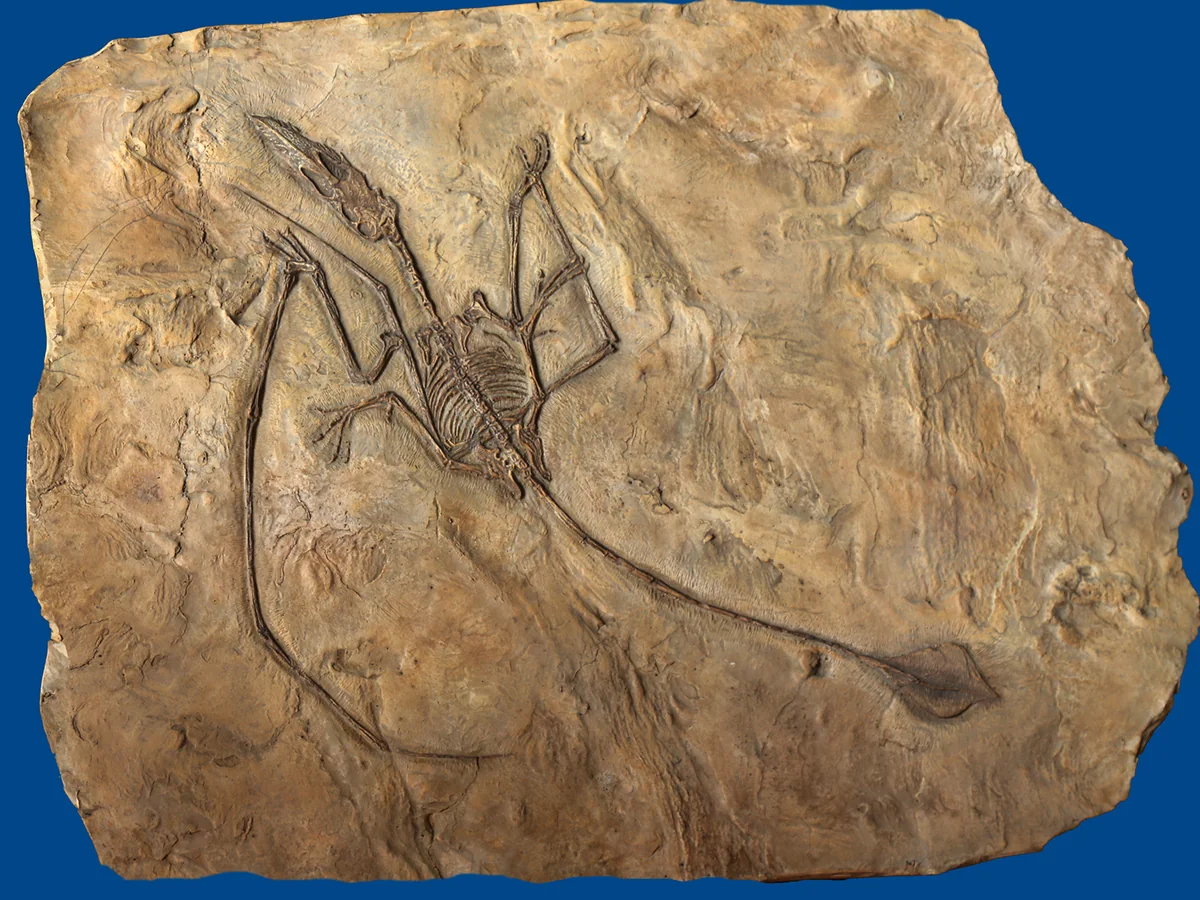
Fossil plates are the small end of the range and the easiest to get wrong. A dinosaur fossil replica in plate form is a slab: a section of matrix with bones, impressions or skin preserved in it. Buyers use them for touch tables, travelling education kits, and wall display in corridors where a mount will not fit.
They are almost never bought one at a time. The normal order is a set that covers a theme — a long-tailed Rhamphorhynchus-type plate next to a short-tailed pterosaur plate, plus a free-standing pterosaur cast for the table, so a visitor can see the animal in the slab and then see what it looked like. Curators who buy dinosaur fossil replicas in sets almost always come back for the third piece after the first two are on the wall, which is why we quote sets rather than units.
The same logic applies further up the range. Buyers comparing replica dinosaur skeletons across suppliers are usually comparing a hall mount against a set of smaller pieces, and the two are not alternatives — a 1:1 mount anchors the room and the small pieces do the teaching. If the budget only covers one approach, the small pieces reach more visitors per unit spent; the mount is what makes people stop walking.
Two specifications decide whether a plate survives a school programme. The first is edge treatment — a plate with a sharp cast edge chips within a term, so the edge should be radiused or framed. The second is the hanging method. A 60 × 40 cm slab is heavier than it looks, and a French cleat with a backing board spreads the load across the wall; two screw eyes do not.
Skin casts deserve their own note because they are frequently misunderstood. A diplodocus skin fossil replica is a cast of an impression — the negative left by skin pressed into mud — which means the surface detail is exactly what the sediment recorded and nothing more. It is not a reconstruction of a dinosaur’s skin. Buyers who expect a textured hide are disappointed; buyers who understand it is a trace fossil use it as the best teaching object in the collection, because it is evidence rather than interpretation. The standard slab is 60 × 40 cm, which is small enough to pass around and large enough to show scale texture at reading distance.
The Armature: Why the Bones Don’t Carry the Load
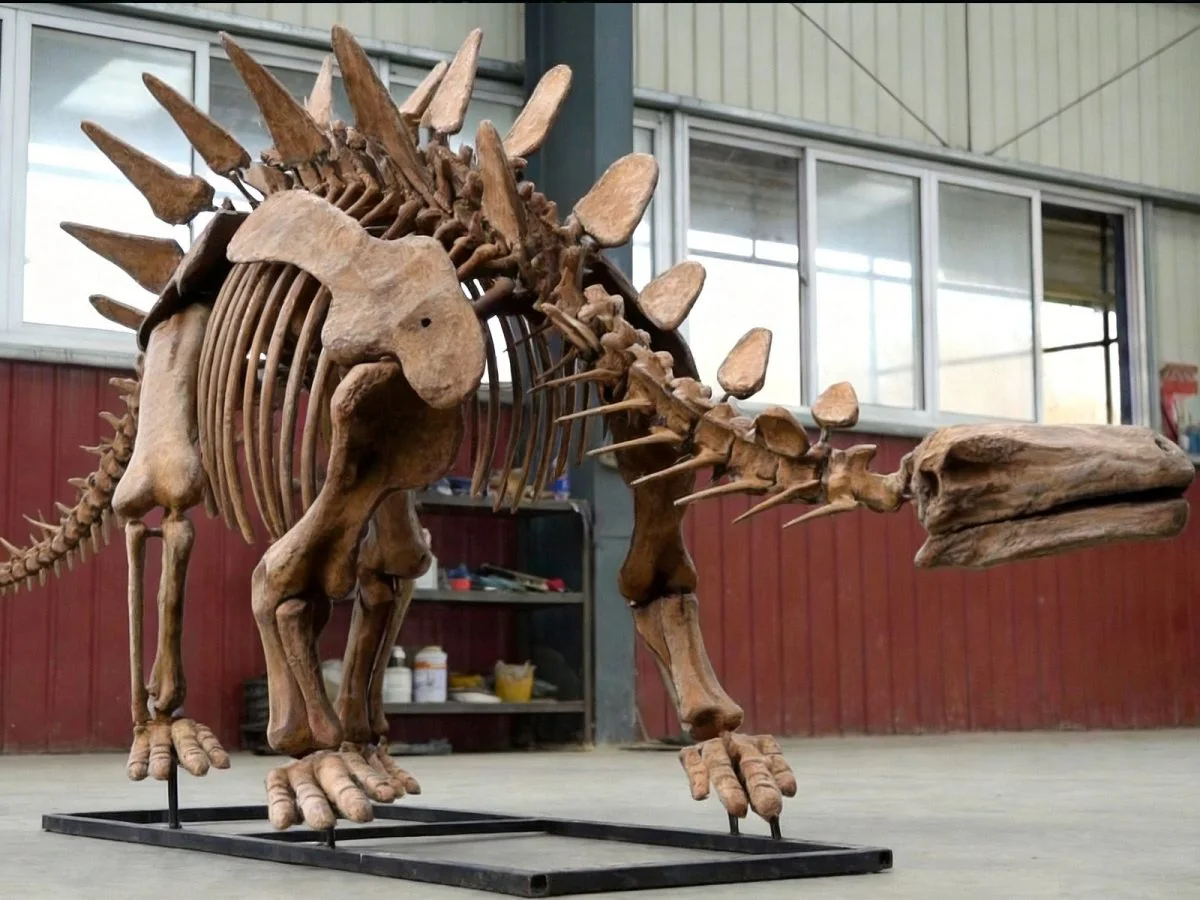
This is the part buyers rarely ask about and always regret not asking. In a mounted skeleton, no bone carries structural load. Every element is a shell fixed to a steel frame, and the frame carries the animal. Our frames are Q235 national-standard steel, welded in-house and corrosion-protected, sized from the finished weight and the pose rather than from a standard drawing.
Three consequences follow, and each one shows up in the finished object:
Bones can be thin. Because the shell is not load-bearing, a dinosaur bone replica can be cast at true wall thickness rather than thickened for strength. That matters on ribs, where a heavy rib visibly sags out of the ribcage line.
Joints are mechanical, not glued. Every bone is fixed to its bracket with a mechanical connection, because a bonded joint fails silently and takes the surrounding bone with it. On large outdoor pieces the shells are mechanically fixed rather than bonded for the same reason: differential thermal movement between steel and composite will break a rigid adhesive bond within a few seasons.
The frame drawing is signed off before casting starts. If a supplier begins casting before the frame is drawn, the pose is being decided by whatever the bones allow — and that is how mounts end up with a hip height that reads wrong from across a hall.
Indoor Mounting: Sightlines and Lighting
Two decisions are routinely made in the wrong order. Position the mount first, then design the lighting track around it — not the reverse. A track laid out before the mount is placed will light the floor where the animal was expected to go.
For a skeleton specifically, lighting is not about brightness. It is about direction. Two sources at a shallow angle from opposite sides give every bone its own edge and make the ribcage read as depth. A single frontal flood flattens the whole specimen into a panel of bone, and no amount of extra fixtures fixes it. If the hall has a ceiling grid, the two key lights should sit roughly 30 degrees off the axis of the mount, one high and one low.
Cable management is the other indoor issue. Frame-mounted sensors, interpretation audio and accent lighting all need power, and a cable run that arrives at the plinth from the public side will be photographed and remembered. Route it up inside the frame from a floor box, and put the floor box where the cleaning trolley will not hit it.
Outdoor Mounts: Wind, Foundation and Corrosion
A large dinosaur skeleton display outdoors is a different engineering problem from the same object indoors, and the difference is almost entirely wind. A 10–30 m mount presents a large sail area at height, and the base has to resist the overturning moment that area generates at the site’s design wind speed. We ask for that wind speed at brief stage, because it changes the frame section, the base plate and the foundation.
The structural thinking behind a static mount is the same thinking that goes into a moving one — the frame carries everything and the outer material carries nothing but its own weight. If you want the longer version of how that split works across both product lines, the piece on the key systems inside an animatronic dinosaur covers frame, drive and skin in the same terms.
Three practical points:
- Weathering steel rather than painted mild steel for the frame on permanent outdoor mounts. Paint fails at welds first, and a skeleton frame has hundreds of welds.
- Hard standing, not soil. A mount on a concrete or compacted hardcore base holds its alignment. A mount on soil settles, and because the frame is rigid, settlement at one corner rotates the whole animal — the tail drops, the head lifts, and the pose is wrong from then on.
- Annual inspection of fixings and topcoat. Not because the structure is fragile, but because the first sign of a loosening bracket is a bone that has started to move independently, and by then it has usually marked the adjacent shell.
Transport and Assembly
A 12 m mount does not arrive as a dinosaur. It arrives as a frame kit and a numbered set of bone shells, in sections sized to a container door. The pelvic block is normally the limiting piece: it is the densest section and it does not compress, so it sets the shipping envelope for the whole order. On a 1:2 mount the same block will fit a standard pallet, which is one of the underrated reasons buyers downscale.
Assembly sequence is frame first, then the largest bones inward — pelvis and spine, then limbs, then ribs, then skull last, because the skull is both the most fragile and the most adjustable element. Allow two to four days on site for a 12 m mount with a two-person crew and a hoist, plus a day for the final pose adjustment after the client has seen it in the space. That last day is not padding; hip height and head angle are almost always adjusted once the animal is standing in the actual room.
How a Quote Is Built
If you are searching for a dinosaur skeleton replica for sale and comparing listings side by side, the numbers you find are almost never comparable. One price covers a 1:4 resin cast shipped in three crates. Another covers a 1:1 mount with a site-specific steel frame and a two-day installation. The species name is often the same, which is what makes the comparison misleading rather than merely difficult.
We do not publish prices for this range, because the same species at the same length can differ by a factor of three depending on what is being built. A quote is assembled from three variables:
Size and section count. A 1:4 mount and a 1:1 mount of the same animal are not scaled versions of each other — the smaller one has fewer sections, a lighter frame and no hoist requirement, which changes both the build and the installation cost.
Element count and detail level. A 200-plus bone T-Rex and a single 1.5 m skull sit at opposite ends. Within the mount range, the variable is how many elements are separately cast and how much surface differentiation is specified.
Frame, base and site conditions. Indoor floor-mounted against a signed-off plinth is one thing; an outdoor 20 m piece on a wind-loaded foundation in a coastal site is another, and the engineering is a real share of the total.
Send us the species, the finished length or height, whether it is indoors or outdoors, and the ceiling or wind figure for the site. What comes back is an itemised quote rather than a single number, so you can see what each decision costs.
Choosing by Venue
| Venue | What works | What to avoid |
|---|---|---|
| Natural history museum | 1:1 mount with signed-off frame drawing; shallow-angle twin lighting; touch bone at hand height separate from the mount | 1:1 in a hall with under 6 m clear height — the head pose will be compromised |
| Science centre | Skull and claw handling sets plus one 1:2 mount as a centrepiece | A single 1:1 mount as the only specimen — throughput suffers |
| Shopping mall | 1:2 or 1:1.5 mount on a raised plinth, lit from two sides, positioned where the escalator sightline lands | Floor-level small pieces — they disappear in foot traffic |
| National park / trail | Weathering steel frame, hard standing, annual inspection schedule | Soil-mounted large pieces; painted mild steel frames |
| School | 1:4 mount, plate sets, education cases with foam lining | Anything over 2 m — storage becomes the problem, not display |
Venues that want movement rather than bone are a different brief, and the answer is usually an animatronic dinosaur rather than a mount. The two are frequently combined: a static skeleton as the scientific anchor, with one or two interactive exhibits nearby carrying the visitor engagement. If you are planning both, read what separates a realistic animatronic from a statue before specifying the moving piece — the fidelity standards are not the same, and the budget split is not obvious.
Two more references are worth reading before you finalise a species list. The six most requested species shows what visitors actually queue for, which is often not what curators expect, and the museum scene guide covers hall layout and circulation for both static and moving exhibits. If you are commissioning a mount and a moving piece together, the video library shows how the two read next to each other in an actual hall, which is faster than reading about it.
Five Questions to Ask Any Supplier
- Which specimen was the mould taken from, and what was reconstructed? A supplier who cannot name the specimen has not made the mould.
- How many sections is the largest bone cast in, and where are the seams? Fewer sections means fewer visible joins; more sections means better transport. Either answer is fine, an evasive one is not.
- How is each bone fixed to the frame? Mechanical connection, hidden from the public side. If the answer involves adhesive on a large piece, walk away.
- What wind speed was the frame designed for? Only relevant outdoors, and always relevant outdoors.
- Can I buy a single replacement bone in year three? The answer tells you whether the moulds were kept and whether the supplier expects to still be trading.
Frequently Asked Questions
How much does a dinosaur skeleton replica cost?
It is quoted per project, not from a list. A single 1.5 m skull and a 12 m mounted skeleton are built on completely different frames, and within the mount range the variables are section count, element detail and site conditions. Send the species, finished size, and whether it is indoors or outdoors — you get an itemised quote you can compare line by line.
How long does a mounted skeleton take to build and install?
Build time depends on element count and whether the frame drawing needs site-specific engineering, which it does for any outdoor piece. Installation on site runs two to four days for a 12 m mount with a two-person crew and a hoist, plus a day for final pose adjustment in the room.
Can visitors touch a cast skeleton?
The mount itself, generally not — not because the material cannot take it, but because repeated contact at the same point wears through the ageing finish and the repair never matches. What works is a dedicated touch element: a cast tooth set, a claw, or a limb bone on a low plinth beside the mount. Those are replaceable.
Is a fiberglass skeleton worse than a resin one?
Not worse, different. Resin holds finer surface detail and is the right choice for skulls, teeth and claws. Fiberglass composite is lighter and better suited to long spans, so it is what most full mounts are built from. Many specimens use both — composite for the span, resin castings for the detail elements.
Do you make custom species?
Yes, where a reference specimen exists to work from. A custom mount needs either an existing fossil reconstruction to cast or a full skeletal reconstruction drawing to build to. The full skeleton and fossil range shows what is already tooled; anything outside it is a project rather than an order.
Can a skeleton mount be moved later?
Yes, and it is worth planning for. The frame is sectional and the bone shells are numbered, so a mount can be dismantled and re-erected — the constraint is the largest section, which does not compress. If a move is likely within a few years, specify section sizes against the destination door widths at the brief stage.
Tell us the species, the finished length, and where it will stand. We will come back with the frame approach and an itemised quote — including what changes if you go from 1:1 to 1:2. Send the brief.