Animatronic Dinosaurs
Animatronic Kentrosaurus
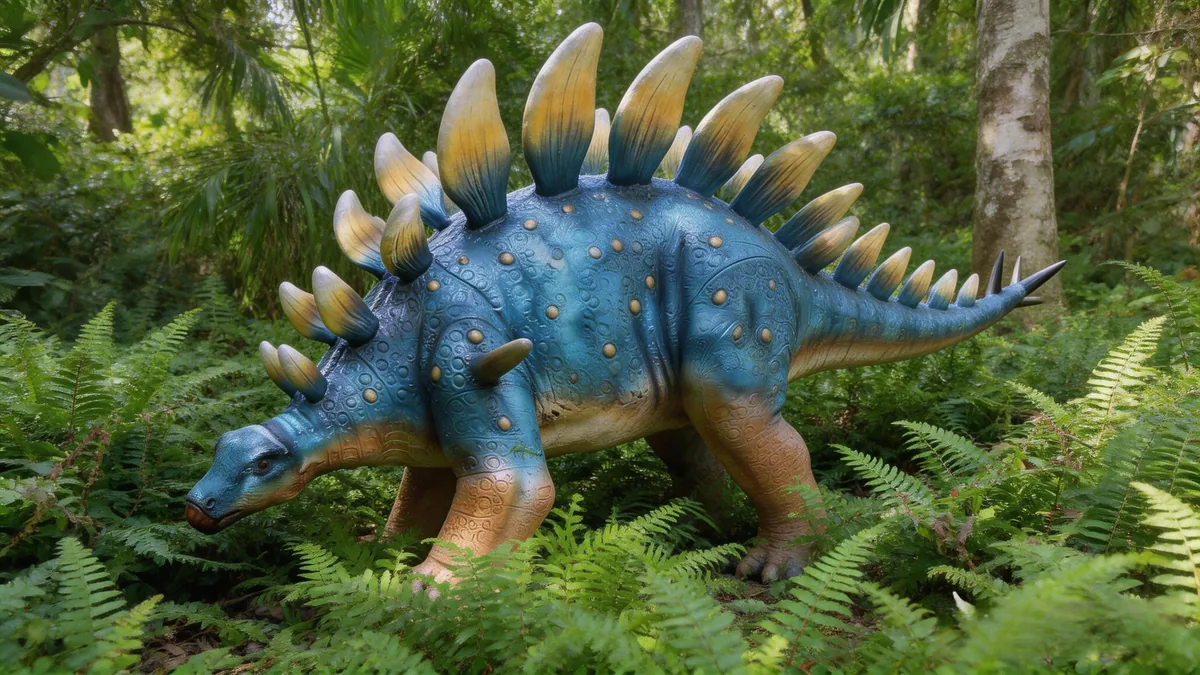
Life-size animatronic Kentrosaurus with shoulder and tail spikes on a working tail swing. A Late Jurassic stegosaur for fossil halls and dinosaur trails.
Life-size animatronic Kentrosaurus with shoulder and tail spikes on a working tail swing. A Late Jurassic stegosaur for fossil halls and dinosaur trails.
Kentrosaurus is the stegosaur people forget, and it is the more interesting one to build. Stegosaurus carried plates. Kentrosaurus carried spikes, in two different sets, on a body a third of the length. The animal was almost entirely defence and very little of it was face.
We build it at life size, with a working tail that swings the rear spike pair, and cast spikes that are designed to survive a public gallery rather than just photograph well.
| Product type | Animatronic Kentrosaurus (Kentrosaurus aethiopicus) |
|---|---|
| Overall length | 4.2–4.8 m |
| Hip height | 1.4–1.7 m |
| Shoulder spikes | Pair, 40–55 cm, angled back and outward |
| Back spikes | Offset double row, 12–16 spikes, 20–35 cm |
| Tail spikes | Pair plus rear row, 45–60 cm, upward angled |
| Head | Small, low, articulated jaw, moving eyes |
| Skin | Composite silicone with cast osteoderm texture along the back |
| Frame | Galvanised steel, weighted base |
| Movements | Tail swing with spike pair, head lift and turn, jaw, blink, breathing, body sway |
| Control | Sensor trigger, timed loop, handheld remote |
| Audio | Low bellow and hiss, 70–80 dB at 1 m |
| Power | 110 V / 220 V, 400–800 W |
| Lead time | 30–40 days after drawing approval |
A 55 cm spike on a tail that swings is the part of this model that gets damaged. Visitors reach over barriers, cleaners work around it, and the spike takes the hit. We cast each spike hollow in a glass-reinforced compound with a steel core running into the frame, so a knock flexes the skin around the spike rather than snapping it.
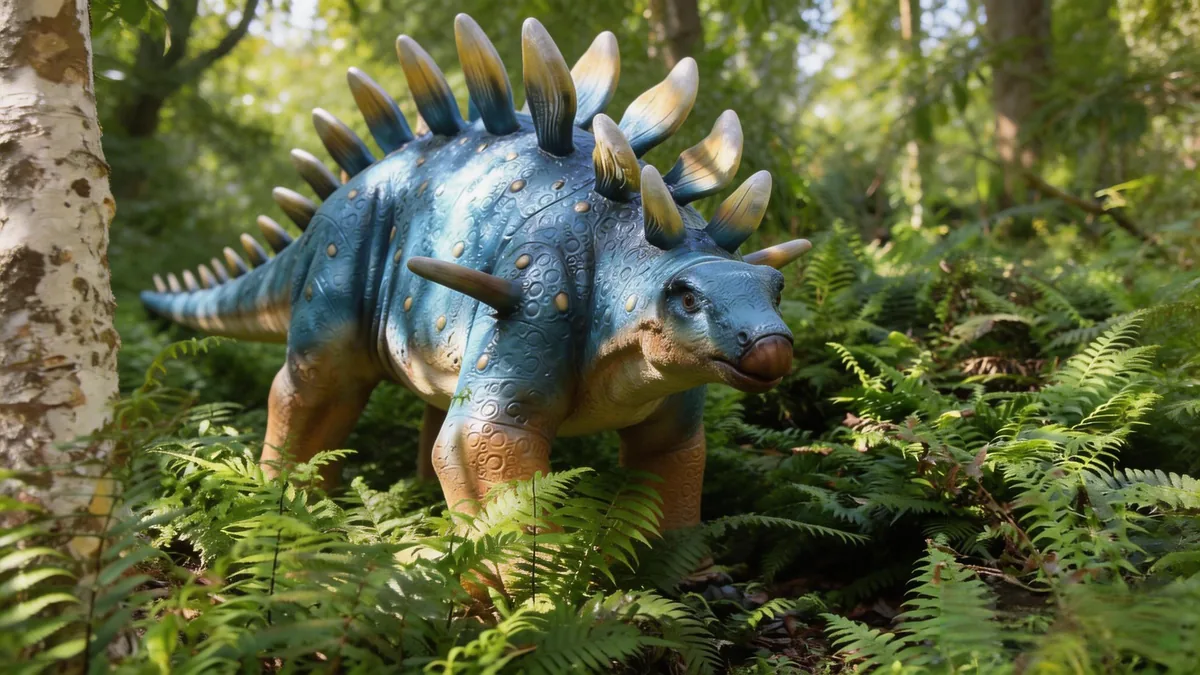
The shoulder pair and the tail pair are different shapes. Shoulder spikes are broader at the base and angled back and out. Tail spikes are narrower and point up, and the rear pair sits further apart. A factory that casts one mould and uses it in both places produces an animal that looks assembled rather than grown, and anyone who has seen the fossil notices.
Kentrosaurus had a small skull and a long tail, and the centre of mass sat well back. That means the head movement is cheap and the tail movement is not. We put two axes in the tail and one in the head, which is the opposite of what most builds do.
The tail swing is slow: about four seconds across the arc, with a pause at each end. A fast swing looks like a toy and, more practically, it puts the rear spikes through a wider swept volume that has to be kept clear of visitors.
The animal carried its hips higher than its shoulders and held its head low, close to the ground. That posture is the single most recognisable thing about a stegosaur and the easiest to get wrong. If the model is built level, it reads as an armoured lizard.
We set the hip height and shoulder height from the scaled drawing and keep the difference visible under the skin, with the back sloping down from the hips to the neck. It costs nothing at the sculpt stage and it is expensive to fix later.
No one knows what colour Kentrosaurus was. That means the choice is the client’s, and it should be made deliberately rather than by default. Two schemes work well in practice.
Muted counter-shaded. Olive-brown above, buff below, spikes in a bone tone. Reads as a real animal, suits fossil halls and museum trails where accuracy of presentation matters more than spectacle.
High-contrast display. Deep blue or green body with pale spike tips, which is what the model in our photographs uses. Reads at distance, photographs well, suits outdoor trails and family parks where the animal has to be visible from thirty metres.
Either way, the osteoderm rows along the back get cast texture rather than paint. Painting bumps onto a smooth back is visible at two metres and it is the first thing that makes a model look cheap.
The best use is next to a Stegosaurus as a size and defence comparison. Plates versus spikes on two animals at the same scale explains convergent defence strategy without a single label, and it is a scene almost no competitor has built.
Our animatronic dinosaur range also covers the other armoured option, Talarurus, which is a smaller ankylosaur and stages well with this one for a Late Cretaceous contrast. For a museum gallery sequence, Kentrosaurus belongs in the Jurassic case, not the Cretaceous one.
Sculpture in foam over a galvanised frame, moulded in four sections, skin cast from those moulds. Spikes are cast separately and fitted after the skin is painted, so their bases sit clean against the body. The tail is a separate section with its own frame spine.
Shipping is five pieces plus the base, around 220 kg total. Installation is one day with two people. The swept volume of the tail swing needs 900 mm clearance each side of the rest position, and we mark that on the site drawing.
Smaller, and built around spikes rather than plates. Kentrosaurus was around 4.5 m long against Stegosaurus at 7–9 m, carried shoulder spikes that Stegosaurus did not have, and had a much smaller head relative to the body.
Yes. It runs as a separate axis group, so a site with tight clearance can run the head and breathing only. We set the option during commissioning rather than shipping it as a software switch the client has to find.
Yes, each one unscrews from its steel core. That makes them replaceable and it means the animal can be crated without a spike puncturing a panel.
With the outdoor specification, yes. The material is a concern less than the colour, so we add a UV-stable topcoat and recommend a paler base for sites in strong sun.
Yes, up to about 30% over life size. Beyond that the leg sections need re-engineering rather than scaling, and the price moves accordingly.
Same factory and the same build standard. What changes is size, movement set and how the exhibit is meant to be used on site.
A Megalosaurus is built around the jaw. The skull is long and heavy, the gape is wide, and the teeth are large and slightly […]
View Product
A 1.6–2 m crested, feathered exhibit built for close viewing — fast, bird-like motion on sensor trigger.
View Product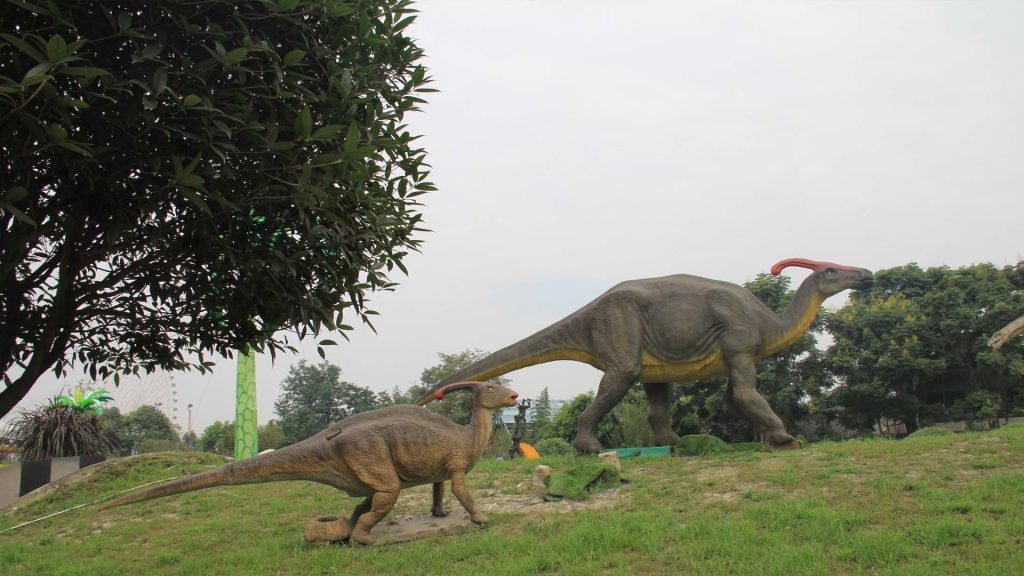
The crest is the reason a Parasaurolophus is worth building. It is a sound instrument as much as a display — the hollow tube […]
View ProductThree things buyers usually want settled before they ask for a drawing — what drives the number, how the piece is actually built, and what to check between suppliers.
Animatronic Dinosaur Buying Guide for Museums & Theme Parks Choosing the right animatronic dinosaur for your museum, theme park, or zoo is one of […]
Read the guide →From fossil reference to finished skin — how proportions, texture, colour and weathering are decided, and what separates a realistic build from a cartoon one.
Read the guide →Why Motor Choice Matters More Than Buyers Expect Motor selection is usually treated as a manufacturing detail. It is not. It is the decision […]
Read the guide →Send your dimensions, movement requirements and installation site. You get a realistic budget range and a dated build schedule.
Or email info@hltdino.com — we reply within one business day.