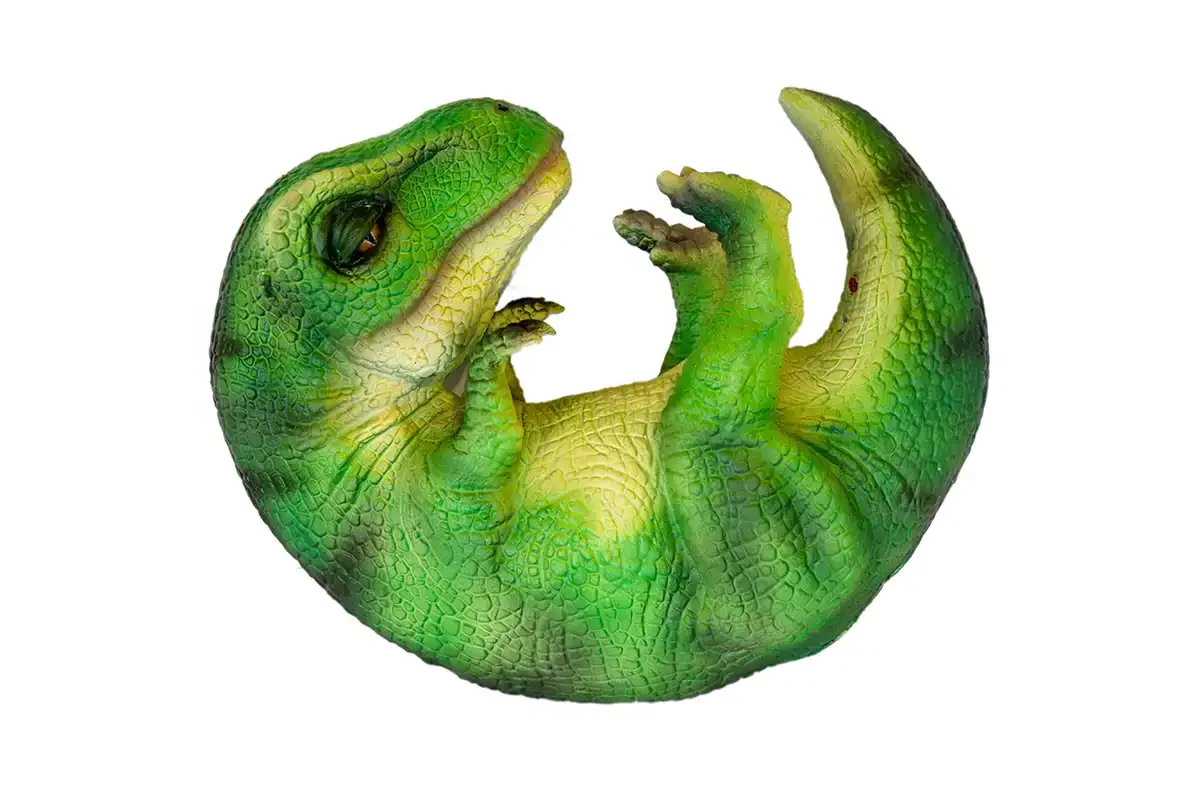
Dinosaur Puppets
An unidentifiable baby animal is a better interactive piece than a recognisable one, and that is not a design compromise — it is the point. Children who cannot name what they are looking at will touch it, talk to it, and try to work out what it eats. A baby T-Rex gets a reaction and then a queue; an ambiguous hatchling gets a conversation.
This is the generic version of our hatchling puppet: same soft body, same touch sensing, same low-voltage control, but without species-specific features. It is built for discovery zones, museum children’s areas, and anywhere the brief is “something alive” rather than “a dinosaur”.
| Species | Unspecified juvenile theropod — deliberately ambiguous sculpt |
| Era | Late Cretaceous sculpt, generic hatchling proportions |
| Type | Sensor-triggered animatronic puppet, soft body, floor seated (not rideable) |
| Size | 1.2–1.8 m curled; custom 0.8–2.4 m |
| Material | Internal steel skeleton, soft high-density foam body, patented silicone skin (ZL 2022 1 0224489.5) with soft-touch finish |
| Surface | Hand-painted UV-resistant pigment, child-safe non-toxic paints, mottled hatchling pattern |
| Animation | Eye blink, head lift, mouth open and close, tail wag, soft breathing |
| Sound | Internal 30 W speaker, generic hatchling chirp library, volume adjustable |
| Power | Rechargeable lithium pack, about 8 hours runtime, or 110/220 V mains |
| Installation | Floor placement on a soft base, no anchoring required, single person repositioning |
| Customisation | Size, colour, mottling, pose, species features (frill, crest, horn set), sound library, branding plate |
| Support | 12-month warranty; battery pack and speaker module field-replaceable |
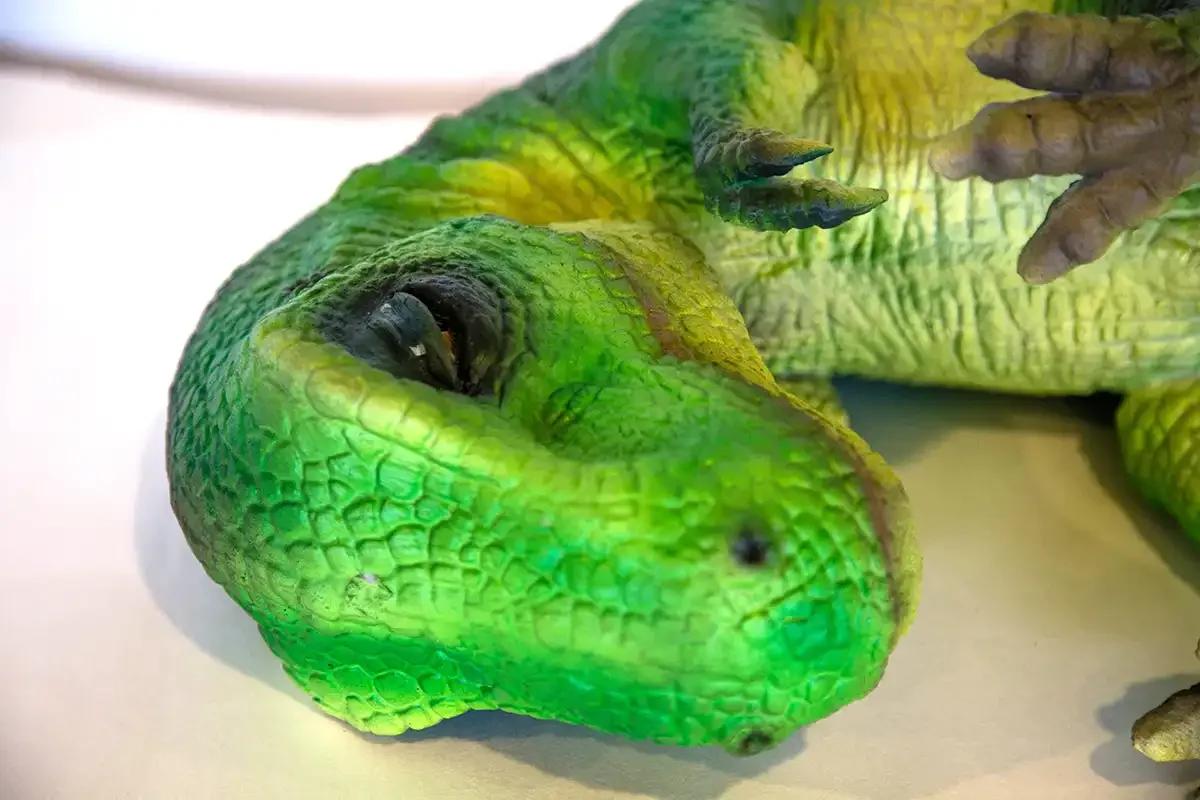
A named animal ends the interaction. A child sees a baby triceratops, says “triceratops”, and moves on. An animal they cannot place keeps them there — and keeps the adult with them there, which is the number that matters in a discovery zone.
It also gives the operator a second use: the same piece can be re-labelled as different species across seasons without rebuilding the body. Where a museum runs a changing exhibition programme, that flexibility is worth more than species accuracy.
Two sensors do the work. An infrared approach zone wakes the controller when someone comes within about 1.5 m, and a soft pressure sensor under the skin confirms actual contact before the full sequence plays.
That two-stage logic is what stops the piece animating at every passer-by. Without it, a busy corridor produces continuous motion, the animal stops reading as alive, and the maintenance load goes up because the mechanism is cycling hundreds of times a day for no interaction.
The controller runs three states. Idle is a slow breathing cycle with occasional blink, which is what keeps the piece looking alive when nobody is near. Active is the full response to touch. Power-save drops the animation rate when the zone has been empty for a set period, which is what makes an eight-hour battery realistic rather than optimistic.
All three are configurable at commissioning. On a low-traffic site the power-save threshold is usually set long; on a busy weekend site it is set short so the piece is always ready. This is a setting, not a rebuild.
It belongs at child height in a supervised space: a discovery corner, a museum children’s gallery, a soft-play entrance. It does not belong in an unsupervised corridor, and it does not belong in a position where it will be climbed — the body is soft and the frame is not load-rated for standing.
Where the position is fully exposed to weather, the IP65 version is the correct build rather than the IP54 standard one. That changes the skin and enclosure specification, so it has to be decided at order.
Yes. The frame and mechanism stay the same; a different species means different sculpting on the same body. Where a species change is likely, tell us at order so the sculpting is planned for it rather than adapted afterwards.
The mechanism is rated for continuous visitor use, but the practical limit is power, not wear. On battery, about eight hours of normal interaction; on mains, the duty cycle is not the constraint. Where a zone runs long days, mains is the realistic choice.
It needs line of sight, not attendance. The safety case for soft edges and low-voltage control assumes the piece is in a supervised area — a staffed gallery or a zone with a camera. It is not built to be left alone with children in an unmonitored space.
No. The speaker module plays from a replaceable library, so chirps can be swapped for a themed set, a branded set, or another species. Volume is adjustable at the control box and capped at commissioning to suit the space.
Same factory and the same build standard. What changes is size, movement set and how the exhibit is meant to be used on site.
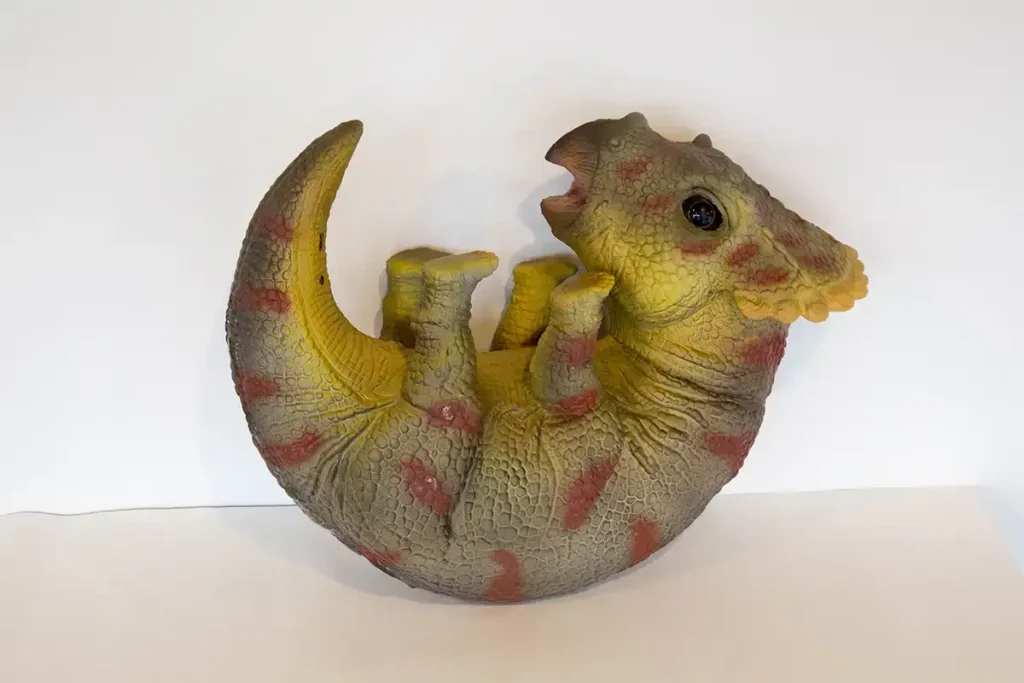
A baby triceratops is a specific shape, and it is not a small adult. The frill is proportionally oversized at this age and still […]
View Product
A hairy baby dinosaur is the version children actually want to touch. Not the 8-metre adult with the moving head — the small, fluffy […]
View Product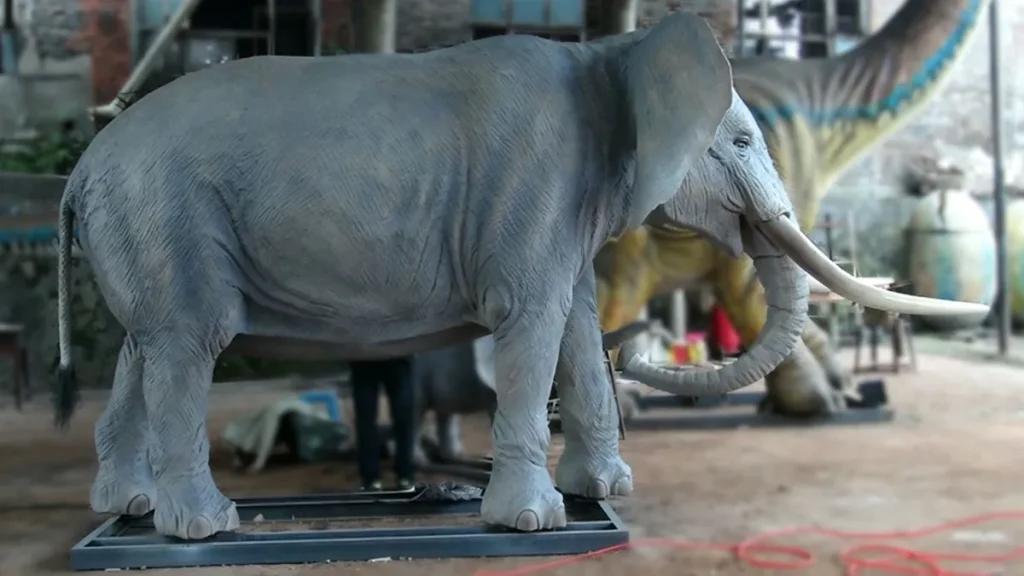
Our animatronic African elephant brings Loxodonta africana to life at full scale — from the deeply wrinkled skin to the independently moving ears and […]
View ProductThree things buyers usually want settled before they ask for a drawing — what drives the number, how the piece is actually built, and what to check between suppliers.
Proximity sensing, touch response and timed shows — what visitors actually do around an interactive exhibit, and how that changes placement and programming.
Read the guide →What Animatronic Products Are Actually Used For Buyers come to animatronic products with one of two jobs in mind, and the job determines almost […]
Read the guide →The procurement process end to end — what you are actually buying, species choice, what moves the price, how to compare factories and what to put in the brief.
Read the guide →Send your dimensions, movement requirements and installation site. You get a realistic budget range and a dated build schedule.
Or email info@hltdino.com — we reply within one business day.