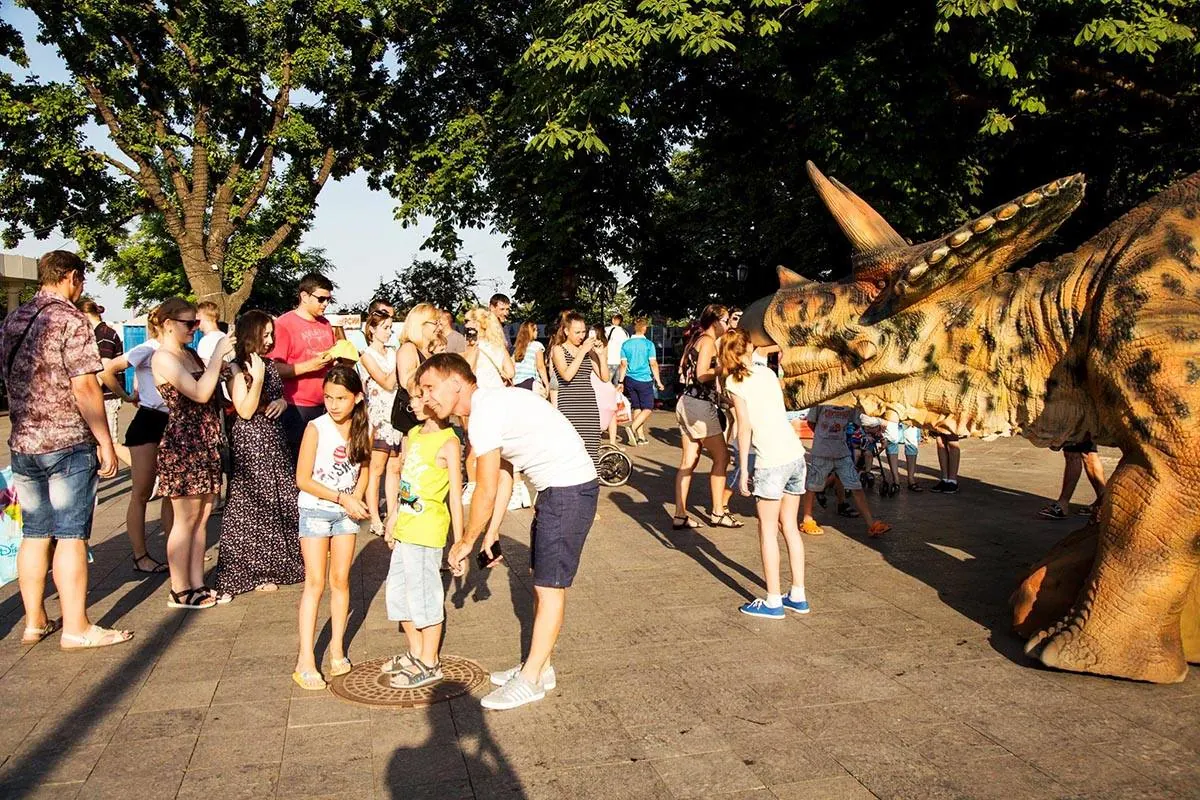
What You Are Actually Buying
An animatronic dinosaur is three things stacked together: a structure that carries weight, a mechanism that produces movement, and a surface that makes the whole thing read as an animal. Buyers who treat it as a single product usually end up disappointed somewhere in the first season, because the three parts age at different rates and are specified by different decisions.
The structure is a welded metal frame sized to the species and the site. It carries the model’s own weight, the load of the moving parts, and wind. On tall species it is the part that decides whether the animal survives its first storm.
The mechanism is the drive system and actuators. What it can do — head turn, jaw, blinking, walking in place, tail movement — is set before anything is sculpted, because actuator placement determines how the body has to be built.
The surface is the skin. This is where a good build and a cheap one are hardest to tell apart in a photograph and easiest to tell apart after a year outdoors. Our own skin formulation is patented (Patent ZL 2022 1 0224489.5), developed specifically because surface failure was the most common long-term problem we saw in fielded models.
When you review a quotation, check that all three are specified separately. A quote that lists a species and a size but nothing about the skin system, the drive type or the frame protection is not yet a specification.
Species: What to Order and Why
Species choice follows from where the animal will stand and what it has to do, not from which dinosaur is most famous.
A note on the second purchase. Buyers who start with one large animal almost always add mid-size species later, because a single landmark holds a crowd for a photograph and nothing else. If the budget only covers one model now, choose a species that will still make sense when it has neighbours — a Brachiosaurus or an Ankylosaurus will, a novelty species will not.
What Drives the Price
There is no price list for animatronic dinosaurs, and the reason is structural rather than commercial: the same species at two sizes, with two movement sets and two surface specifications, is genuinely two different machines. Four factors account for most of the variation.
Size and species mass. Weight scales faster than height. A model double the height is substantially more than double the frame, the drive and the shipping volume.
Movement list. A static model with a moving head and jaw is one build. Add walking, tail articulation, eye movement and blinking, and you have added actuators, control channels and programming — and you have changed the frame, because moving parts load it differently.
Interaction. Sensors, gesture control and operator-driven programming add both hardware and development time. This is usually the smallest line in the quotation and the largest in the visitor’s memory.
Environment. An indoor model and a fully exposed outdoor model of the same species are not the same product. Sealing, surface system, base design and anchor method all change.
Two related pages go deeper: what affects the cost explains the drivers, and the 2026 pricing guide shows how they combine in practice.
How to Compare Manufacturers
Most suppliers look similar at the quotation stage. They separate at the specification stage.
- Do they ask about your site before quoting? A supplier who quotes without asking about ground conditions, wind exposure and power has quoted for a model, not for your installation.
- Is the skin system described, or just the look? “Realistic skin” is not a specification. Ask what the surface is, how it is applied, and how it behaves after a season outdoors.
- Is the drive type named? Brushless, servo, stepper, hydraulic and pneumatic systems have different maintenance profiles. Comparing our guide to hydraulic and pneumatic movement and to motor selection will let you read a quote properly.
- Can they show fielded models? Not renders. Ask for installations that have run for at least a full season.
- What happens after commissioning? Spare parts availability, remote fault diagnosis and whether wear components can be shipped separately matter more in year two than in year one.
One practical test: describe a problem the model will face — a coastal site, a tight access route, a venue with no technical staff — and see whether the answer changes the build. A supplier who builds to your constraints is doing engineering. A supplier who answers everything with “yes, no problem” is selling.
Customisation: What Can Be Changed
Customisation is broader than most buyers assume, and cheaper than most expect, provided it is decided before production.
- Species and pose — including poses that do not exist in a catalogue: crouching, mid-stride, rearing, feeding, guarding a nest.
- Scale — set by the room, the ceiling, or the viewing distance you actually have.
- Movement and sound — which parts move, how far, how fast, and what the animal sounds like.
- Surface and colour — regional and period-accurate colouring, or a scheme matched to a brand or an existing exhibit.
- Interaction logic — trigger distance, response sequence, and whether the animal reacts differently to a lone visitor and a crowd.
- Base and mounting — freestanding, anchored, suspended, or staged on terrain.
What cannot be changed late is structure. Pose and movement affect the frame, and the frame is built first. Design decisions made after the frame is welded are expensive; the same decisions made before cost very little.
The Brief: What to Send
A brief that answers these gets an accurate quotation much faster, and a more accurate one.
- Species, size and pose, with the site plan or at least the footprint.
- Setting — indoor, covered outdoor, fully exposed; and the climate.
- Ground and fixing — paved, decking, grass, existing foundation, or unknown.
- Movement list — what each part of the animal should do.
- Interaction requirement — passive, sensor-triggered, gesture-controlled, or operator-driven.
- Power position and cable route, if known.
- Installation constraints — access width, lift availability, delivery window, whether the site is trading.
- Operating plan — permanent or seasonal, who maintains it, and whether it will ever be moved.
Inspection, Payment and Delivery Terms
For a purchase at this scale, the schedule matters as much as the specification, and it is worth agreeing how each stage is verified before production starts.
The usual structure runs: design confirmation, then a production deposit, then a factory inspection when the model is mechanically complete but before finishing and packing, then balance against shipping documents, then on-site commissioning. The factory inspection stage is the one buyers most often skip and the one that saves the most money — it is the last moment when a problem can be corrected without a shipping claim.
If your organisation requires third-party inspection, say so at the quotation stage. It changes the schedule, and it needs to be built into the plan rather than added at the end. Inspection points, acceptance criteria and the documentation that ships with the model should all be written into the order, not agreed verbally.
Shipping, Crating and Installation
Large models ship in sections, and where the joints fall is a design decision.
Crating is designed around the animal: the sections are planned so that seams land in places that will be least visible on reassembly — along a flank, behind a limb, under the jaw. Every order should ship with an assembly sequence and a lighting connection diagram, because a model that arrives without documentation gets assembled by guesswork, and guesswork damages surfaces.
Installation time on site depends mostly on what is already prepared. If the base is poured and the power is in position, a small group of models is typically a matter of days. If the base is not ready, the shipment sits in storage, which is both expensive and a risk to the surface.
Confirm the access route before shipping. A model that fits the site but not the gate is an expensive problem, and it is entirely avoidable with a tape measure.
After Delivery: Maintenance and Spares
An animatronic dinosaur has a maintenance profile closer to a piece of machinery than to a statue, and it is a light one.
The routine is inspection rather than repair: check fixings after high winds, listen for changes in the sound of the drive, keep the skin clean, and replace wear components before they fail rather than after. Most of the problems venues report in year two trace back to a missed inspection in season one.
Three things are worth confirming at order stage: that spare parts can be shipped separately, that remote fault diagnosis is available, and that the maintenance schedule and parts list are documented for whoever inherits the exhibit. Our standard position for animatronic products is a 12-month warranty, with wear components and spares available as part of the order.
Common Mistakes in a First Purchase
- Buying size instead of pacing. One enormous animal and nothing around it holds a crowd for four minutes.
- Quoting before the site is understood. Ground, wind and power change the build, and discovering that after the order is placed is the most expensive mistake on this list.
- Treating the skin as cosmetic. It is the part that decides how the model looks in year three.
- Skipping the factory inspection. It is the last cheap opportunity to fix a problem.
- Forgetting who maintains it. A venue with no technical staff needs a different specification, and saying so at the start costs nothing.
- Not planning for the second animal. Most venues buy more; the first purchase should leave room for that.
Frequently Asked Questions
How long does an animatronic dinosaur take to build and deliver?
Schedule follows from species, scale, movement complexity and how many units are in the order — not from a standard lead time. It is agreed against a fixed delivery date once the design is confirmed, and we build to that date.
Can I see the model before it ships?
Yes, and for a purchase of this size you should. The standard point is when the mechanics are complete and tested but before finishing and packing. We support third-party inspection where the buyer’s process requires it.
Will it survive our climate?
That is what the environment specification is for. Coastal salt air, inland freeze-thaw and humid tropical conditions are each specified differently, which is why we ask about the site before quoting. The same species in two climates are two builds.
What if a part fails?
Wear components are the items that fail first, and they are available as spares with the order so a venue can replace them without shipping the model back. Remote diagnosis covers adjustment and fault-finding; on-site support is arranged where the situation needs it.
Do you supply the base and the power work?
Base and mounting design is part of the model specification. Ground works and mains power are usually delivered locally, because they depend on the site and on local contractors — but we provide the load figures, fixing positions and cable requirements so they can be built to, not improvised around.
Is there a warranty?
Our standard position for animatronic products is a 12-month warranty, with spare parts available as part of the order.
Next Steps
If you send us the species you have in mind and where it will stand, we can come back with a specification and a firm quotation rather than a range — including what the site needs to have ready, what the schedule looks like, and which parts of the brief will change the build if you decide differently.
Keep reading
- Animatronic dinosaurs — every dinosaur model we build, with sizes and motion sets.
- Animatronic animals — hyena, tiger, elephant and other life-size mammals.
- Interactive exhibits — proximity and gesture-triggered show pieces.
- Dinosaur rides — ride-on builds for parks and family entertainment centres.
- Museums · theme parks · zoos — how the venue changes the brief.
- Past installations — what we have shipped, by region.
Send us your brief to start.