A buyer flies to Zigong, watches a dinosaur open its jaw and roar on the factory floor, and signs the acceptance sheet. Six weeks later the same animal arrives on site and will not hold a pose. The two events feel like they should be the same test. They are not, and the gap between them is where most purchase disputes start.
Factory acceptance testing — FAT — is the last chance to catch a problem while the manufacturer still has the jigs, the spares and the technician who built the unit. After shipment, the same fault becomes a site visit, a delayed opening and an argument about who pays. A FAT is not a formality or a photograph opportunity. It is a structured set of checks with a written result, run before the money is final and the container is sealed.
This article covers what a buyer actually verifies at a factory acceptance for a life-size animatronic, how long the test should run, what a reasonable sampling plan looks like, and how to handle the moment something fails. It is written from the factory side, with the numbers we use on real machines, so you can specify a test that catches faults instead of one that only produces a signed page.
What a Factory Acceptance Test Is — and Is Not
A FAT confirms that the unit does what the contract says, in the factory, before it ships. Three things follow from that definition. It sits at the end of a longer process — if you are still at the stage of checking who you are dealing with, start with how to verify an animatronic dinosaur manufacturer.
It tests the agreed specification, not your hopes. If the contract says jaw open to 42 degrees, the test measures jaw open to 42 degrees. If the contract just says “lifelike”, there is nothing to test against and the acceptance becomes a matter of opinion. The single most useful thing a buyer can do before a FAT is to arrive with a written spec: dimensions, motion list, sound, control method and finish.
It happens at the factory, so it cannot prove site performance. A FAT cannot tell you how the animal behaves in 38-degree heat, in a salt-air coastal venue, or beside a fire detector that trips at a certain particle count. Those are site commissioning questions. Confusing the two is why some buyers arrive at a museum opening convinced they were sold a faulty machine, when in fact the factory test never claimed to cover that environment.
It ends in a document. A FAT that is not written down did not happen, as far as a dispute is concerned. The output is an acceptance report with each check marked pass or fail, any deviations listed, and a signature from both sides. Photographs and video are attachments to that report, not a substitute for it.
Before You Fly: What to Fix in the Contract
Most FAT problems are decided weeks earlier, in the purchase order. Getting these five lines right makes the test itself straightforward.
A measurable specification
Replace adjectives with numbers. “Realistic movement” becomes a motion list: jaw, neck yaw, neck pitch, eye blink, tail, forelimbs, and any special action. “Lifelike sound” becomes a roar track at a stated duration, with a level measured at one metre. “Life-size” becomes an overall length and standing height. If a number matters to you, it belongs in the spec before the test, not in a complaint afterwards. The motion list is easier to write once you understand the six systems inside an animatronic dinosaur; the power figures belong alongside the power and air requirements.
Who witnesses, and how remote works
A FAT can be attended in person or witnessed by video. On-site is better for large pieces because you can walk around the animal, hear the sound in the room and see the joints up close. Live video is a reasonable fallback and is now common for repeat orders, but it changes what you can verify: agree in advance that the camera will show the whole animal, the control screen and a visible clock, and that the feed is continuous rather than edited clips. A two-hour live stream with a recorded copy is worth more than ten polished videos.
The acceptance standard and who judges it
State what a pass means and who calls it. For physical checks the standard is usually the drawing. For subjective items — skin colour, surface texture, how “alive” the idle state looks — agree on a reference: an approved sample, a photo signed off at the design stage, or a named person on each side whose judgement is final. Ambiguity here is what turns a two-day trip into a two-week email argument.
How deviations are classified
Not every failure blocks shipment. Agree in advance on three classes: critical — the unit cannot perform a contracted function, must be fixed before shipment; major — a visible or functional shortfall that must be fixed or formally accepted with a price adjustment; minor — cosmetic, logged and closed before or after shipment by agreement. Without these classes, every small scratch becomes a negotiation.
The remedy and the clock
Write down what happens if the unit fails: the factory fixes and re-tests within a stated number of days; if it cannot be brought to spec, the buyer may reject, delay final payment or accept with an agreed reduction. Also state who pays for a re-test and, if a witnessed trip is repeated, who covers travel. This is uncomfortable to discuss before an order and very cheap compared with discussing it after a container has sailed.
What to Actually Verify on the Floor
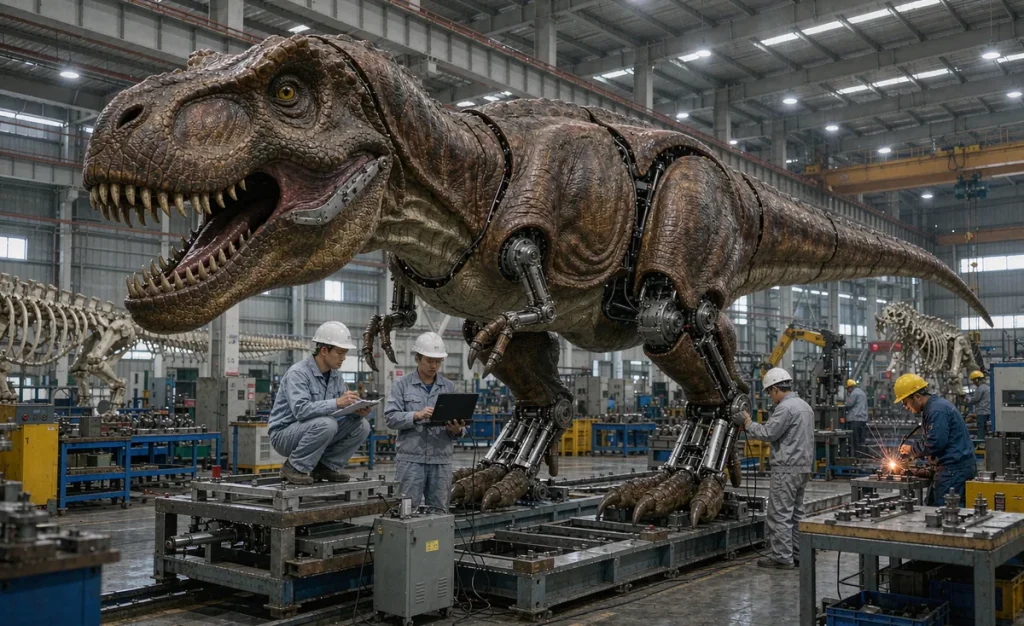
A good FAT walks the contract line by line. For a life-size animatronic, the checks fall into seven groups.
1. Dimensions, mass and match to drawings
Measure overall length, standing height and width against the approved drawing, including the widest point of the tail sweep and the arc of an open jaw. Check the split lines — where the animal separates for shipping — and confirm the mating flanges and dowel pins are present and undamaged. Weigh each section or read its marked mass, because the number on the rigging plan has to match the thing that arrives. On a multi-section piece, check that the sections are numbered and that a trial fit has been done at the factory, with the bolt holes aligned and the aviation connectors labelled.
2. Every contracted motion, through its full range
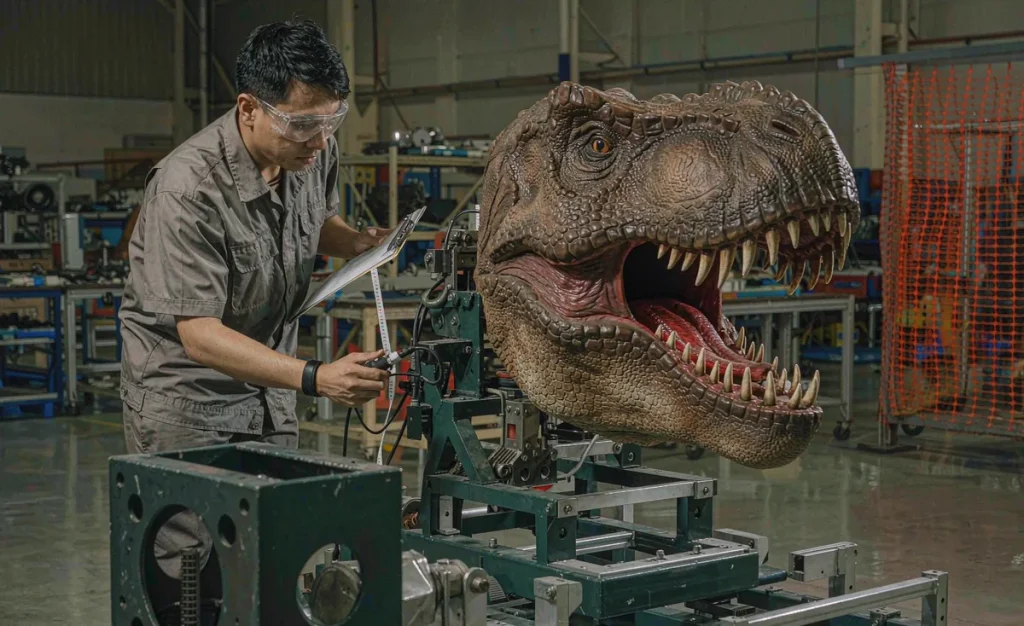
Run each motion individually and then in combination. Jaw opening, neck yaw left and right, neck pitch up and down, eye blink, tail swing, forelimb movement and any special action — each should complete its range smoothly, without stutter, audible gear knock or a end-stop slam. Ask to see the slowest speed as well as the fastest: a servo that is smooth at full speed but judders at low speed will ruin a quiet rest state. Compare against the motion list in the contract, and tick each one off on the report rather than relying on memory.
3. Sound, at a stated level and duration
Play every contracted track. Check that the roar is the agreed recording and length, that it starts and stops cleanly without a click, and that volume is consistent between cycles. Measure the level at one metre with a simple meter if the spec names a figure. If the animal has a speaker inside the body, listen from the front and from the side — a common fault is a track that sounds fine at the control desk but disappears in the animal’s own cavity. Confirm the sound file is stored locally on the controller and will not be lost when the commissioning laptop leaves.
4. The control system, including the failure states
This is where a FAT earns its keep. Test every control method the contract promises: the handheld controller, the preset button, the sensor trigger if fitted, and the emergency stop. Then test the states nobody demoed normally — what happens on power loss, and what happens when power returns. Does the animal return to a safe rest pose, or does it snap to a stored position with a jaw slam? Does the e-stop physically cut motion power, or only pause software? Press the e-stop mid-motion and watch. A controller that behaves correctly only when everything is calm is not finished.
5. Skin, finish and the details you paid for
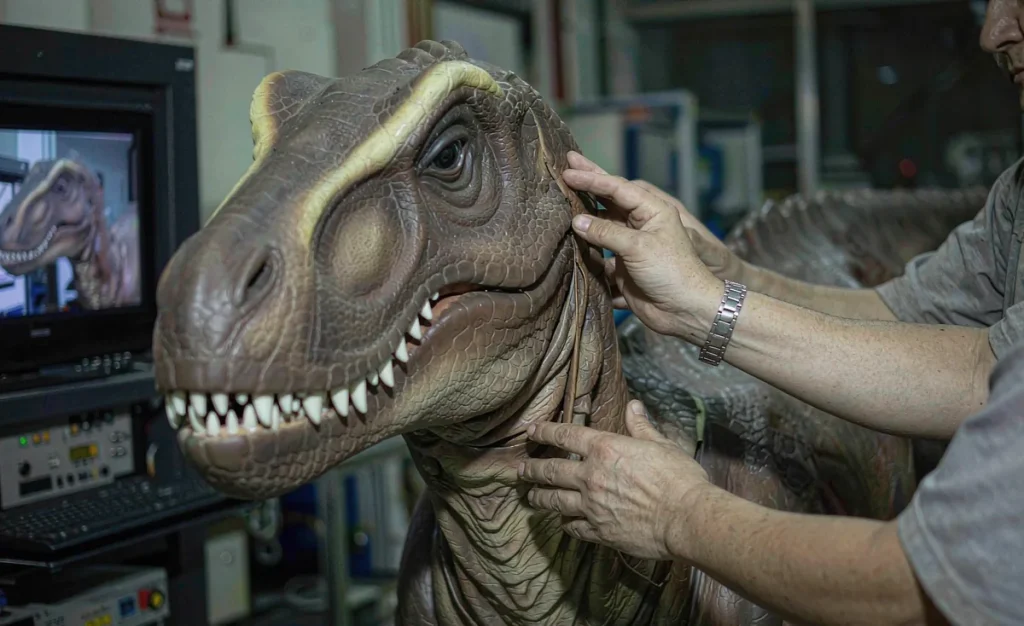
Inspect in good, even light — factory spotlights hide a lot. Check the skin for seams, glue lines and colour breaks, especially around the mouth, eyes and the junction between head and neck. Look at the underside and the back of joints, which are the areas most often rushed. Compare the paint and texture against the signed sample. Check that eyes, teeth and claws are securely fixed; a tooth that is loose in the factory will not survive a month of children. If the contract names a silicone skin, confirm the material and the patent or material certificate where applicable, rather than taking “silicone” on trust — what a genuine silicone skin looks like is worth knowing before you inspect one.

6. Electrical, connectors and documentation
Check that every electrical run ends in a labelled aviation connector, that the labels match the wiring diagram, and that spare fuses and a spare set of critical sensors ship with the unit. Ask for the Conformity documentation — CE or UL declaration with the model designation matching the goods, not a generic certificate for a different product. Confirm the control cabinet, drives and commissioning laptop are packed in the same flight case that will stay on site, so the thing tested is the thing delivered.
7. Packing, as part of the test
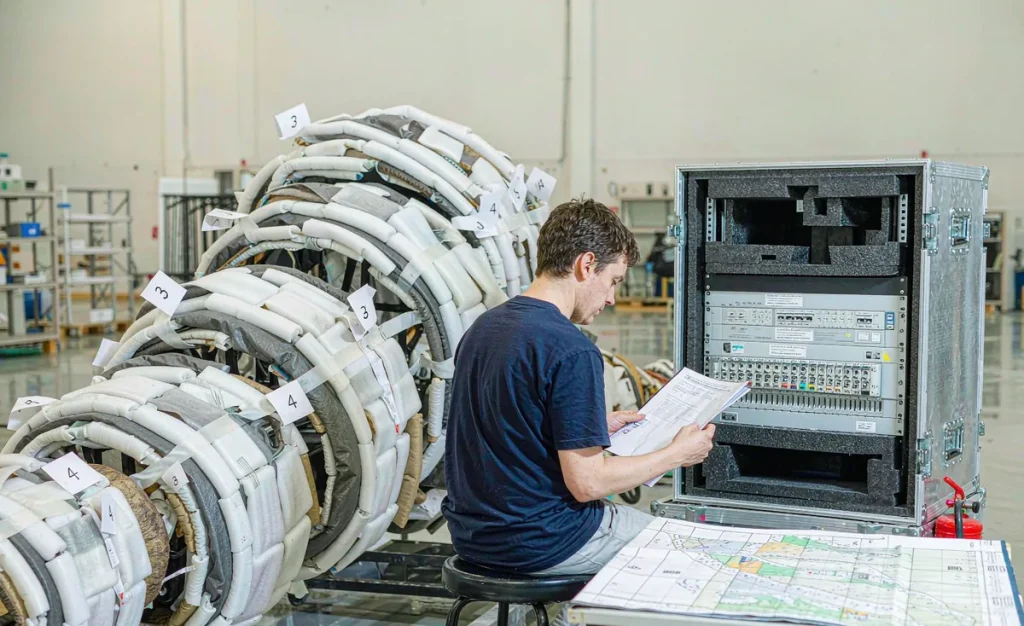
Acceptance is not complete until you have seen how the unit will travel. Confirm foam wrap rather than timber crates, so there is no ISPM 15 heat-treatment issue and no crate to dispose of at your end. Check that each section’s foam is cut to that section and labelled, that protruding parts are protected, and that the loading arrangement matches the container plan. Photograph the packed unit before it is sealed — this is the image that ends the “it was fine when it left” argument if something arrives damaged.
The Continuous Run: Why Hours Matter More Than Minutes
A five-minute demonstration proves the animal can move once. It does not prove it will still be moving after a full day of operation. The most valuable part of a FAT is the continuous run, and it is the part most often skipped because it is boring to watch.
The standard we use is a 24-hour continuous cycle for a full-size piece, run in the factory with the same controller and power supply that will ship. For a smaller unit or a repeat order, 8 to 12 hours may be agreed instead. The animal runs its normal programme on a loop, with the full range of motion and sound active, and the technician logs any fault, reset or manual intervention.
What does a burn-in actually catch?
- Thermal drift. Servos and drivers that warm up over hours and begin to stutter, lose torque or trip on over-temperature. Almost impossible to find in a ten-minute demo.
- Loose fixings. Screws and brackets that work loose under repeated vibration, especially around the jaw and neck where the movement is hardest.
- Intermittent connections. A connector that makes contact when cold and fails after a few hours of warmth and movement — the classic fault that appears only on site.
- Software locks. A controller that freezes after a certain number of cycles, or a sound file that stops replaying after a set count.
- Power behaviour. Whether the supply holds stable through repeated peak loads, when jaw, roar and motion all fire together.
Ask for the log, not just the result. A run with three logged resets that were fixed is more informative than a clean run nobody witnessed. The point is not to catch the factory out; it is to catch the fault while a technician and a shelf of spare parts are still in the room.
How Much to Test: Sampling Without Guesswork
On a single flagship animal, test everything. The sampling question arises when an order contains multiple identical units — ten small pieces for a touring show, for example. Testing all ten for 24 hours each may be unnecessary, but testing one tells you nothing about the batch.
A practical approach borrows from standard acceptance sampling: define a batch, sample a fixed proportion, and set an acceptance number. For a small batch of identical units, a common starting point is to fully test the first unit and a percentage of the remainder, with the rule that any failure triggers testing of the whole batch. Agree the exact rule with the factory before the test and write it into the report.
What matters more than the statistical method is the acceptance number — how many failures you will tolerate before rejecting the batch. For a critical function such as the e-stop or a load-bearing joint, the number is zero. For a cosmetic item, it may be one or two. Stating “zero critical, up to two minor” is far clearer than “all must be perfect”, which nobody can deliver and which gives the factory no way to close a minor issue honestly.
Video Witness vs Being There
Both work, with different trade-offs. Being present lets you walk around the unit, put a hand on a joint and hear the sound in the room. It also lets you change the test mid-stream — “run that jaw again, slower” — which is often where the useful information comes from.
Live video is cheaper and increasingly accepted for repeat orders. If you go this route, specify the conditions in the contract: a continuous unedited feed showing the whole animal and the controller, a visible clock, an agreed test sequence run in order, and a recorded copy delivered with the report. Insist that the camera can be moved on request to inspect a specific area. A fixed camera that shows only the animal’s good side is not a witness.
One hybrid works well: attend the first FAT for a new product in person, then use live video for identical repeat units. The in-person visit establishes the reference for how the animal should look and sound; later video tests compare against that reference.
When Something Fails: Running the Deviation Process
Failures are normal. What matters is how they are recorded and closed. A good FAT has a deviation log with five columns: the item, the agreed standard, what was observed, the class (critical, major, minor), and the agreed action with a date.
For a critical failure — a contracted motion that does not work, a load-bearing problem, a failed e-stop — the unit does not ship. The factory fixes it and re-runs the affected checks. For a major issue, either the factory fixes it before shipment or both sides agree in writing to accept it with a price adjustment or a remote fix at commissioning. For a minor cosmetic point, log it, photograph it and agree when it will be closed.
The worst outcome is a verbal “we will fix it on site”. Without a line in the report, that promise has no owner and no date, and it will surface at the worst possible moment — during installation, with a venue full of people waiting.
After the Signature: What FAT Does Not Cover
Signing the acceptance report releases the unit for shipment; it does not end the buyer’s involvement. Three things happen after the FAT that deserve their own checks, and they belong to site commissioning rather than the factory test.
The packed unit must match the tested unit. Photograph the packing, confirm the section numbers and connector labels, and keep the spare parts list with the shipping documents. This is the bridge between FAT and the arrival checks.
On-site assembly has its own acceptance. When the sections are bolted together and the aviation connectors clicked home, the animal is tested again in its real environment. This is where dowel pins and jig-drilled flanges earn their cost: the sections fit without field drilling, and the bolt pattern matches on the first attempt.
Environment-specific behaviour is tested on site. Heat, humidity, salt air, detector zoning and the actual sound of the room cannot be reproduced in a factory. If your venue has a fire detection system, the interaction between atmosphere effects and detectors is a site question that no FAT can answer.
For the full chain of what happens after the factory — how the animal splits, how it is packed, what fits in a container and what installation looks like day by day — see shipping and installation for animatronic dinosaurs. For where the FAT sits in the overall purchase, from enquiry to delivery, see the complete buying guide.
The One-Page FAT Checklist
If you take one thing to the factory, take this list. It fits on a page and it turns a vague “show us the dinosaur” into a test with a result.
- Written specification with numbers: dimensions, motion list, sound, control, finish
- Acceptance standard per item and who judges subjective points
- Deviation classes agreed: critical, major, minor
- Dimensions, mass and section split lines measured against the drawing
- Every contracted motion run individually and in combination, slow speed included
- Sound tracks played at a stated level, heard from front and side
- All control methods tested, including e-stop and power-loss/restore behaviour
- Skin, finish and fixings inspected in even light, compared to signed sample
- Connectors, labels, spare parts and CE/UL documents checked
- Continuous run logged: 24 hours for a full-size unit, 8–12 for smaller or repeat
- Packing inspected and photographed against the container plan
- Deviation log closed with actions, dates and owners; both sides sign
Frequently Asked Questions
Do the teeth, claws and eyes stay firmly attached?
They should — and the way to be sure is to check at the factory, not after arrival. Teeth, claws and eyes are fixing points where a loose part will fail quickly under children and constant cycling. During a factory acceptance test we check that every one is secure, and we inspect the skin seams, glue lines and colour breaks in even light rather than showroom spotlights. A unit that passes those checks in the factory is far less likely to generate a service call in month one. If you cannot attend in person, a recorded video walkthrough of the same checklist is the next best thing.
How long should a factory acceptance test take? For a full-size piece, allow a day for the checks and a 24-hour continuous run alongside it, so two days in total. Smaller units and repeat orders can be compressed to a day with an 8-to-12-hour run.
Do I have to travel to the factory? No. Live video with a continuous unedited feed, a visible clock and a recorded copy is accepted for many orders, especially repeats. An in-person visit is more valuable for a new product because you can inspect areas a camera will not show.
What is the difference between FAT and commissioning? FAT happens at the factory before shipment and tests the agreed specification. Commissioning happens on site after assembly and tests the animal in its real environment — including heat, sound and fire detection. Neither replaces the other.
What if the animal fails the continuous run? A logged failure with a fix is a normal outcome and more useful than a clean but unwitnessed run. Critical faults must be fixed and re-tested before shipment; major and minor issues are closed by an agreed action with a date and owner in the deviation log.
Can I reject a unit at FAT? Yes, if it cannot be brought to the agreed specification. This is why the contract should state the remedy and the re-test terms before the order is placed — rejection is straightforward when the standard and the consequences were written down in advance.
Is a 24-hour burn-in really necessary? For a full-size animal that will run daily in a public venue, yes. It is the only check that catches thermal drift, loosening fixings and intermittent connections — the faults that almost always appear after installation rather than during a demonstration.
If you are specifying a new animatronic and want a test plan your supplier can actually run, the useful starting point is the written specification: dimensions, motion list, sound and control method. Send us your requirements and we will tell you what we can verify at the factory, what needs to wait for site commissioning, and what the acceptance report will look like.