A 12-metre Tyrannosaurus cannot be shipped as a 12-metre Tyrannosaurus. That single fact shapes everything about how a large animatronic is engineered, packed, cleared through customs and put back together on your site.
Most buyers ask about price first and shipping second. Then the shipping answer arrives and it turns out to be the thing that decides whether the project is feasible at all — because a unit that does not fit through a container door either costs two to three times more to move, or has to be cut and welded on site, which nobody wants.
This is how we handle it at HLTDINO: the exhibit is designed around the container from the first drawing, not adapted to it after the fact. Below is the full chain — how a dinosaur is broken down, how it is packed, what actually fits in a 40HQ, which documents travel with the container, what has to be ready on your site before the truck arrives, and what assembly looks like hour by hour.
Why the Container Comes First, Not the Sculpture
There are two ways to build a large animatronic dinosaur. The first is to sculpt and engineer it as a single object, then figure out logistics at the end. That approach produces beautiful showroom pieces and miserable shipping bills, because by the time anyone measures the door opening the frame is already welded.
The second way — the one we use — treats the shipping container as a fixed constraint that the structure has to satisfy. Every major dimension is checked against a door opening before the steel is cut.
The numbers that matter are not the ones most people quote. Interior length and width get all the attention, but the real bottleneck is the door aperture:
| Container | Internal length | Internal width | Internal height | Door opening (W × H) | Payload |
|---|---|---|---|---|---|
| 20GP | 5.90 m | 2.35 m | 2.39 m | 2.34 × 2.28 m | ~28 t |
| 40GP | 12.03 m | 2.35 m | 2.39 m | 2.34 × 2.28 m | ~26 t |
| 40HQ | 12.03 m | 2.35 m | 2.69 m | 2.34 × 2.58 m | ~26 t |
| 40FR (flat rack) | 12.00 m | 2.44 m | — | open sides | ~40 t |
So any single packed section — foam wrap included — has to clear 2.34 m wide and 2.28 m high on a standard box. Exceed either figure and the shipment moves to flat rack or open top — which changes the freight class, the lashing plan, the insurance and, usually, the port of entry.
That 2.28 m height limit is the reason a standing adult T. rex never ships upright. It is also the reason a sauropod’s neck leaves the body at the base rather than halfway up: a 4-metre neck section lying flat is a 4-metre load. A 4-metre neck section standing up is a rejected booking.
Where a Dinosaur Actually Splits
Splitting an exhibit is not a matter of choosing convenient cut points. Each joint has to sit where the structural bending moment is lowest, so the connection carries load without a bulky external brace. In practice that produces five standard division lines:
- Neck base — head and neck travel as one piece; the joint sits at the cervico-thoracic transition.
- Behind the shoulder — forelimbs stay with the torso, which keeps the shoulder actuator inside the body where it is protected.
- Ahead of the hip — hind limbs, pelvis and hip drives remain a single rigid unit. This is the heaviest section and the one that defines crane capacity.
- Tail base — the tail splits into one or two sections depending on length.
- Torso mid-line — only on units above roughly 10 m, where the body itself will not fit inside a 12 m container alongside everything else.
Section count scales with body length, and so does the weight of the heaviest single piece:
| Body length | Sections | Longest section | Heaviest section | Packed pieces |
|---|---|---|---|---|
| 4–6 m (juvenile, medium theropod) | 3 | ~2.6 m | ~180 kg | 1–2 |
| 7–9 m (adult theropod, small sauropod) | 4 | ~3.2 m | ~350 kg | 2–3 |
| 10–13 m (large theropod, ceratopsian) | 5–6 | ~4.5 m | ~700 kg | 3–5 |
| 14 m+ (sauropod, oversized custom) | 6–8 | ~5.8 m | ~1,100 kg | 5–8 |
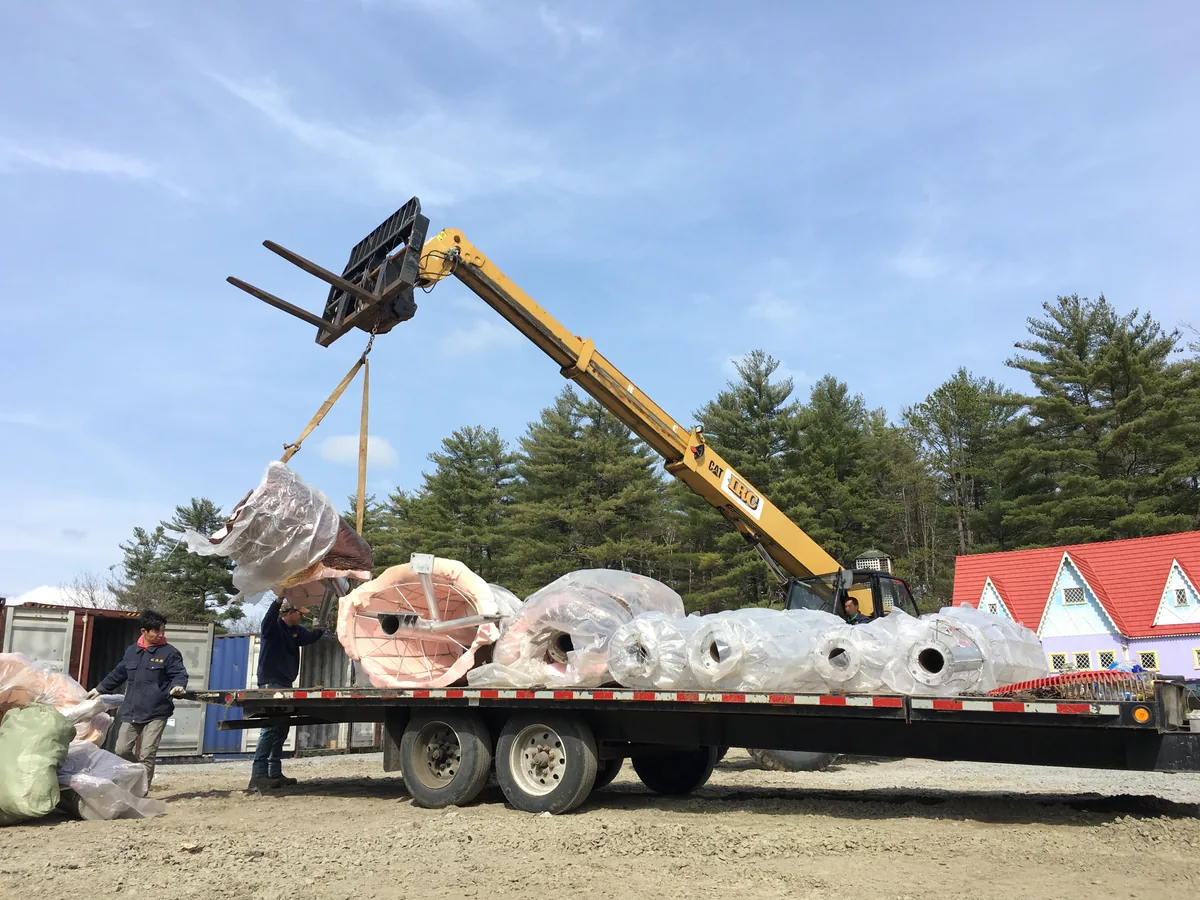
Those weights are for the frame, skin and installed drives together. They are the numbers that get handed to the rigging crew and the ones that determine whether a 3-tonne telehandler is sufficient or an 8-tonne mobile crane has to be booked.
The Joint Itself: Bolted, Not Welded
How the sections reconnect is the part buyers underestimate most. A welded joint means hot work, post-weld inspection, grinding and re-priming — all of which have to happen outdoors, in the rain, on a site with no fume extraction. It also means the connection is only as good as whoever is holding the torch that day.
Every HLTDINO joint is a mechanical connection designed at the same time as the frame:
- Machined steel flanges welded to each frame end at the factory, drilled on a jig so the bolt pattern matches across the pair.
- M16 to M24 bolts in grade 8.8, torqued to a value printed in the assembly manual.
- Dowel pins that engage before the bolts do, so alignment is repeatable and the sections cannot rotate against each other.
- Aviation connectors for every electrical run — servo power, encoder, sensor, audio. Colour-coded and keyed differently by axis so a harness cannot be plugged into the wrong socket.
- A silicone lap lip on the skin at each seam. After bolting, the lip is bonded with colour-matched silicone and textured to the surrounding surface. From two metres away the joint disappears.
The practical consequence: a mid-size unit can be reassembled by a crew with hand tools and a torque wrench, with no welding equipment on site and no repainting of structural steel.
Packing: Foam, Not Crates
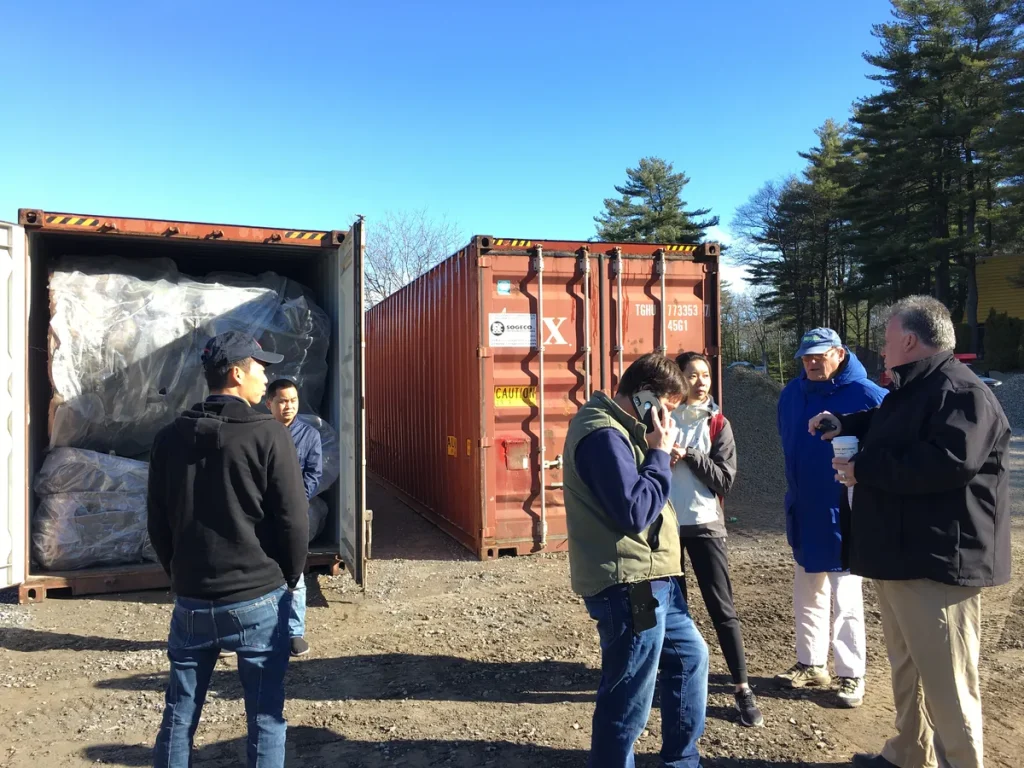
This is where the process differs most from how industrial equipment usually ships, and buyers notice it on the loading photos before they notice anything else. There are no timber crates. Large sections are wrapped in foam and loaded straight into the container. Small models and the control gear travel in aluminium flight cases.
Each section is wrapped in 20–30 mm EPE foam, with denser moulded foam blocks bonded at the load points — the flange faces, the hip cradle, the jaw, the tail tip. Corner protectors go on any frame edge that could puncture the wrap, then the whole piece is sealed in stretch film. Skin surfaces get a foam pad anywhere they could contact steel, and nothing is stacked on a wrapped skin.
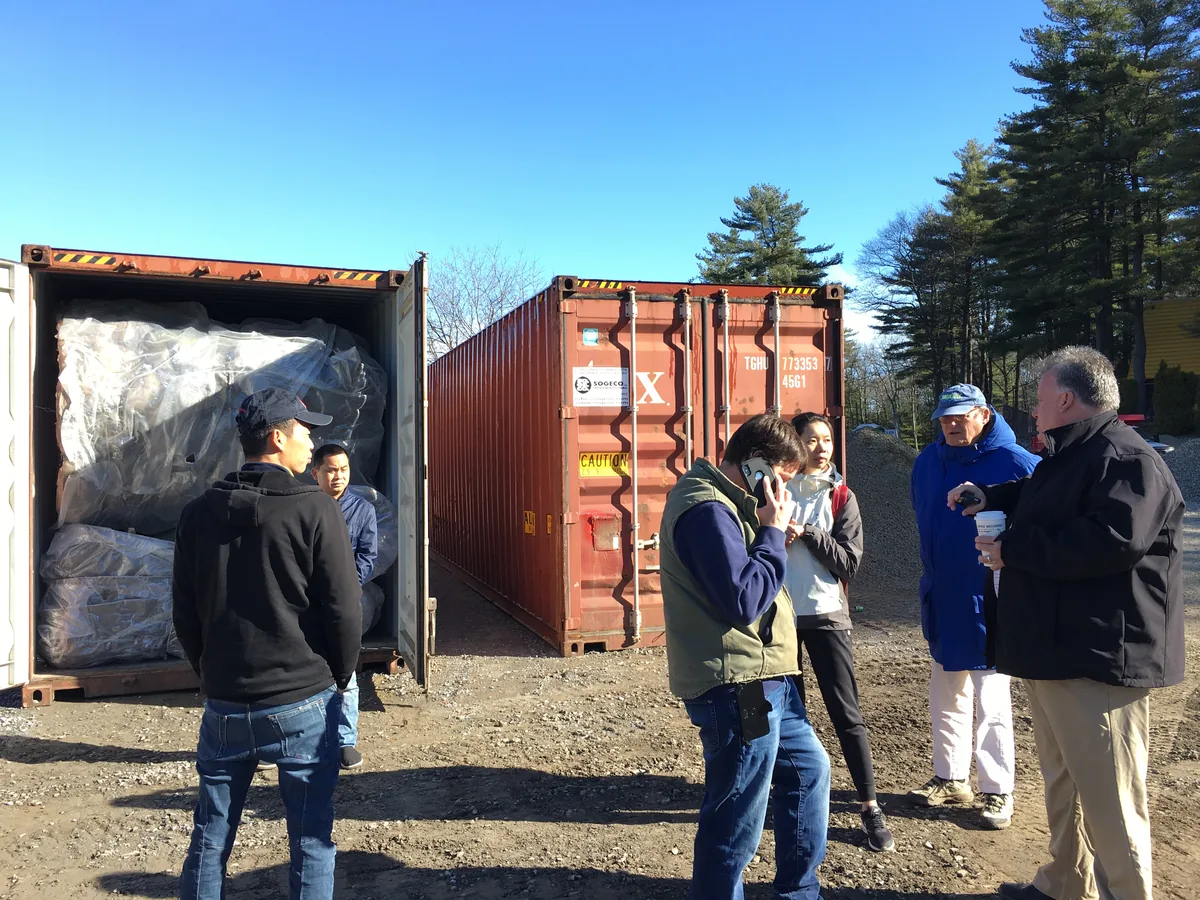
The reason is arithmetic, not cost-cutting. A plywood crate built around a 4.5 m torso adds 150–250 kg and 100–150 mm to every face. A section engineered to clear the 2.34 m door with 30 mm to spare does not survive that. Foam adds roughly 30 mm, weighs almost nothing, and follows the shape instead of forcing it into a box — so the volume a crate would waste on empty corners stays available for the next section.
| Timber crate | Foam wrap + flight case | |
|---|---|---|
| Added weight, 4.5 m section | 150–250 kg | 6–10 kg |
| Added to each dimension | 100–150 mm | ~30 mm |
| Wood packaging controls | ISPM 15 marking, heat-treatment record, possible inspection | None — no solid-wood packing on the goods |
| Disposal at destination | Client pays to remove and dispose of it | Film and foam to commercial waste; flight cases stay |
| Reuse on site | None | Flight cases double as site storage and transport for the control gear |
Two conditions come with it. Foam-packed sections have to travel in a dry van container — not open top, and not a flat rack without a tarp — because the wrap is impact protection and weather resistance, not a roof. And the load has to be lashed, not packed tight: webbing straps to the container’s floor D-rings, with inflatable dunnage bags filling the voids between odd-shaped pieces. There is no crate wall to lean on, so the lashing plan carries the whole job.
Where solid-wood dunnage is still used for blocking and bracing against the container walls, that timber is regulated the same as any other wood packaging material and carries the ISPM 15 mark. Processed board — plywood, OSB — is exempt, which is why our bracing kit specifies it. If a supplier waves the question away, ask which of the two they mean. A container held for fumigation in Australia or Brazil because of an unmarked offcut costs more than the whole bracing kit.
What Travels Beside the Dinosaur
The skeleton and skin are never the whole shipment. These items are packed separately, and getting them wrong is a common cause of a stalled commissioning:
| Item | Packing | Why it cannot ride inside the body |
|---|---|---|
| Control cabinet | Aluminium flight case, foam-lined, desiccant | Vibration and condensation; needs to be positioned at the operator station, not inside the animal |
| Servo drives and power supplies | Anti-static wrap, inside the cabinet or its flight case | Heat, dust and impact |
| Loose skin panels and colour paste | Flat cartons | Creasing and pigment separation in heat |
| Spare silicone, adhesive, texture tools | Flight case with the tool kit | Needed for seam finishing on site |
| Assembly manual, wiring diagram, torque table | Document folder, duplicated digitally | Customs may inspect; the site crew needs a physical copy |
Small models ship the same way at their own scale: a 1 m hatchling or a tabletop piece gets a foam cradle inside a wheeled flight case, which is also how it should be stored between seasons. The flight cases are not a formality. The control cabinet, the drives and the commissioning laptop travel in the same locked case that will sit beside the unit for the next five years, so the thing that arrives on site is the thing that stays on site — no crate to cut open, no crate to dispose of, and no argument about where the spare servos went.
Container Loading: What Actually Fits
Volumetric capacity is a poor guide on its own, because animatronic sections are awkward solids that do not tessellate. What matters is the loading plan: which section goes where, what stacks, and what can only sit on the floor.
Approximate real-world loads we work to:
- 20GP — two to three 4–6 m units, or a single 10–13 m unit fully broken down. Suitable when the site needs one statement piece rather than a trail.
- 40GP — six to eight 4–6 m units, or two 10–13 m units.
- 40HQ — eight to twelve 4–6 m units, or three to four 10–13 m units. The extra 300 mm of internal height is what makes a second tier of wrapped sections viable.
Loading discipline matters as much as arithmetic. Heavy frame sections go on the floor and toward the centre line, never resting on a lighter piece. Every section is lashed to the container’s floor D-rings with webbing straps, and the gaps between odd-shaped pieces are filled with inflatable dunnage bags, because a container ship in a swell will move a 700 kg frame section if nothing stops it. Nothing is nailed down — there is no crate to nail through, and a nail hole in a container floor is a repair bill at the depot.
When It Genuinely Does Not Fit
Three routes exist for exhibits that exceed the 2.34 × 2.28 m envelope, and the choice is usually made on cost:
- Split further. Cheapest, provided the extra joint does not compromise the structure or the skin continuity. This is the preferred answer and the reason the design stage matters.
- Flat rack or open top. The section ships as-is on a flat rack, lashed and tarped. Freight can rise two to three times, lashing must be certified, and the receiving port has to handle out-of-gauge cargo.
- Build on site. For permanent installations where the structure is welded in place, a crew travels and assembles from raw steel. Slow and expensive, but it removes every dimensional limit.
If a project is heading toward option two or three, it should be identified during quoting — not after the deposit clears.
Documents That Travel With the Container
A shipment of animatronics is a normal commercial export and needs the normal paper, plus two items specific to this trade:
- Commercial invoice and packing list, with dimensions and net/gross weight per section — not one lump figure. Customs and the rigging crew both need the breakdown.
- Bill of lading.
- Certificate of origin.
- CE or UL declaration of conformity, with the model designation matching the goods.
- A packing declaration confirming the goods carry no solid-wood packaging — required for Australia, and worth having anywhere the container may be inspected.
- Cargo insurance certificate covering out-of-gauge and handling risk if applicable.
The packing list deserves emphasis. A single line reading “1 × animatronic dinosaur, 2,000 kg” will cause the container to be devanned for inspection, and the schedule to slip. A section-by-section list, with each piece dimensioned and weighed, lets the freight forwarder book correctly and lets the customs broker clear without a physical exam.
Before the Truck Arrives: Site Preparation
This is where projects actually fail — not in the workshop, but in the car park outside the venue. Six things have to be true before delivery day.
1. Access width and turning radius
The largest section has to reach the installation point. Measure the narrowest gate, the tightest corner and any overhead obstruction (cables, branches, canopy). Practical minimums: 3 m clear width, 4 m turning radius for a rigid truck, and nothing overhead below 4.5 m if a crane is lifting.
2. Ground bearing and foundation
An outdoor unit needs a concrete pad — typically 150 mm minimum thickness, reinforced, on compacted sub-base — with cast-in anchor positions matching the base plate drawing. That drawing is issued roughly two weeks before shipment so the pad can cure in time. Indoor units on a slab usually need only resin anchors, but the slab has to be sound, not a screed over hollow fill.
3. Power
Voltage, phase and total connected load are specified per model. The cabinet needs a dedicated circuit and a means of isolation within sight of the operator. Cable route and gland position should be agreed before the pad is poured, because chasing a cured slab is nobody’s idea of a good week. Full electrical and air requirements are covered in our power and air reference.
4. Drainage
Outdoor units sit in a depression more often than anyone expects. If the base is below surrounding grade, water pools around the anchors and rust starts at the most loaded point. Specify a fall away from the plinth.
5. Lifting plan
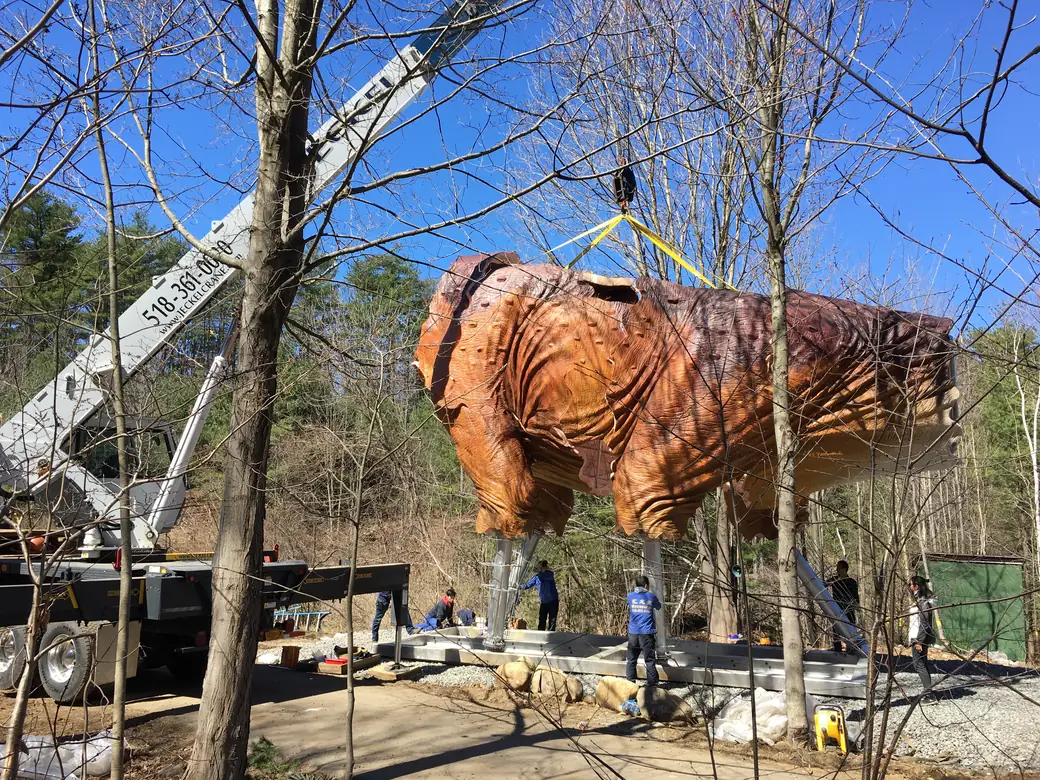
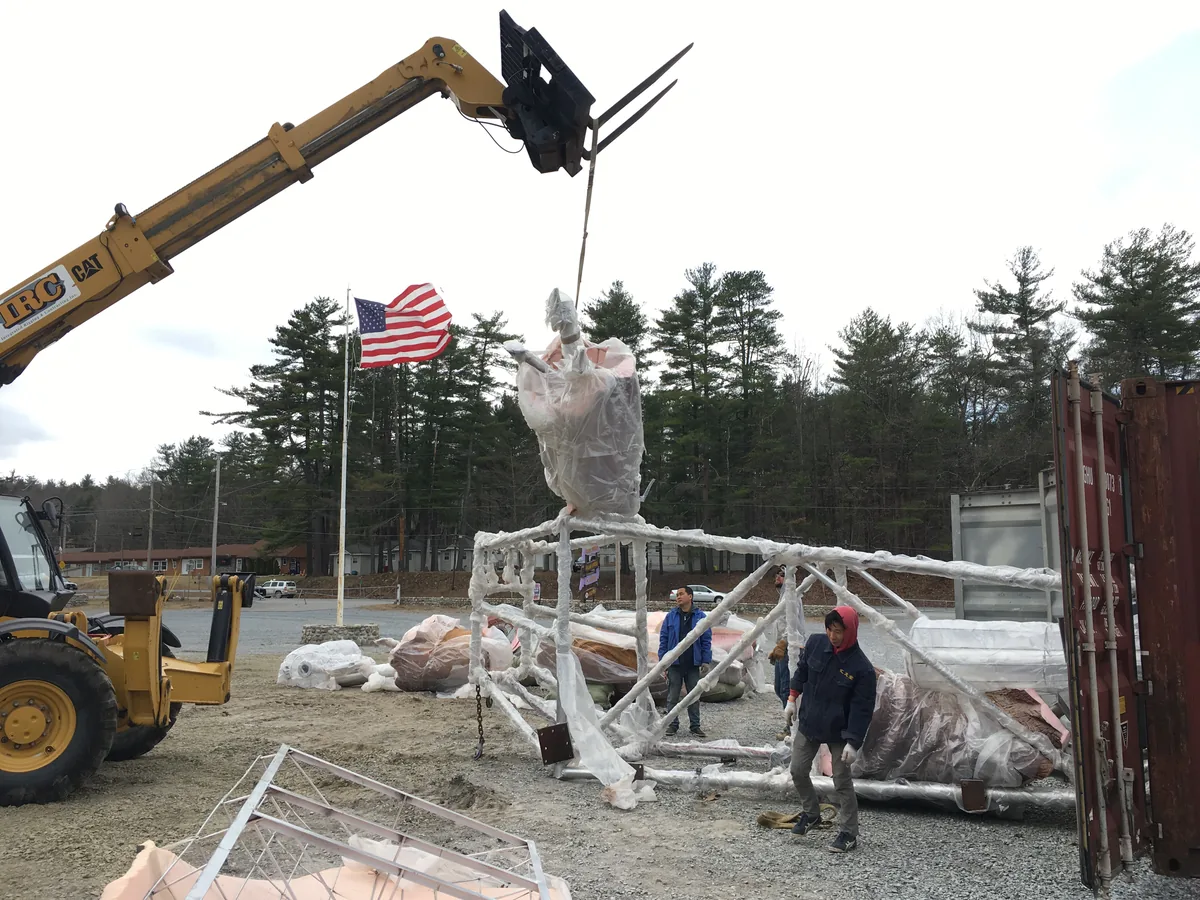
Who provides the crane, what capacity, and where can it stand? The heaviest section sets the requirement. A 700 kg piece at 6 m radius needs roughly a 3-tonne lift rating with margin; 1,100 kg needs an 8-tonne class machine. Confirm the crane can physically reach the pad without crossing a lawn, a drain or a gas main.
6. Storage
Sections that arrive before the pad is ready have to live somewhere dry and level. Silicone skin stored in direct sun for a fortnight will need rework, and foam wrap left standing on wet ground draws moisture up into the skin. Plan the laydown area before you confirm the shipping date.
Assembly, Day by Day
For a 10–13 m unit with a six-person crew, a realistic schedule on a prepared site:
| Day | Work | Crew |
|---|---|---|
| 1 | Unload, inventory against packing list, stage sections in assembly order, position the hip unit on the pad | 6 |
| 2 | Bolt torso, neck and tail sections to the hip unit; torque to spec; fit dowel pins; check frame alignment | 6 |
| 3 | Electrical interconnection, cabinet mounting, sensor and audio wiring, insulation checks before energising | 4 + 1 electrician |
| 4 | Skin seam bonding and texturing, colour blending, limb skin fitting | 4 |
| 5 | Motion programming verification, sensor calibration, continuous run test, handover walkthrough | 4 |
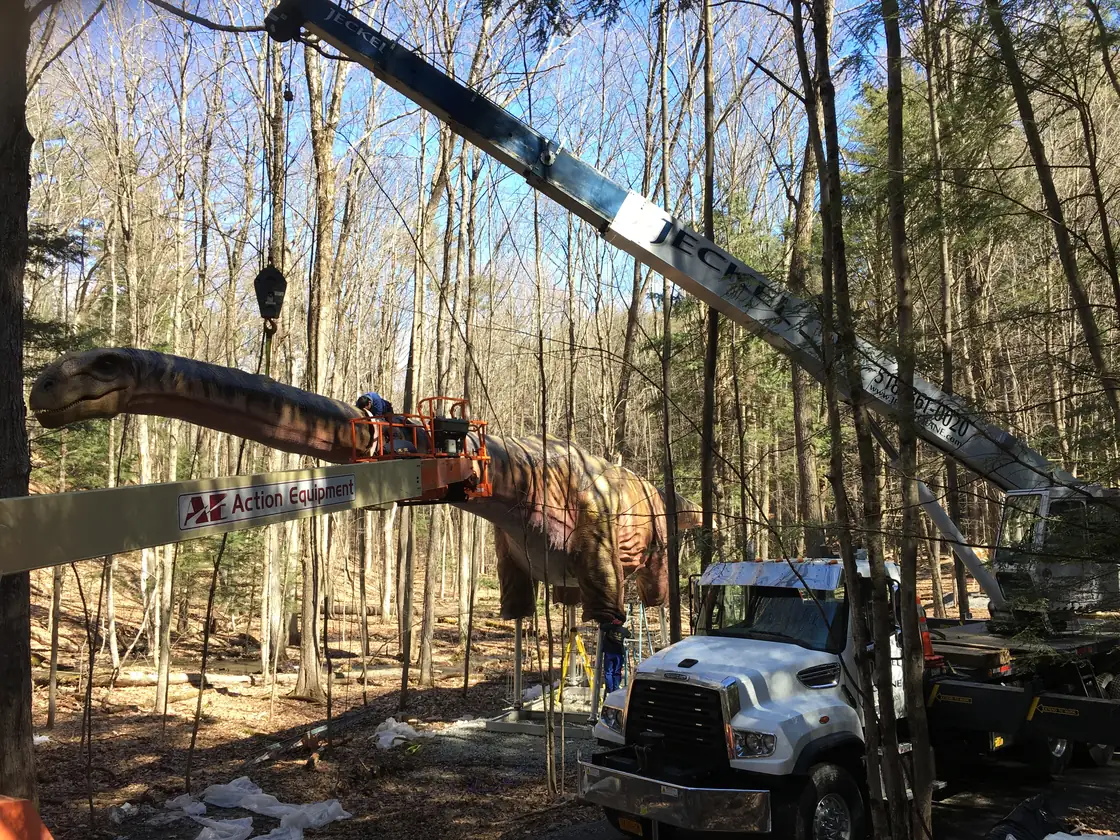
A 4–6 m unit compresses into one long day with two people: the frame arrives in three sections, the joints are accessible, and the skin seams are short.
Two things shorten the schedule more than anything else: a pad that is already cured and square, and a forklift or telehandler on site from hour one. Without the second, day one is spent waiting.
Commissioning: What “Finished” Actually Means
Assembly is complete when the bolts are torqued. Commissioning is complete when the unit has proven it will still be working in three months. We run the following before handover:
- Every axis driven to both mechanical limits, with soft limits set inside them.
- Each sensor triggered at its specified range — typically 3 to 8 m for motion activation — and re-tested at the extremes of ambient light.
- Audio cued to movement, with volume set for the venue’s background noise rather than the workshop’s silence.
- Continuous run of at least four hours, with cabinet and motor temperatures logged.
- Emergency stop tested under load, not at rest.
- Torque audit on a sample of joints after the run, since vibration settles new connections.
Handover includes the torque table, the wiring diagram, the sensor map and a short video of the unit running correctly — which becomes the reference for every future maintenance visit.
The First Month After Opening Day
New mechanical connections settle. Bolts that were torqued correctly in the workshop will read slightly under spec after four weeks of operation, which is normal and expected. Re-torque the joint schedule at week four, then move to a quarterly check. Skin seams should be inspected at the same time; a seam that is lifting is easy to bond early and expensive to repair once water has been behind it.
The full inspection rhythm, including what to look at weekly versus annually, is set out in maintenance and service life.
Common Questions
How long does shipping take?
Production lead time depends on size and complexity and is quoted per project. Ocean transit from China runs roughly 25–35 days to the US West Coast, 30–40 days to the US East Coast, 30–45 days to Northern Europe, and 18–28 days to Australia, port to port. Add customs clearance and inland haulage at each end.
How is a life-size dinosaur packed?
Not in a crate. Large sections are wrapped in 20–30 mm EPE foam with denser moulded blocks at the load points, corner protectors and stretch film, then lashed to the container floor D-rings and braced with inflatable dunnage bags. Small items — control cabinet, drives, tool kit — travel in aluminium flight cases that stay on site afterwards. The goods themselves carry no solid-wood packaging, so there is no ISPM 15 marking to chase and no fumigation hold on arrival.
Can we assemble it ourselves?
Yes for small and medium units, provided the site has the lifting equipment and the crew follows the torque table. Large units are usually assembled by our crew with local labour support, because the hip section handling is the risk point. Full installation is available through our services team.
What if our site has no crane?
A telehandler or a large forklift can handle sections up to roughly 700 kg if ground conditions allow. Above that, a mobile crane is the practical answer. Tell us the heaviest lift available at quoting stage and the split plan can be adjusted to suit it.
Can the dinosaur ship fully assembled?
Only small units, and only by flat rack or specialist out-of-gauge service. For anything above about 4 m, the freight premium exceeds any saving on assembly time.
Do we need a concrete foundation for an indoor unit?
Not necessarily — a sound structural slab with resin anchors is normally sufficient. What is not acceptable is tile, paving, or a screed over void. The base plate needs to bear on something that will not crush.
What about customs in our country?
Animatronic exhibits classify as mechanical or electrical display equipment, not toys, and the correct HS heading matters for duty. We provide the classification we use and the CE/UL documentation; your broker confirms the final entry. Getting this wrong is the single most common source of demurrage in this trade.
Where This Fits in the Wider Purchase
Shipping and installation sit at the end of a chain that starts with exhibit planning and product selection. If you are still at the earlier stage, the buying guide for museums and theme parks covers sizing, species mix and budget structure, and the dinosaur catalogue shows what each body length looks like assembled.
One step before that is deciding who builds it. The 12-point manufacturer verification list sets out the documents to request, the measurements to take and the answers that should end a conversation — worth working through before you compare quotes, because a split plan from a company that does not build its own frames is not really a split plan.
If you already know what you want and the question is how it physically arrives, send us the site plan — access width, ground conditions, available lifting equipment and power supply. We will come back with a split plan, a packing list and a schedule that reflects your site rather than a generic template.