Roughly half the companies selling animatronic dinosaurs internationally do not build them. They are trading offices with a website, a photo library borrowed from a factory, and a margin. That is not automatically a problem — a good trading company can manage quality and logistics well — but it becomes a serious problem when you believe you are buying from the factory and you are not.
The failure mode is consistent and predictable. A unit arrives with skin 2 mm thick instead of 4 mm, a frame made from 1.5 mm tube instead of 3 mm, unbranded servo drives, and a control cabinet wired by someone who has never seen a wiring diagram. It works for six months, then a joint starts cracking and there is nobody to call.
None of this is detectable from a brochure. It is detectable in about two hours of structured questioning, plus a video call to the workshop floor. Below are the twelve checks we would run ourselves if we were buying, in the order they eliminate risk fastest.
1. Business licence: does the scope of business include manufacturing?
Ask for: the business licence, translated, with the registered scope of operations visible.
Chinese business licences state what a company is permitted to do. A pure trading entity will list wholesale, retail, import and export — and no manufacturing. A factory lists production or manufacture of the relevant goods.
Red flag: the licence is described verbally as “we manufacture” but never actually sent. Or the scope reads sales of rather than manufacture of. Neither is fatal, but it changes who you are dealing with and who carries the risk when something fails in year two.
2. Export registration and customs code
Ask for: the 10-digit customs registration number, and the export licence if the destination requires one.
This number is verifiable against Chinese customs records and tells you whether the company has actually exported, or only claims to. It also confirms they can issue the export documentation set themselves rather than routing through a third party who will not answer questions in year two.
Red flag: reluctance to share it, or an offer to “handle the paperwork through our partner”.
3. The workshop floor, not the showroom
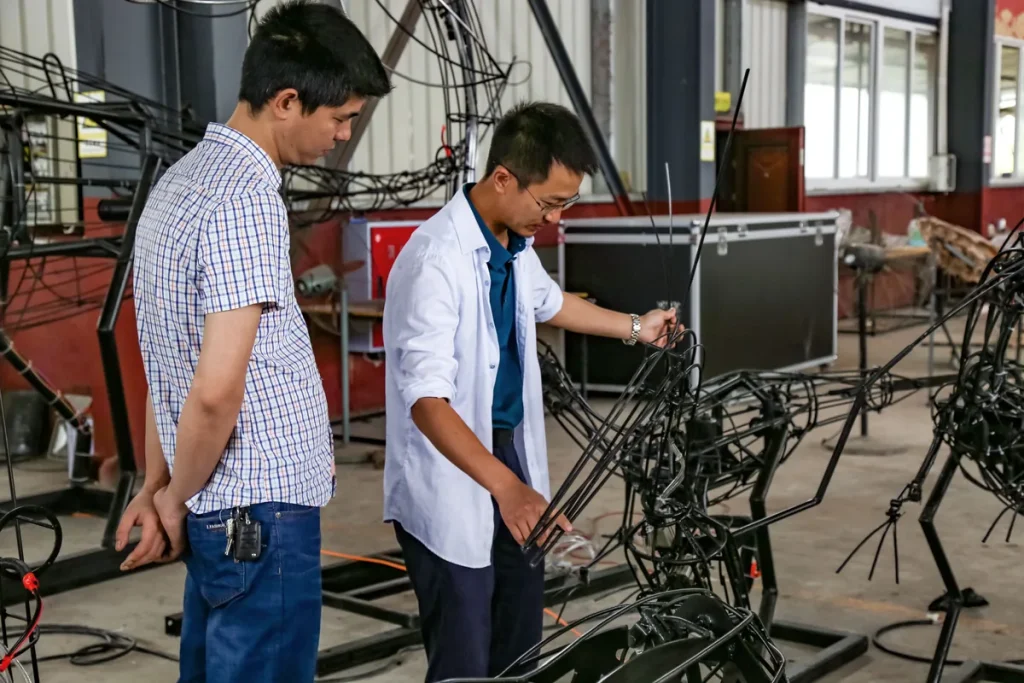
Ask for: a live video call, walking from the office to the production floor, with no advance notice of the route. Not a recorded tour. Not a drone video.
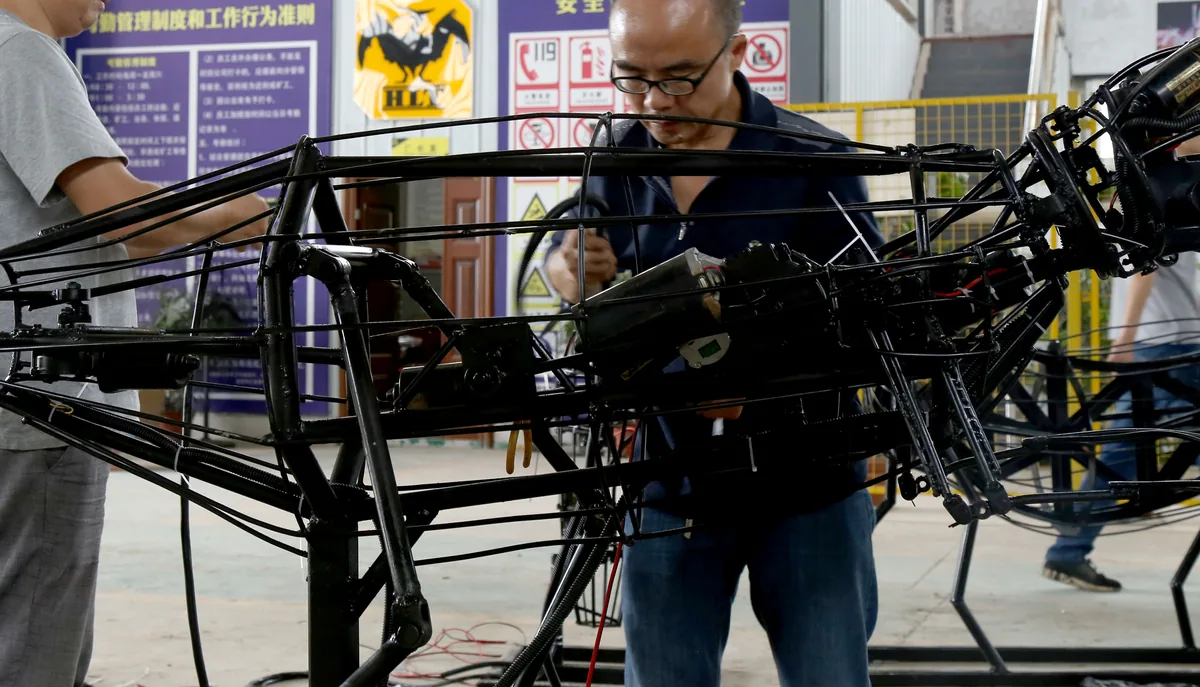
Every real factory looks a little chaotic in the middle of a build. What you are looking for is activity that matches the product: steel being cut and welded, frames in jigs, skin being laid up in moulds, cabinets being wired, finished units being run-tested.
Red flag: a spotless floor with three display pieces and no work in progress. Showrooms look like showrooms because that is all they are. Also watch for a workshop that is clearly producing something else — lanterns, statues, signage — with one dinosaur in the corner.
4. Workshop area, layout and tenure
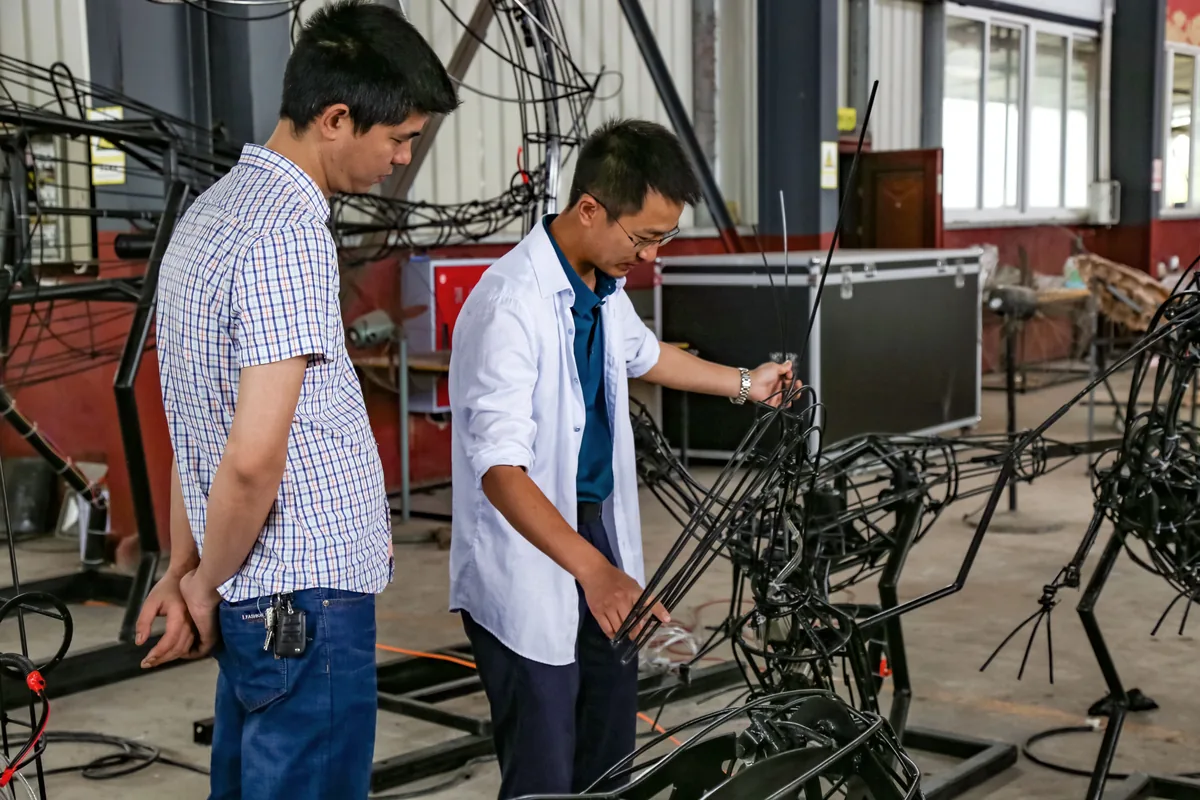
Ask for: total floor area, a layout drawing marking the welding bay, skin workshop, electrical assembly area, paint booth and finished-goods area — and how long they have held the premises.
Area alone proves little, but layout proves a lot. A factory that lays up silicone skin needs ventilation, temperature control and a dedicated mould area. A factory that builds frames needs a welding bay with extraction and a paint area that is not the same room. If the layout has one open shed and no separation, the skin is being laid up next to grinding dust, and the finish will show it within a year.
Red flag: a number quoted for area but no drawing, or a drawing whose areas do not add up to the number.
5. Silicone skin: thickness, measured
Ask for: the specified skin thickness in millimetres, and a video of someone measuring a finished section with a digital caliper, on camera, at three points.
This is the single most useful physical measurement in the whole category. Thin skin tears at joint seams, cracks at flex points, and cannot be repaired invisibly because there is no material to work with. Thick skin costs more in silicone and more in weight, which is exactly why it gets economised on.
Ask also how the skin is reinforced at high-flex areas — around the jaw, the neck base, the tail — because that is where failures begin. Our own approach to skin construction is set out in silicone skin for animatronic dinosaurs.
Red flag: a thickness given as “standard” or “depends”, without a number. Or a measured value under 3 mm on a large unit.
6. Steel frame: tube wall and welds
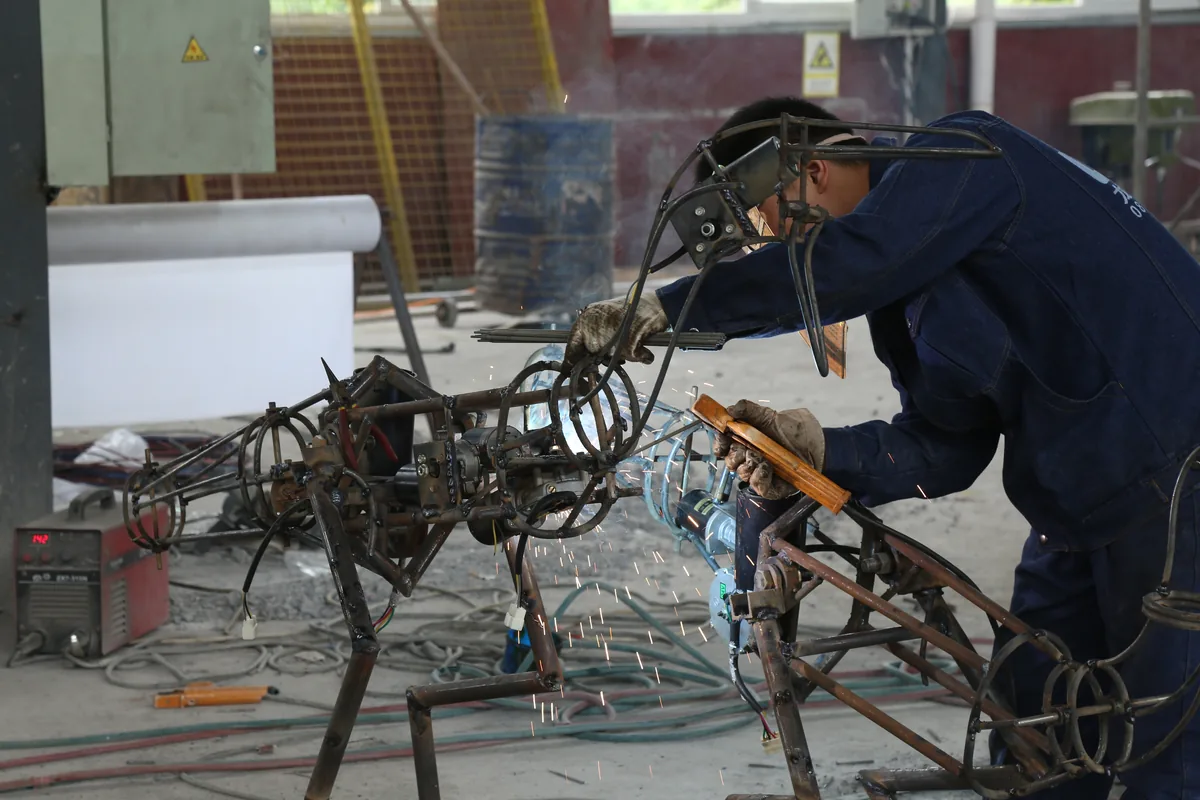
Ask for: the main frame tube specification — outside diameter and wall thickness — plus close-up photographs of welds at a hip or shoulder joint, and the surface treatment process before painting.
Frame failures are rare but catastrophic, and they always start at a weld or a thin wall. Wall thickness is where cost is quietly removed: 3 mm tube to 1.5 mm tube halves the steel cost and nobody notices until the unit is loaded.
Surface treatment matters as much. Shot blasting or acid pickling followed by an epoxy primer is a different product from wire-brushing and a coat of enamel. On an outdoor unit, that difference is the whole service life.
Red flag: welds photographed from a distance, or described as “strong”. Ask for the toe of the weld, in focus.
7. The drive train: name the components
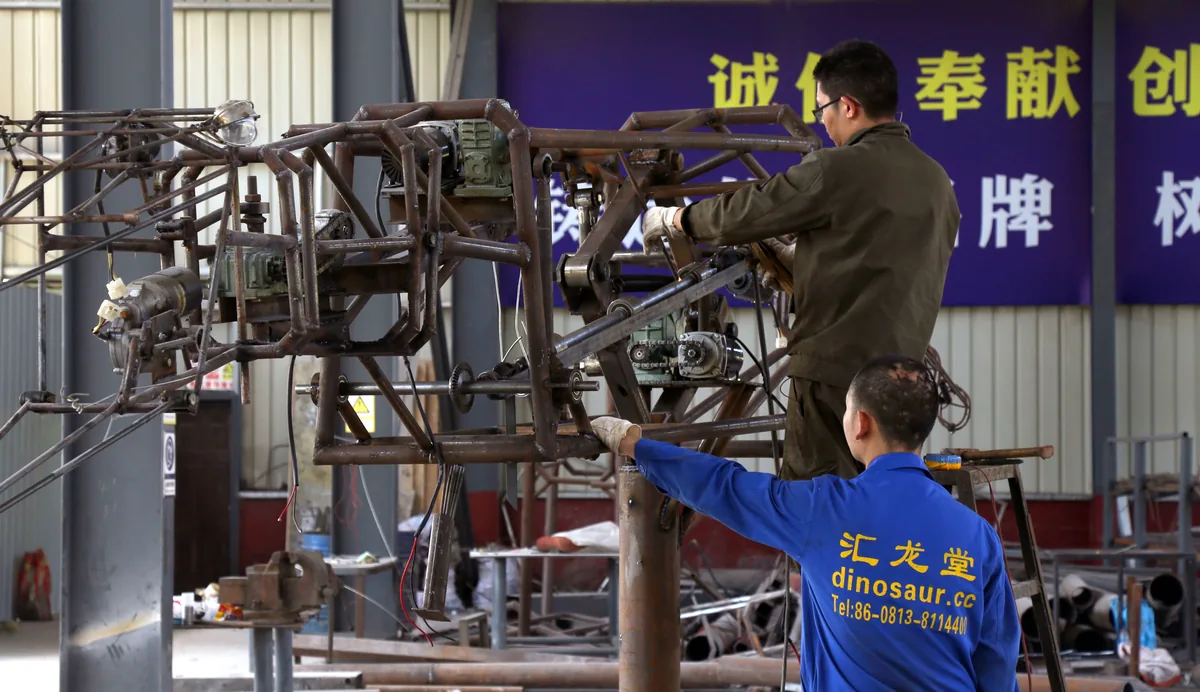
Ask for: brand and model of the servo motors, the gearboxes and the motion controller. Not “high quality servo”. A part number.
Drives are the most expensive bought-in components and the easiest place to substitute. A branded servo and an unbranded clone look identical in a photograph and behave completely differently after 2,000 hours. Brand also determines whether a replacement can be sourced locally in five years.
Ask what happens if a servo fails in year three: is the model still in production, and what is the lead time on a replacement?
Red flag: refusal to name brands, or “we use several depending on availability”. The second answer means you cannot plan spares.
8. Control cabinet workmanship
Ask for: a photograph of an open cabinet, in focus, with the wiring visible. Then ask what the PLC or motion controller is, and whether the cabinet is built in-house or subcontracted.
Cabinet workmanship is the clearest single indicator of overall build quality, because it is the one place where everything is visible at once. Look for: ferrules on every wire end, numbered cores, a wiring diagram in a pocket inside the door, DIN rail mounted components, separate power and signal routing, and a label on every terminal.
Red flag: twisted-and-taped connections, wires bundled with cable ties and no numbering, or a cabinet photographed only from outside.
9. Certification that matches the actual model
Ask for: the CE or UL documentation, and check that the model designation on the certificate matches the model being quoted.
Certificates are frequently real but belong to a different product, or cover a component rather than the assembly. A CE declaration for a servo motor tells you nothing about the exhibit. What you want is a declaration of conformity for the machine as supplied, with the standards cited and the model number matching your quotation.
If the destination requires UL, ask which UL standard applies and whether the assembly or only the components are listed.
Red flag: a certificate image with the model number blurred, or a document that cites no standards.
10. Continuous run test records
Ask for: how long a finished unit is run before it is packed, and whether that test is logged. Ask to see a log.
An animatronic that runs for ten minutes in a showroom proves nothing. Thermal problems, binding joints and encoder drift appear after hours, not minutes. A factory that tests seriously will have a number and a record — typically a continuous run of several hours with cabinet temperature noted.
Red flag: “we test every unit” with no duration and no record. Or a test performed before the skin goes on, which means the unit was never run at final weight.
11. Spare parts list and response commitment
Ask for: the recommended spares list that ships with the unit, and a written response commitment for a breakdown — how fast a diagnosis, how fast a part, who pays for what.
Every exhibit eventually needs a part. The question is whether that part is on your shelf, in the supplier’s warehouse, or needs to be manufactured. A serious supplier will ship a spares kit matched to the unit — a spare servo on the most loaded axis, skin repair material in the correct colour, seals, a sensor — and will state response times rather than implying them.
Red flag: spares discussed only as a future purchase, with no list at handover.
12. Reference projects you can actually contact
Ask for: two or three installed projects in your region or your sector, with a contact who has agreed to be called. Not a logo wall.
A logo wall is marketing. A named site that will take a phone call is evidence. When you call, ask three things: did the unit arrive when promised, was the documentation accurate, and how many service interventions in the first two years.
Our project case studies are written to answer exactly those questions — including the parts that were difficult.
Red flag: references offered only as photographs, or a site that turns out to be a distributor rather than an end user.
Three Patterns That Repeat
Across this category, the same three deceptions come up often enough to be worth naming.
The borrowed factory
You are shown a workshop that belongs to someone else — a cousin’s factory, a former employer, a partner they place orders with. The tour is real, the building is real, the relationship is not what you were told.
How to break it: ask them to walk to the front gate on the video call and film the company name plate, then compare the address against the business licence. Also check that the entity on the contract, the entity receiving payment and the entity on the export documents are the same. A “group company” explanation for three different names is worth a second look.
The refurbished unit sold as new
Frames are durable, so a used frame can be re-skinned, re-wired and sold as new. From the outside it looks identical. The giveaways are inside: original factory welds are uniform and jig-aligned, repair welds are not; a new build has no filled holes, no unused bolt patterns, no mismatched paint under the frame coating.
How to break it: ask for the frame’s production date and the unit’s build record. Ask for a photograph of an unpainted frame joint — new steel is bright, reused steel shows pitting or old primer.
The borrowed certificate
A genuine CE or UL document that belongs to a different product, or covers a component rather than the assembly. The certificate photographs well and means nothing for your machine.
How to break it: compare the model designation character by character against the quotation. If a notified body number is cited, check it against the EU NANDO database — an invalid or withdrawn body number is a clear answer. And ask which standards the declaration cites; a document that cites none is a letterhead, not a certificate.
When to Walk Away
Most of this list is about gathering evidence. These five are about acting on it.
- They will not do a live workshop video. There is no legitimate reason to refuse this, and every illegitimate one.
- Three or more of the twelve answers are evasive. One gap can be an organisational weakness. Three is a pattern.
- The quote is more than 40% below the other bids. Silicone, steel, servos and labour all have floor prices. That gap is being taken out of the product, and it will show up in year two.
- They will not name the contract entity before you pay a deposit. This is the single most common precursor to a dispute nobody can resolve.
- They claim to do everything. Real factories have things they are good at and things they outsource. Uniform enthusiasm across every product category is a sales posture, not a capability.
The Short Version: What to Send Them
Copy this into an email. The speed and completeness of the reply is itself the thirteenth check.
- Business licence with scope of operations, and your customs registration number.
- Workshop area and layout drawing. How long have you held the premises?
- A live video call to the production floor this week — no recorded tour.
- Specified silicone skin thickness in mm, with a caliper measurement on camera.
- Main frame tube OD and wall thickness; close-up weld photographs at a hip joint; surface treatment process.
- Brand and model of servo motors, gearboxes and motion controller.
- Photograph of an open control cabinet, in focus. PLC brand. Built in-house?
- CE/UL documentation with the model designation matching our quotation.
- Continuous run test duration before packing, and a sample log.
- Spares list shipped with the unit, and your written breakdown response commitment.
- Two installed references we may contact, in our region if possible.
- Lead time, split plan and packing list for the sizes we are considering.
Why This List Is Short Enough to Be Useful
There are a hundred questions you could ask. These twelve are the ones where the answer is either verifiable or evasive — there is no middle ground, and no amount of polished marketing survives a request for a caliper reading on camera.
A supplier who has nothing to hide will answer all of them within a day and will probably enjoy it, because most buyers never ask. A supplier who deflects three or more is telling you something useful before you have spent anything.
If you are at the stage of shortlisting rather than auditing, the buying guide for museums and theme parks covers sizing and species mix, and the FAQ answers the commercial questions that come up most often.
Once the shortlist is down to two or three and you are comparing delivery terms, the shipping and installation guide explains how a unit is split for a 40HQ, how it is packed and what assembly involves on site — usually the point where otherwise similar quotes start to diverge.
How We Answer Our Own List
It would be dishonest to publish a verification list without inviting the same scrutiny.
HLTDINO has manufactured in Zigong since 2012, with a team of 120 across design, production, installation and outreach, all on one site. We hold a patent on our silicone skin formulation (ZL 2022 1 0224489.5), we build frames and lay up skin in-house rather than assembling bought-in parts, and we run every finished unit before it is packed. Our electrical assemblies are built to CE and UL component standards, with documentation issued against the supplied model.
Ask us for the twelve items above and you will get the documents, the caliper video and the cabinet photograph. If any answer is not good enough for your project, that is worth knowing early — for both of us.
Send your requirement with the sizes and destination, and the first reply will include the split plan and lead time, not just a price.