Most of the enquiries that reach a dinosaur factory are, unsurprisingly, about dinosaurs. But a steady share of them are not — and they come from the buyers with the most repeat potential: aquariums filling a saltwater hall, natural history museums building a Pleistocene gallery, botanical gardens looking for something that moves without needing a gardener.
These projects fail in different ways from a dinosaur build, and the failures are rarely about sculpture quality. They are about salt, cold, condensation and the assumption that a machine built for a park lawn will behave the same way six metres under chlorinated water or inside a −10 °C cold room. This article is about what actually changes.
Why Dinosaur Halls Add Marine and Ice Age Displays
A dinosaur exhibition has a predictable commercial problem: it is a single visit. The family comes once, photographs the T-Rex, and does not return for two years. Venues that depend on local repeat traffic — city aquariums, regional museums, science centres — solve this by rotating a secondary hall every twelve to eighteen months. Marine and ice age themes are the two most common choices, because they re-use the same infrastructure: a dark room, a controlled climate, a one-way visitor flow and a gift shop exit.
They also re-use the same procurement relationship. A venue that has already bought one animatronic exhibit knows how the process works, knows what freight and installation cost, and can brief a second project in a fraction of the time. That is why the second and third orders from an existing client are usually not dinosaurs at all.
From the factory side, marine and ice age lines are not side products. They share the frame line, the silicone shop and the control assembly with the dinosaur work — the mechanisms are the same servo-and-reducer architecture — but the sealing, the materials and the testing protocol are different enough that they are quoted and built as separate product families.
Animatronic Sea Creatures: What an Aquarium Brief Actually Asks For
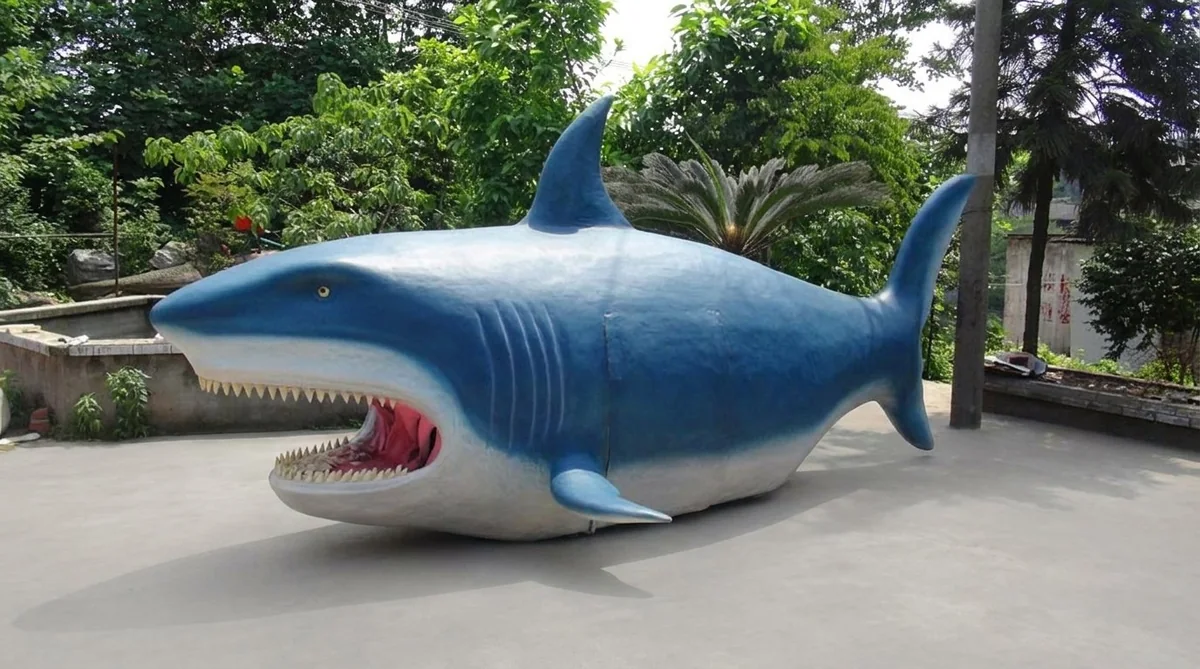
The single most common request in this category is a shark. It is also the one with the least room for shortcuts, because the buyer usually knows exactly why they are asking: large pelagic sharks do not survive in captivity. A great white has never been kept alive in an aquarium for more than a few months. Public aquariums that want a shark hall have three options — smaller benthic species, a filmed projection, or a model. The model is the only one that gives them a full-size animal they can walk beside.
The salt problem is a materials problem
Saltwater destroys mild steel quickly and predictably. In a marine hall, every structural element inside the tank envelope has to be either 316L stainless, marine-grade aluminium, or a coated steel that has been specified for the exposure — not the Q235 carbon steel that is perfectly adequate for an outdoor dinosaur standing in a park.
The same logic runs through the small parts that nobody quotes separately: hinge pins, fastener grades, cable glands, terminal blocks. A galvanised bolt in a saltwater splash zone will show red rust inside one season, and by the time the client notices it, the thread is gone and the part cannot be disassembled for service. We specify 316 stainless for anything inside the tank envelope and for anything within splash range of a wave or a filter return.
Seals are the other half. A silicone O-ring is the wrong choice here — silicone has poor resistance to some oils and swells in certain chemical exposures. EPDM handles saltwater and chlorine well but is attacked by petroleum-based lubricants, which means the grease inside the joint has to be chosen to match the seal, not the other way round. This is the kind of decision that never appears on a purchase order and determines whether a unit is still dry after two years.
In-tank and dry-side are two different builds
Buyers often use the same phrase — “an aquarium exhibit” — for two products that share almost nothing.
In-tank units are designed to sit in water with visitors on the dry side of the glass. The skin has to survive continuous immersion, the mechanism is fully sealed, and the control cabinet lives outside the tank in a dry service room rather than on the animal. Service access is through the tank top or a dry sump, which means the whole unit has to be designed for lifting out.
Dry-side units stand behind glass or on a rockwork ledge with no water contact at all. They are closer to a standard animatronic with a higher corrosion specification, and they are far cheaper to build and to service. A surprising number of “underwater” exhibits in real aquariums are dry-side units set behind blue-tinted glass with a bubble curtain. That is not a trick — it is the correct engineering answer when the budget is finite and the service access is bad.
The useful question to ask a supplier is not “can you build a shark” but “is this unit rated for immersion, splash or dry side” — and then to check that the answer matches the drawing.
Motion is deliberately slower in water
One detail that surprises clients: an underwater animal does not need fast movement, and fast movement looks wrong. Water damps acceleration, so a shark that swings its tail at dinosaur speed reads as mechanical. Marine units are programmed with longer cycles, lower peak velocity and more overshoot — the tail coasts into its stop rather than hitting it. Buoyancy is faked with counterweights so the unit does not appear to fight gravity.
That slower programming also extends service life. Lower peak torque means lower stress on the reducer and the joint bearings, which matters because pulling a unit out of a tank for repair costs far more than the part.
Ice Age Animals: The Cold Gallery
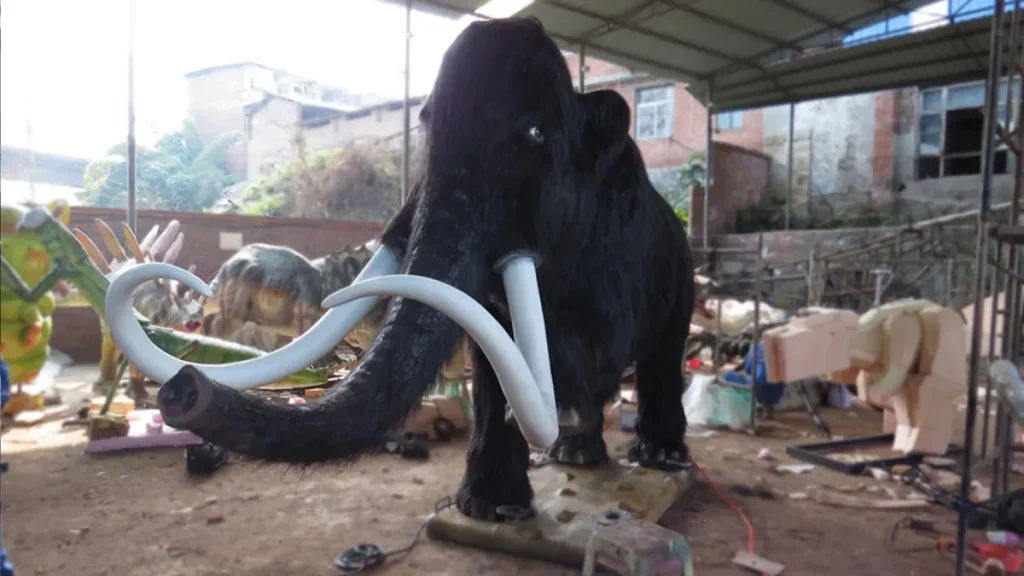
The Pleistocene hall is the museum equivalent of a shark tank — a theme that gives a natural history venue a second room without competing with its dinosaur collection. The three species that carry the category are the woolly mammoth, the cave bear and the sabertooth cat. Mammoth is asked for most often, usually at life size, often as a family group with a juvenile.
The commercial logic is straightforward: a mammoth is instantly recognisable to a visitor who knows nothing about the Pleistocene, and it photographs well in low light. A cave bear is the one that museum curators ask for by name, because it lets them tell a story about the cave deposits their own collection came from.
Cold tests a different set of parts
A cold-room gallery, held between −5 °C and −15 °C, breaks things that work perfectly at room temperature. The list is consistent across projects:
Silicone stiffens. Shore hardness rises as temperature falls, so a skin that flexes easily at 20 °C becomes noticeably stiffer at −10 °C. Joints that were programmed with a comfortable margin start to bind. The fix is a softer compound and a wider motion envelope, decided at the mould stage — not something that can be corrected on site.
Grease thickens. Standard lithium grease channels badly at low temperature, and the reducer starts to feel notchy. Low-temperature synthetic grease costs more per kilogram and is worth every cent.
Batteries lose capacity. If the remote handset or the backup supply uses batteries, expect a third of the runtime at −10 °C. We move the control cabinet out of the cold room and run a sealed harness through the wall whenever the layout allows it.
Displays stop displaying. A standard LCD panel goes sluggish or blank below −10 °C. If the client wants a screen in the gallery, it needs a heated enclosure, and that has to be in the electrical budget from the start.
Condensation, not cold, kills electronics. Every time the room warms for cleaning, moisture condenses on cold metal. Conformal coating on the boards and a desiccant-packed cabinet solve it; neither is expensive if specified at build time.
Fur changes the maintenance schedule
Furred species need a different service rhythm from skinned ones. The fur traps dust and, in a humid gallery, holds moisture against the skin underneath. Brushing and a periodic low-temperature drying cycle are part of ownership, not optional extras. It is worth writing into the handover document, because a mammoth that looks tired after two seasons is usually a maintenance issue rather than a build failure.
Carnivorous Plants: Prop or Exhibit?
This is the category where briefs most often go wrong, and it is worth being direct about why. Searches for animatronic Venus flytraps and man-eating plants are dominated by Halloween retail — a consumer product that runs on a small air bladder, sells for the price of a costume, and is designed to be used for three weeks a year. That is a legitimate product, but it is not what a botanical garden is buying.
A garden or a science centre wants something different: a plant that reads as botanical rather than theatrical, that can run daily for years, and that survives a glasshouse environment — high humidity, strong UV through the glass, and misting systems that put water on the surface every few minutes. The material questions change completely. Mould and algae growth on the surface matter more than impact resistance. Moving parts are small and precise rather than large and dramatic.
The plants that work commercially are the recognisable carnivorous species — Venus flytrap, pitcher plant, sundew — plus larger tropical foliage and trees for indoor landscapes and themed retail. What does not work is treating a Halloween prop as a permanent exhibit; the mechanism is not rated for continuous duty and the finish will not survive a misting cycle.
What Changes Technically, Side by Side
The three families look different and are quoted differently, but the engineering differences come down to four variables.
Corrosion specification. A park dinosaur can be built on Q235 steel with a galvanised finish and a repaint every few years. A marine unit needs 316L in the wet envelope and marine-grade fasteners throughout. An ice age unit sits between the two but adds condensation to the problem.
Sealing. Dry-side dinosaur work is largely splash-proof. Immersed work is a sealed pressure envelope with cable entries that have to be individually rated. This is where a cheap quote becomes expensive: sealing is invisible, so it is the first thing cut.
Motion profile. Dinosaurs are built to read from twenty metres away, with large motions and generous joint travel. Marine work is slower and softer; botanical work is smaller and more precise. The servo sizing and the reducer ratios follow from that, not the other way round.
Service access. Every one of these builds should be designed around how a technician reaches the joint that will fail first. In a dinosaur that is a ladder and a hatch. In an aquarium it is a lifting frame and a dry sump. In a cold room it is a service window and a warm place to put your hands.
How We Build These Lines
All three families are built in the same 8,000 ㎡ workshop in Zigong that produces our dinosaur work — the same steel line, the same silicone shop, the same electronics bench and the same outdoor test ground. That matters less for capacity than for materials: the silicone skin patent (ZL 2022 1 0224489.5) is ours, which means a marine or ice age build gets the same skin chemistry as a dinosaur and a colour formula that stays on file by serial number for later repair.
Testing follows the exposure rather than the species. A dry-side aquarium unit is run for a full cycle outdoors before crating, the same as a park dinosaur. An immersed unit gets a tank test on a temporary frame, and the client receives the seal inspection record with the shipping documents. A cold-room unit is tested at reduced temperature where the schedule allows, because a mechanism that binds at −10 °C will not reveal itself in a warm workshop.
What to Put in the Brief
If you are specifying one of these projects, these are the details that change the quote most, and the ones most often left out:
Exposure class. Immersed, splash zone, or dry side behind glass. State it explicitly and ask for it in writing on the drawing.
Water chemistry. Fresh, salt, or chlorinated — and whether the unit sits in the display tank or a separate sump. Chlorinated water attacks different seals than saltwater does.
Gallery temperature range. Not just the set point. The swing between a cold night and a cleaning-day warm-up is what condenses on the electronics.
Service access route. Can a technician reach the unit with a ladder, a lifting frame, or only through a hatch? This single answer can change the frame design.
Who maintains it. A venue with in-house technicians can take a more modular, field-serviceable build. A venue with no technical staff needs a design that fails gracefully and a clear spare parts list.
Send those five answers with a species list and a rough footprint, and a factory can give you a realistic quote instead of a placeholder number. That is true for dinosaurs, and it is more true for the halls that are not about dinosaurs at all.
Browse the product lines behind this article: animatronic sea creatures, ice age animals and animatronic plants and trees — or see the life-size animatronic shark and the woolly mammoth museum exhibit in detail.