Animatronic Dinosaurs
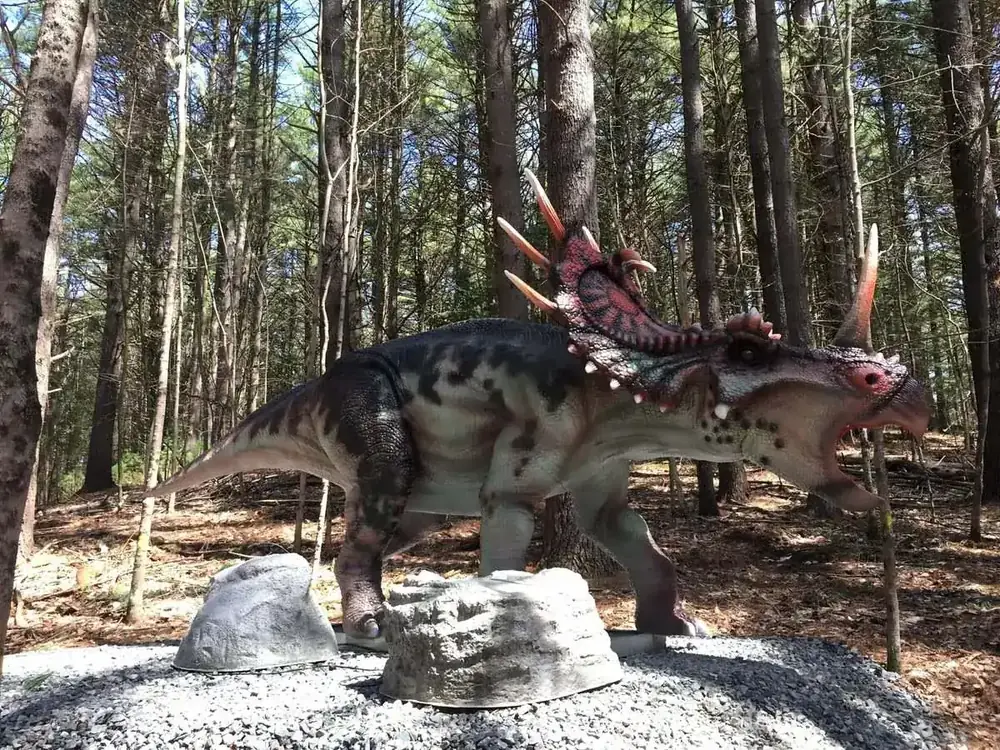
Styracosaurus gets mistaken for a Triceratops more than any other animal in the catalogue, and the mistake is worth correcting because it is the whole identity of the build: one horn on the nose instead of two over the eyes, and six long spikes around the frill instead of a scalloped edge.
| Length | 5 m standard; customisable |
|---|---|
| Frame | Hot-dip galvanised weathering steel |
| Surface | High-density hand-finished skin, weatherproof |
| Power | 110–240 V AC, 50/60 Hz |
| Solar option | 24 V DC solar-compatible configuration |
| Motion | Head turn, jaw, neck, tail; levels set at order |
| Duty | Indoor or outdoor |
| Transport | Frill and spikes removed for shipping, refitted on site |
The nasal horn is a single horn on the snout, and it is the feature that separates this animal from every other ceratopsian in the range. The frill carries six long spikes, and the length matters — short spikes read as a Triceratops with a decorative edge, long ones read as Styracosaurus.
The frill itself is narrower than a Triceratops frill, which is the second thing people get wrong when they build it from a generic ceratopsian mould.
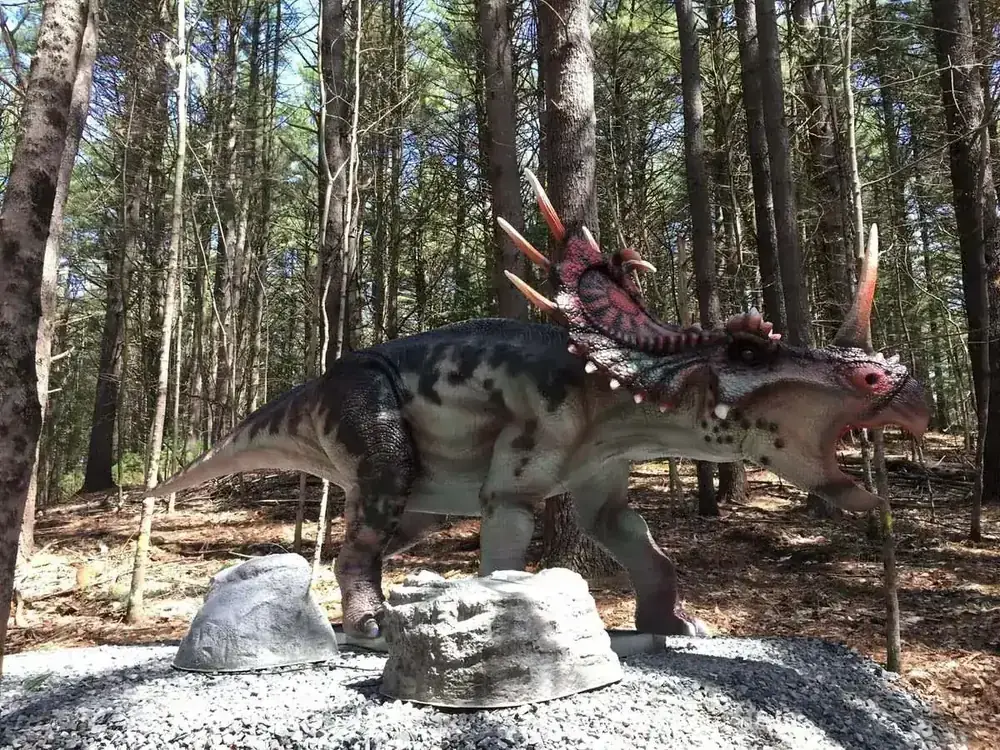
A ceratopsian head is a large proportion of the animal, and on a 5-metre build it sits at the end of a neck that has to carry it through a head turn. That is the structural question on this animal: not the body, the neck joint.
The head turn is therefore limited and slow. A wide, fast turn on a heavy head reads as a mechanism and puts load on the joint every cycle. What works is a short turn, a jaw that opens on a slow cycle, and a neck that rises and settles.
The frill and its spikes come off for transport and are refitted on site. The spikes are moulded with the frill rather than fixed on individually, which means there is no root joint to open — but it also means the frill is a single large piece that needs its own crate.
On site the frill is one of the last parts to go on, after the neck is run through its range. Fitting the frill first and then discovering the neck needs adjustment is the mistake that costs a day.
Five metres is museum-hall scale and small-park scale at the same time. In a hall it sits as a single specimen with the frill lit from the side. Outdoors it works on a trail with the animal seen at three-quarters rather than head-on — head-on, the frill hides the horn and the animal loses its identity.
If the site is outdoor and the animal is far from power, the 24 V solar configuration is worth pricing. On a 5-metre build with a moderate motion set, solar is genuinely practical.
Is it a Triceratops? No. One nasal horn and six frill spikes. The two are different sculpts, not colour variants.
Can the frill be widened? No — widening it makes it a different species. If you need a wide frill, that is the Triceratops.
How long is assembly? One to two days with a small crew, most of it the neck and frill.
Does it need a foundation? A hard standing with anchors. It is not a heavy animal for its size, but a 5-metre body on soil will settle.
110–240 V AC at the animal, with the usual drainage detail at the base. Indoors, the constraint is ceiling height at the frill — the animal is 5 metres long but the frill is the tallest point, and it is the number to check against the ceiling services.
Outdoors, place it so the frill is not backlit for most of the day. A frill in silhouette loses the spikes, and the spikes are the reason to buy this animal.
The neck is run through its full range before the frill goes on, then the frill is fitted and the head turn is set to a short, slow arc. The jaw cycle is slowed to match.
The setting worth taking time over is the head turn amplitude. Too wide and the animal looks like it is scanning for something; a short turn with a pause reads as an animal looking at the visitor.
Materials. Hot-dip galvanised weathering steel frame, high-density hand-finished skin, frill and spikes moulded as one piece.
Related. the animatronic dinosaur range, the Triceratops, museum exhibit layout, request a quote.
Same factory and the same build standard. What changes is size, movement set and how the exhibit is meant to be used on site.
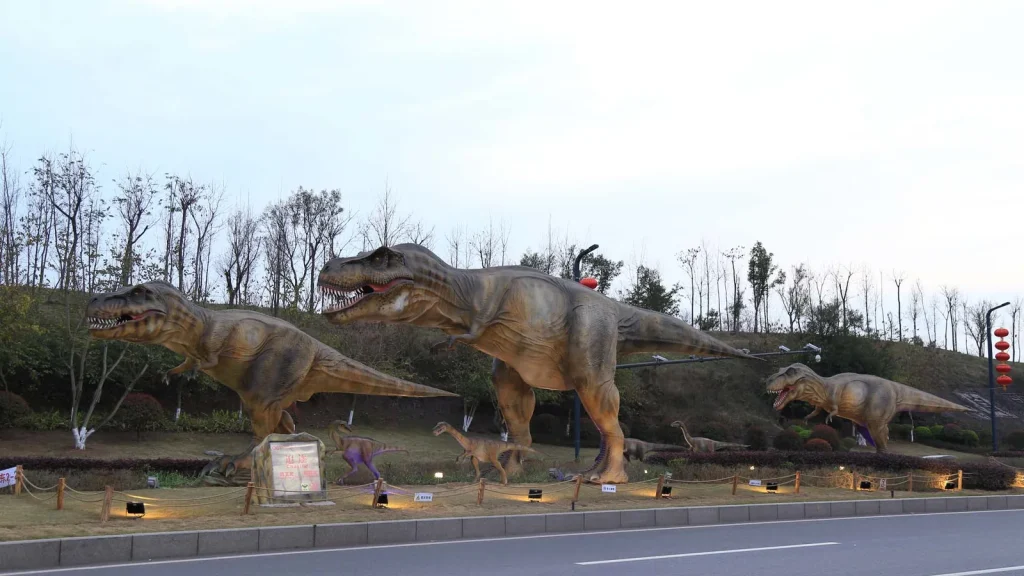
A life-size animatronic T-Rex built to your dimensions — 4–12 m body length, six to twelve motion axes, sensor or remote control.
View Product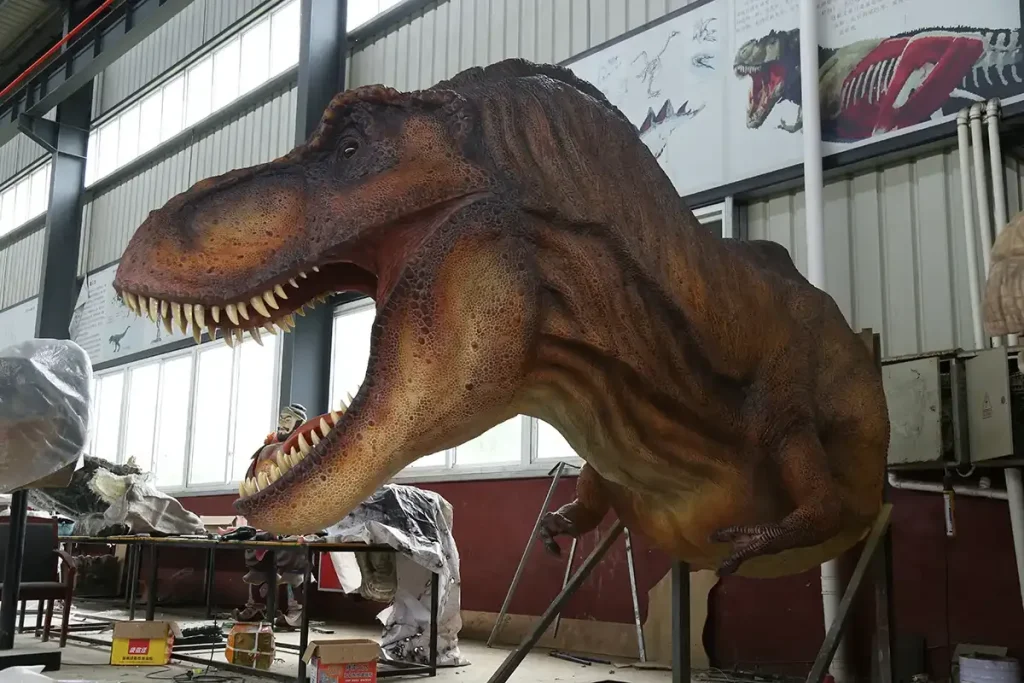
Gesture-responsive T-Rex that reads hand movement and approach speed — every visitor gets a different reaction. Indoor or outdoor, built to order.
View Product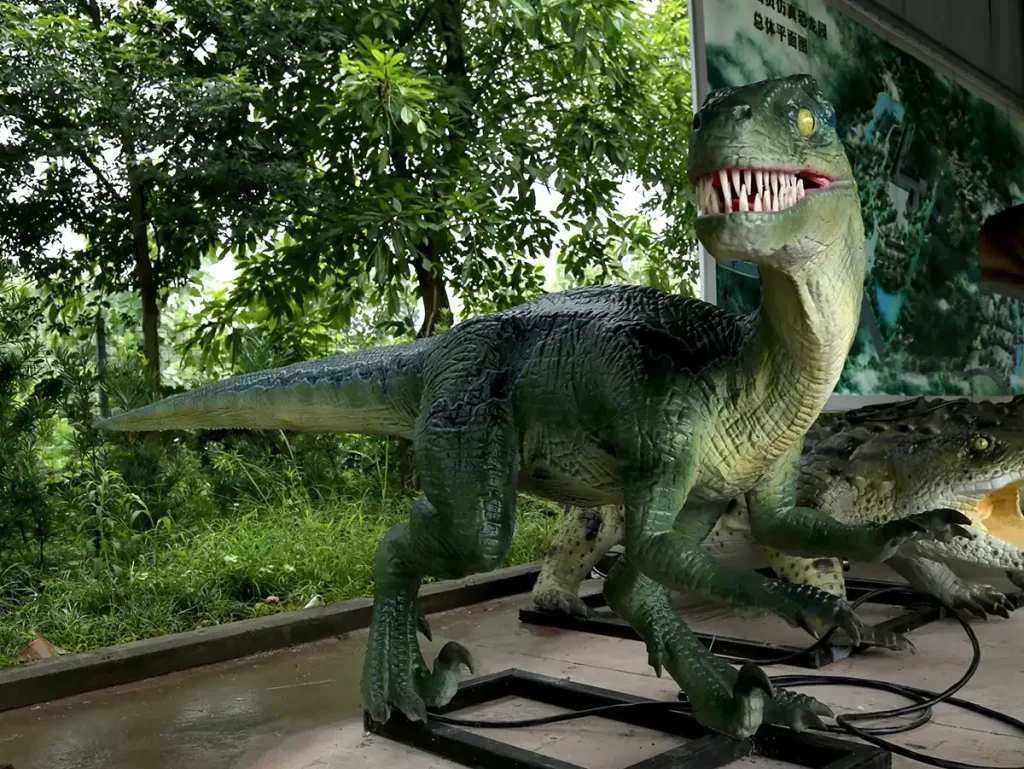
A velociraptor is read from the feet up. The sickle claw on the second toe, the stiff counterbalancing tail, the forward-leaning line from hip […]
View ProductThree things buyers usually want settled before they ask for a drawing — what drives the number, how the piece is actually built, and what to check between suppliers.
Animatronic Dinosaur Buying Guide for Museums & Theme Parks Choosing the right animatronic dinosaur for your museum, theme park, or zoo is one of […]
Read the guide →From fossil reference to finished skin — how proportions, texture, colour and weathering are decided, and what separates a realistic build from a cartoon one.
Read the guide →Why Motor Choice Matters More Than Buyers Expect Motor selection is usually treated as a manufacturing detail. It is not. It is the decision […]
Read the guide →Send your dimensions, movement requirements and installation site. You get a realistic budget range and a dated build schedule.
Or email info@hltdino.com — we reply within one business day.