Animatronic Animals
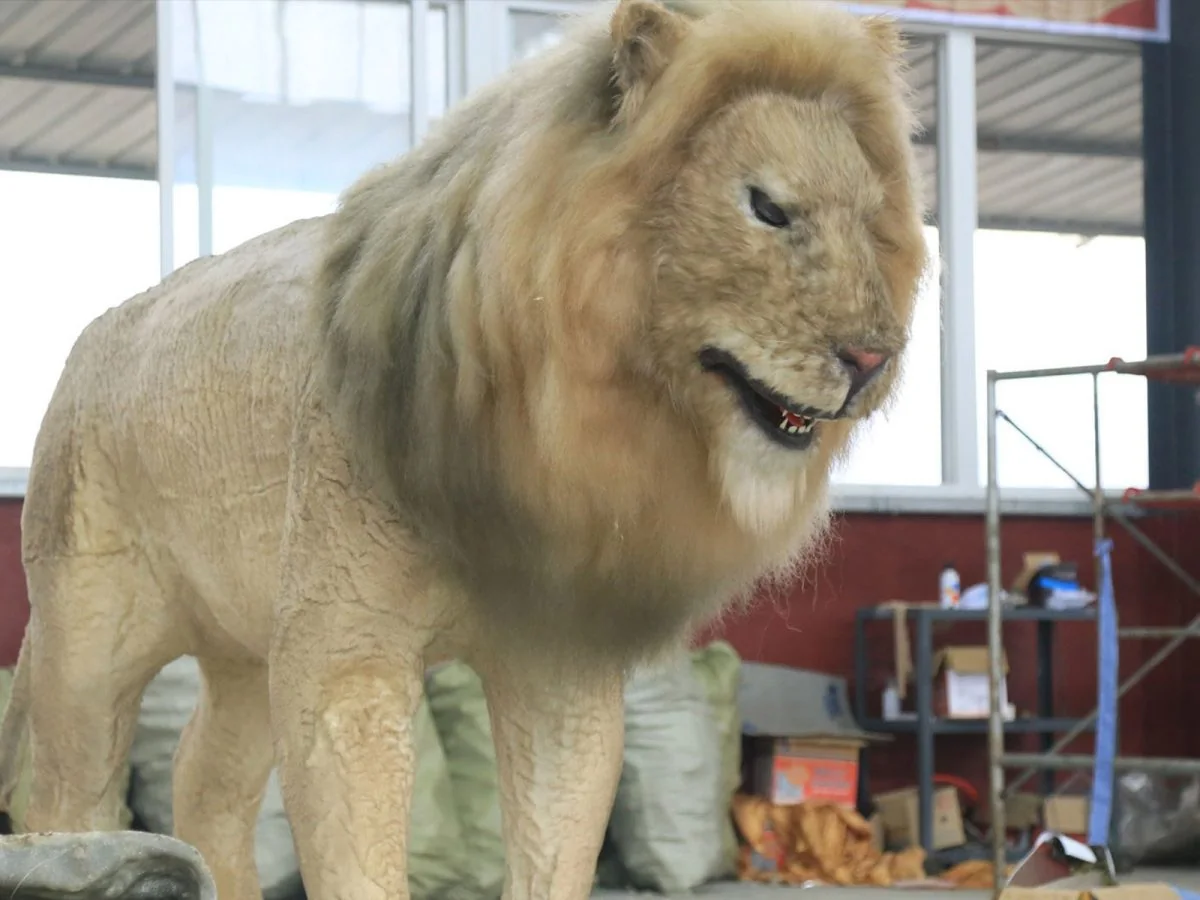
A lion is the easiest animal in the catalogue to get wrong. Everyone knows what a lion looks like, and the failure mode is specific: it comes out looking like a mascot. The difference between a lion and a mascot is almost entirely in the head — eye depth, brow, and how the mane sits around the face.
| Size | Life size — about 2.6 m nose to tail, 1.2 m at the shoulder |
|---|---|
| Frame | Hot-dip galvanised weathering steel |
| Surface | High-density hand-finished skin with weatherproof finish |
| Power | 110–240 V AC, 50/60 Hz |
| Solar option | 24 V DC solar-compatible configuration available |
| Motion | Head turn, jaw, breathing and tail sets; levels specified at order |
| Duty | Outdoor standard, indoor on request |
| Size options | Custom sizes on the same frame design |
Three things separate a realistic lion from a mascot. Eyes set slightly deep under a heavy brow, so there is a shadow line above them. A mane that sits behind the face rather than framing it like a collar. And a muzzle that is narrow at the nose rather than rounded.
All three are sculpting decisions made before production, and none of them can be fixed with paint. When we quote a lion we send the head sculpt for approval first, because approving the body and then discovering the face is wrong is how these projects go badly.
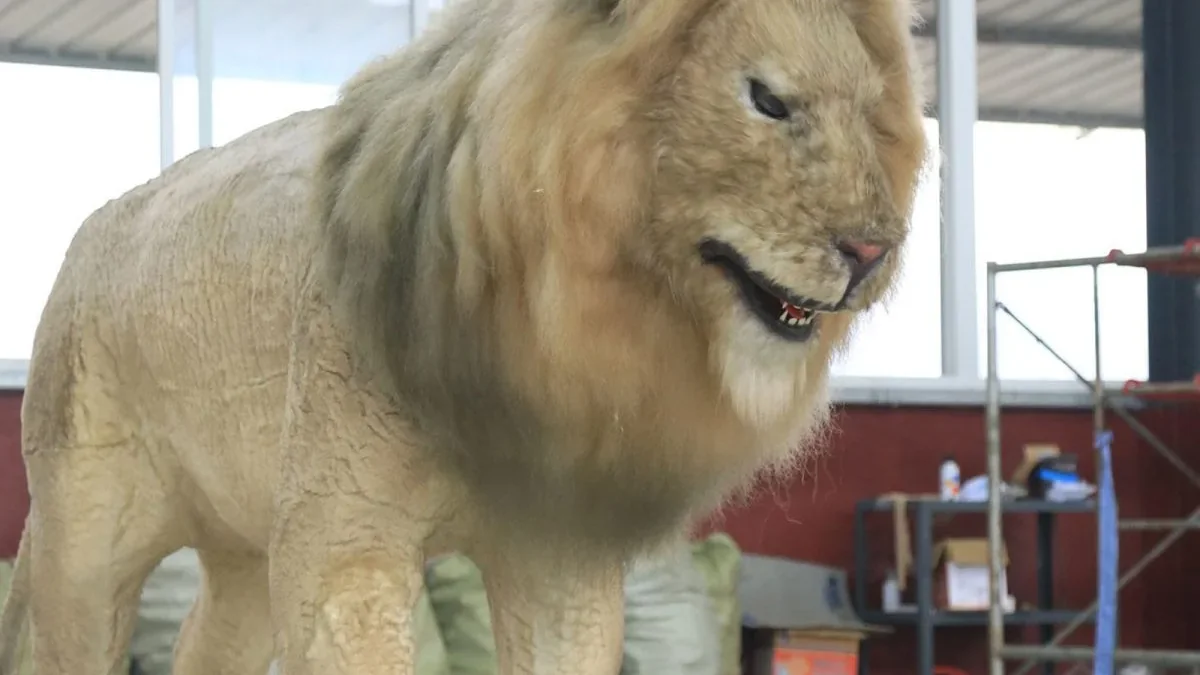
Hot-dip galvanising rather than a painted frame, because a zoo lion spends its life outdoors and the inside of a frame is where corrosion starts. The surface is high-density hand-finished skin with a weatherproof finish on top.
Outdoor also means the mane has to drain. A sculpted mane that holds water grows a film in the folds and looks dirty within a season, so the build is detailed so water runs off rather than sitting in the deepest part of the mane.
A 24 V DC solar configuration is available and it is genuinely useful for a trail animal far from a power point. It is not a universal answer: the panel has to face something, the battery has to live somewhere concealed, and a shaded position under trees will not keep up.
Ask for solar when the animal is going into an open site with a long cable run. Ask for mains when there is power within thirty metres — the solar kit costs more than the cable, and it adds two components that can fail.
Is it a male or female lion? Male with mane is the standard build. A female is a different sculpt and is usually ordered as a pair.
Can it roar? Yes, with audio fitted. On an outdoor exhibit the roar carries further than expected — check the nearest boundary before setting the volume.
Does it need an operator? No. It runs on a cycle or a sensor, unattended.
Can it be posed lying down? Yes, and for a zoo trail the lying pose is often the better choice: it reads as a resting animal rather than a statue of one.
Mains at the animal position, or the solar configuration if the site has no supply. The base needs a hard standing rather than direct ground contact, and the position needs to be out of standing water — the same rule as any outdoor piece, and the one most often skipped on smaller animals because they look light enough to sit anywhere.
If the lion is going into an enclosure-adjacent position, check the viewing distance. A life-size lion at three metres reads as a model; at eight metres it reads as an animal, and the difference is entirely about distance.
Commissioning is short. The motion level is set, the cycle timing is set, and where audio is fitted the volume is set against the nearest boundary rather than against the animal.
The one setting worth taking time over is the idle behaviour. A lion that only moves when triggered looks dead between visitors; a lion with a slow breathing idle and an occasional head turn looks alive whether anyone is there or not. That idle is a programme setting and it is what most separates a good install from an average one.
Materials. Hot-dip galvanised weathering steel frame, high-density hand-finished skin with weatherproof finish, optional 24 V solar configuration.
Related. the animatronic animal range, the zebra display, zoo installations, request a quote.
Same factory and the same build standard. What changes is size, movement set and how the exhibit is meant to be used on site.
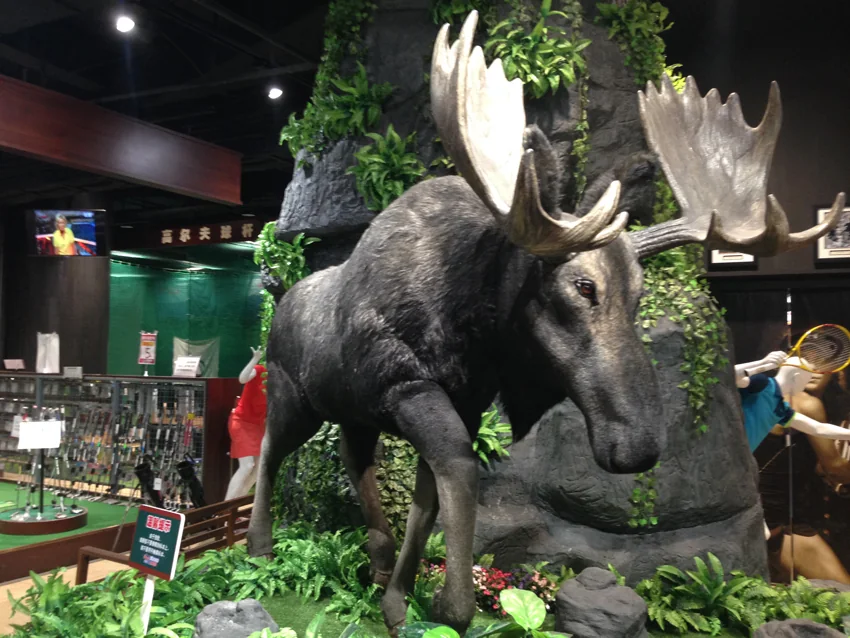
A moose is recognised by three things and nothing else: the palmate antlers, the hanging dewlap under the throat, and the shoulder hump that […]
View Product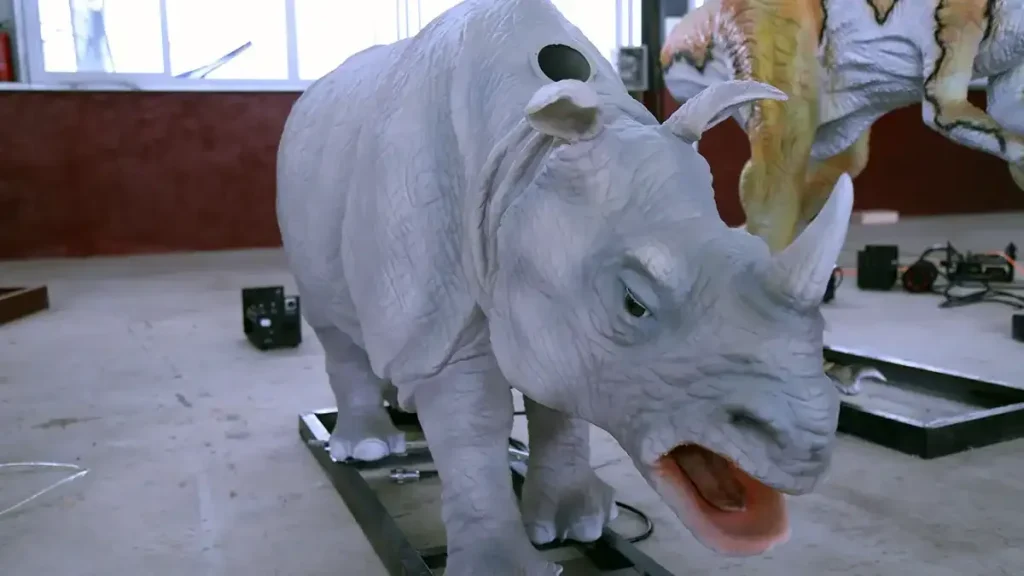
Animatronic white rhino built for year-round outdoor display — mouth and vocal system, head raise, concrete base for loose ground or grass.
View Product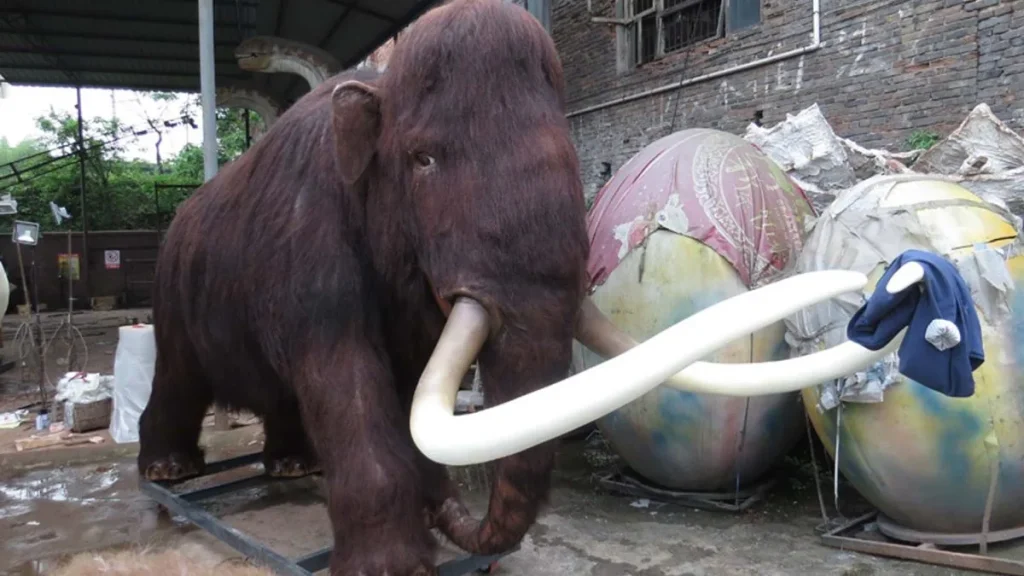
Life-size animatronic woolly mammoth — 4 m at the shoulder, 3 m tusks, articulating trunk and proximity triggers for Ice Age halls.
View ProductThree things buyers usually want settled before they ask for a drawing — what drives the number, how the piece is actually built, and what to check between suppliers.
Extinct and hard-to-keep species, sculpted to anatomy keepers can check — where animatronic animals earn a place beside a living collection.
Read the guide →From fossil reference to finished skin — how proportions, texture, colour and weathering are decided, and what separates a realistic build from a cartoon one.
Read the guide →How Much Does an Animatronic Dinosaur Cost? Understanding the Key Cost Factors If you are planning a museum exhibition, theme park attraction, or promotional […]
Read the guide →Send your dimensions, movement requirements and installation site. You get a realistic budget range and a dated build schedule.
Or email info@hltdino.com — we reply within one business day.