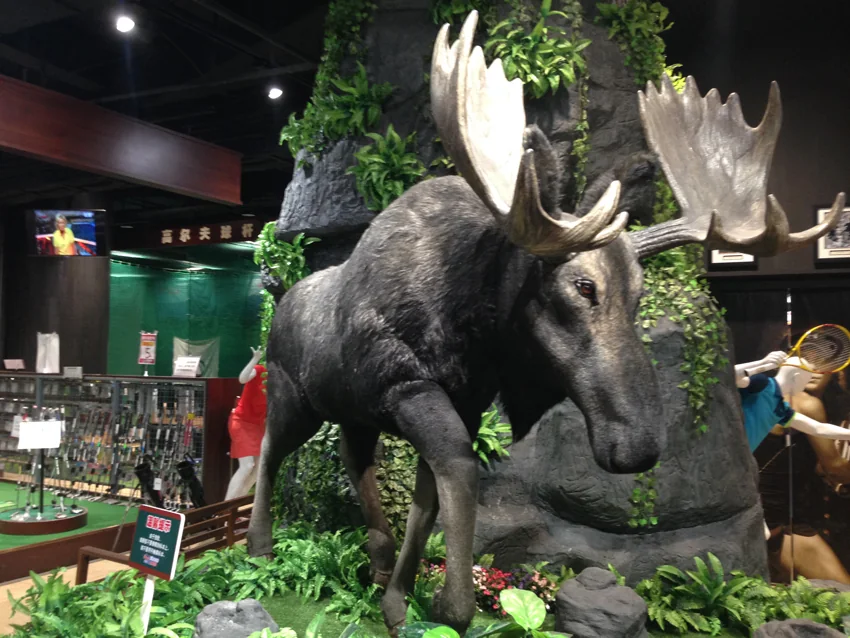
Animatronic Animals
A moose is recognised by three things and nothing else: the palmate antlers, the hanging dewlap under the throat, and the shoulder hump that puts the head lower than the back. Get all three right and the animal is unmistakable at a hundred metres. Get the antlers wrong — thin, branched, deer-like — and it reads as an oversized elk no matter how good the skin is.
This is a life-size bull moose at 2.6–3 m at the antler tips, built for nature parks, zoos, wildlife museums and lodge entrances. The movement set is deliberately small: head turn, ear flick, jaw and a slow breathing cycle.
| Species | Alces alces — bull moose, mature |
| Era | Modern, extant species |
| Type | Full animatronic, motion and sound, outdoor-rated |
| Size | 2.6–3.0 m at the antler tips, 2.4–2.7 m long; custom available |
| Material | Welded steel frame, high-density foam core, patented silicone skin (ZL 2022 1 0224489.5); antlers in reinforced composite |
| Surface | Hand-painted UV-resistant pigment, layered coat tone, sealed against wetting |
| Animation | Head turn and tilt, ear flick, jaw open and close, breathing |
| Sound | Bull moose call and breathing, motion-triggered, volume adjustable |
| Power | 110/220 V AC, sealed outdoor control box at the base |
| Installation | Ground anchors supplied, 2 technicians, half a day; antlers fitted on site |
| Customisation | Antler spread, pose, coat tone, movement set, sound library, base style |
| Support | 12-month warranty; antlers ship separately crated and are field-replaceable |
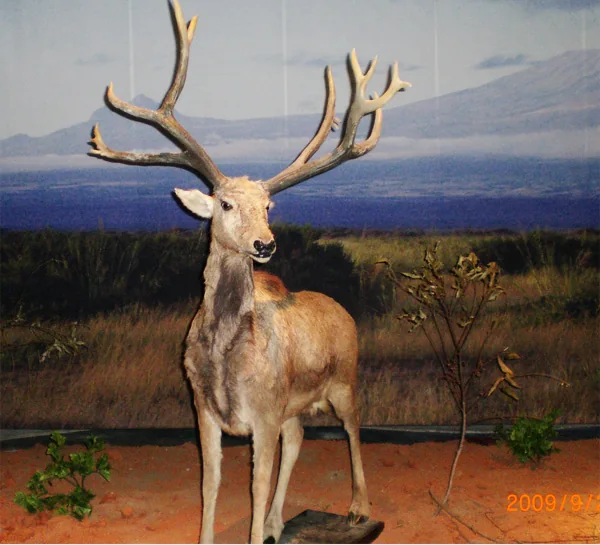
A mature bull’s antler spread is close to 1.5 m across, and it is the most fragile part of the build. Shipping them attached means shipping a lever arm that will take any impact in transit straight into the skull.
They are moulded in reinforced composite rather than foam, mounted on steel spigots, and fitted on site with the head supported. That also makes them replaceable — a cracked palm is a parts order rather than a rebuild, which matters on a piece sited where visitors can reach it.
Most animatronic deer family builds share a body plan and change the head. A moose cannot be built that way, because the silhouette is defined by a shoulder hump that sits above the neck line and a head that hangs forward of it. The frame has to carry a raised shoulder block, and the neck leaves the body low and forward rather than high and vertical.
That shape also changes the balance. With the head forward of the shoulder and the antlers high, the centre of mass sits further forward than on a deer of the same weight, so the base plate and the anchor layout are sized for a forward-leaning load rather than a symmetric one.
Four axes — head turn, head tilt, ear flick, jaw — plus a breathing cycle. No walking, no rearing, no trunk or tail theatrics. A moose standing in vegetation is a still animal, and a piece that moves a lot stops reading as a moose and starts reading as a robot.
The movement that matters most is the ear flick. It is small, fast, and it is what makes a still animal look alert rather than switched off. Head turn carries the interaction at distance; the ear flick is what visitors notice when they are close.
It suits a position with vegetation behind it, at the edge of a path rather than in the middle of one. A moose among birch or conifer reads as an encounter; the same piece on open paving reads as a statue of a moose.
It also works at lodge and visitor-centre entrances where the animal is a regional reference rather than part of a dinosaur or safari theme. There it functions as a marker — something to meet under — and the interactive movement is what stops it being furniture.
Yes. A smaller spread is available, and a cow moose build without antlers is the same body with different sculpting. Where the piece sits where visitors can climb, the antler-free version removes the obvious handhold.
The frame and antlers are built for accumulation on the horizontal surfaces. Where the site expects heavy sustained snow, tell us at order — the antler palms are then specified thicker, since the palm is the surface that collects.
Yes, and it usually should be. A moose alone reads as one animal; a moose with a calf, or with a bear at a distance, reads as a habitat. The calf is a smaller build on the same design.
Yes — from near-black through the grey-brown of a mature bull. The tone is chosen against the vegetation behind the position, because a dark moose against dark conifer loses its silhouette.
Same factory and the same build standard. What changes is size, movement set and how the exhibit is meant to be used on site.
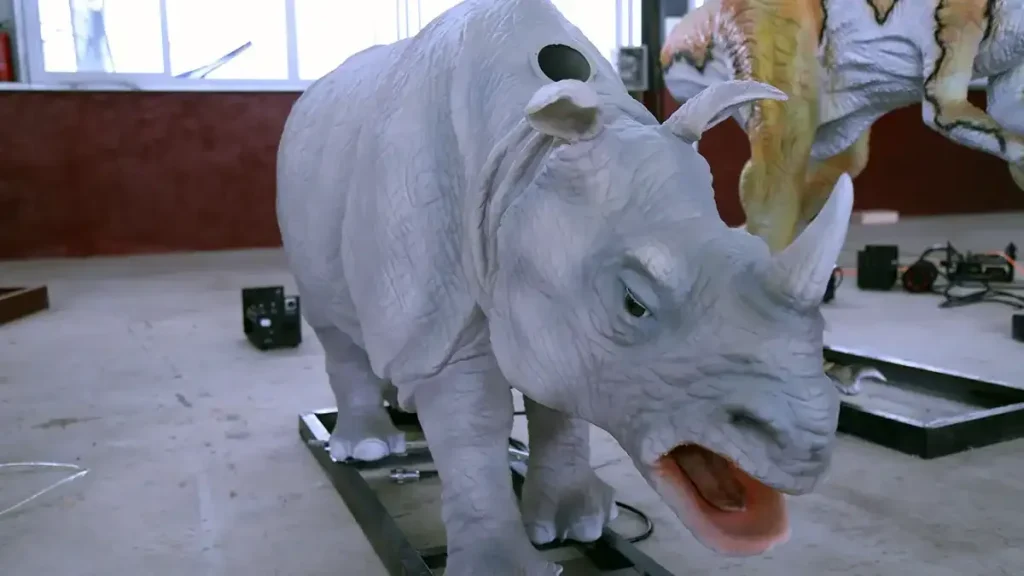
Animatronic white rhino built for year-round outdoor display — mouth and vocal system, head raise, concrete base for loose ground or grass.
View Product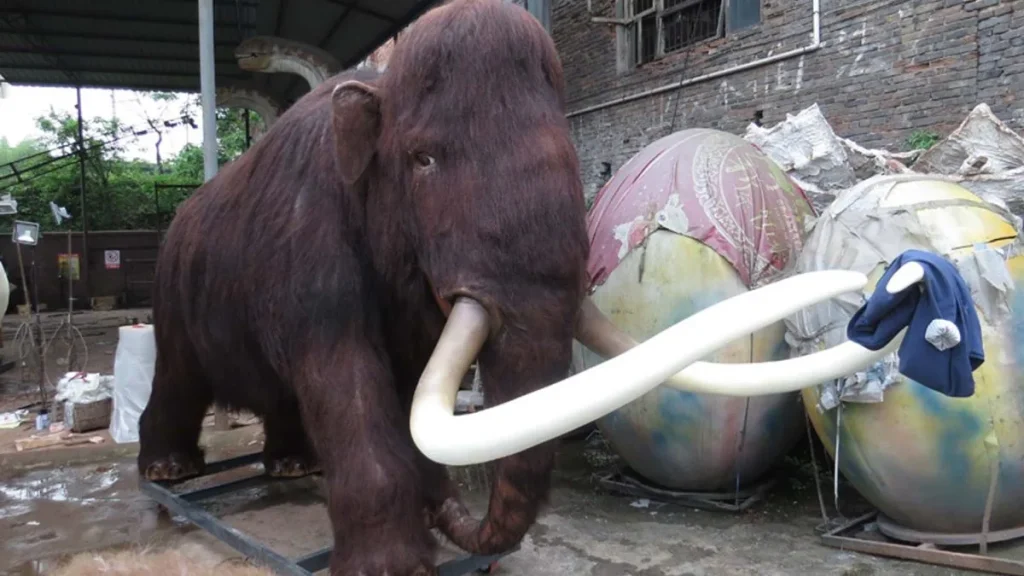
Life-size animatronic woolly mammoth — 4 m at the shoulder, 3 m tusks, articulating trunk and proximity triggers for Ice Age halls.
View Product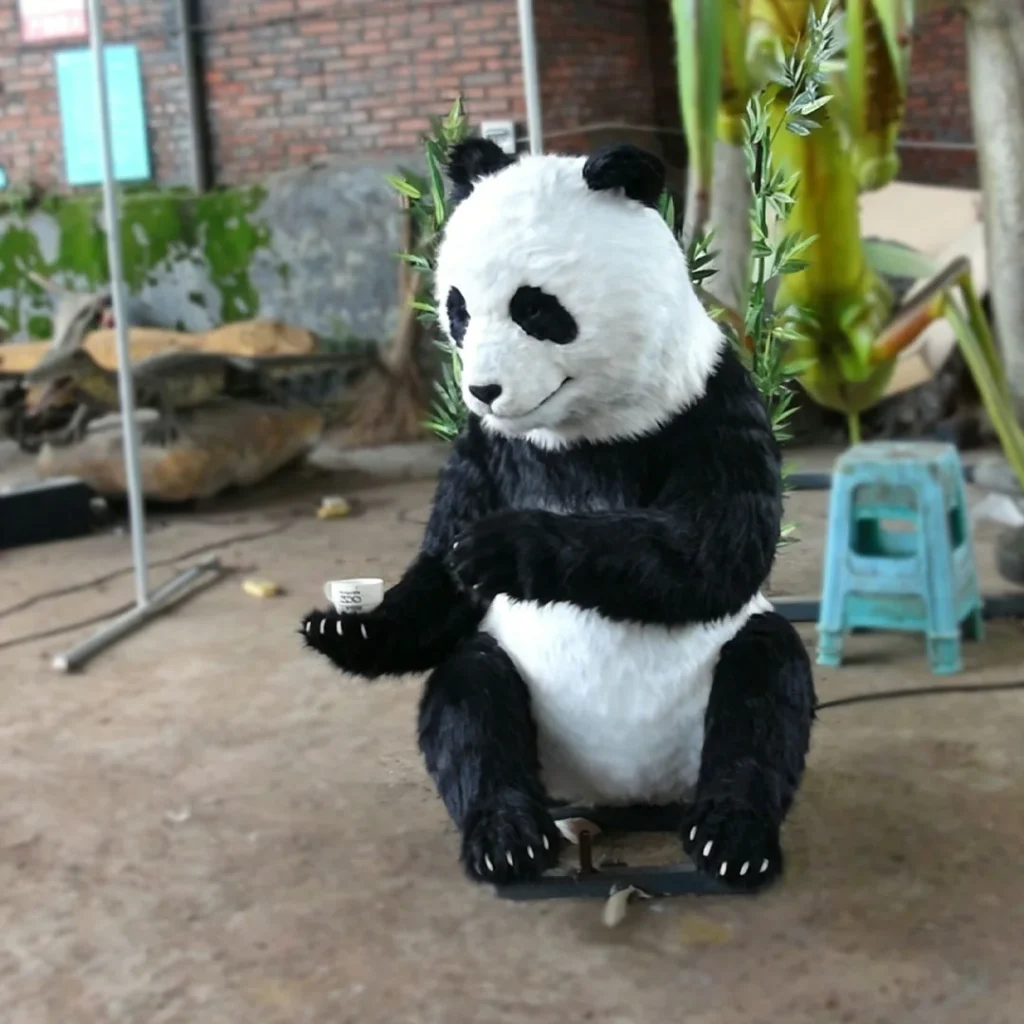
A panda is the most photographed animal in the catalogue and the one where a small error is most visible. Everyone has seen a […]
View ProductThree things buyers usually want settled before they ask for a drawing — what drives the number, how the piece is actually built, and what to check between suppliers.
Extinct and hard-to-keep species, sculpted to anatomy keepers can check — where animatronic animals earn a place beside a living collection.
Read the guide →From fossil reference to finished skin — how proportions, texture, colour and weathering are decided, and what separates a realistic build from a cartoon one.
Read the guide →How Much Does an Animatronic Dinosaur Cost? Understanding the Key Cost Factors If you are planning a museum exhibition, theme park attraction, or promotional […]
Read the guide →Send your dimensions, movement requirements and installation site. You get a realistic budget range and a dated build schedule.
Or email info@hltdino.com — we reply within one business day.