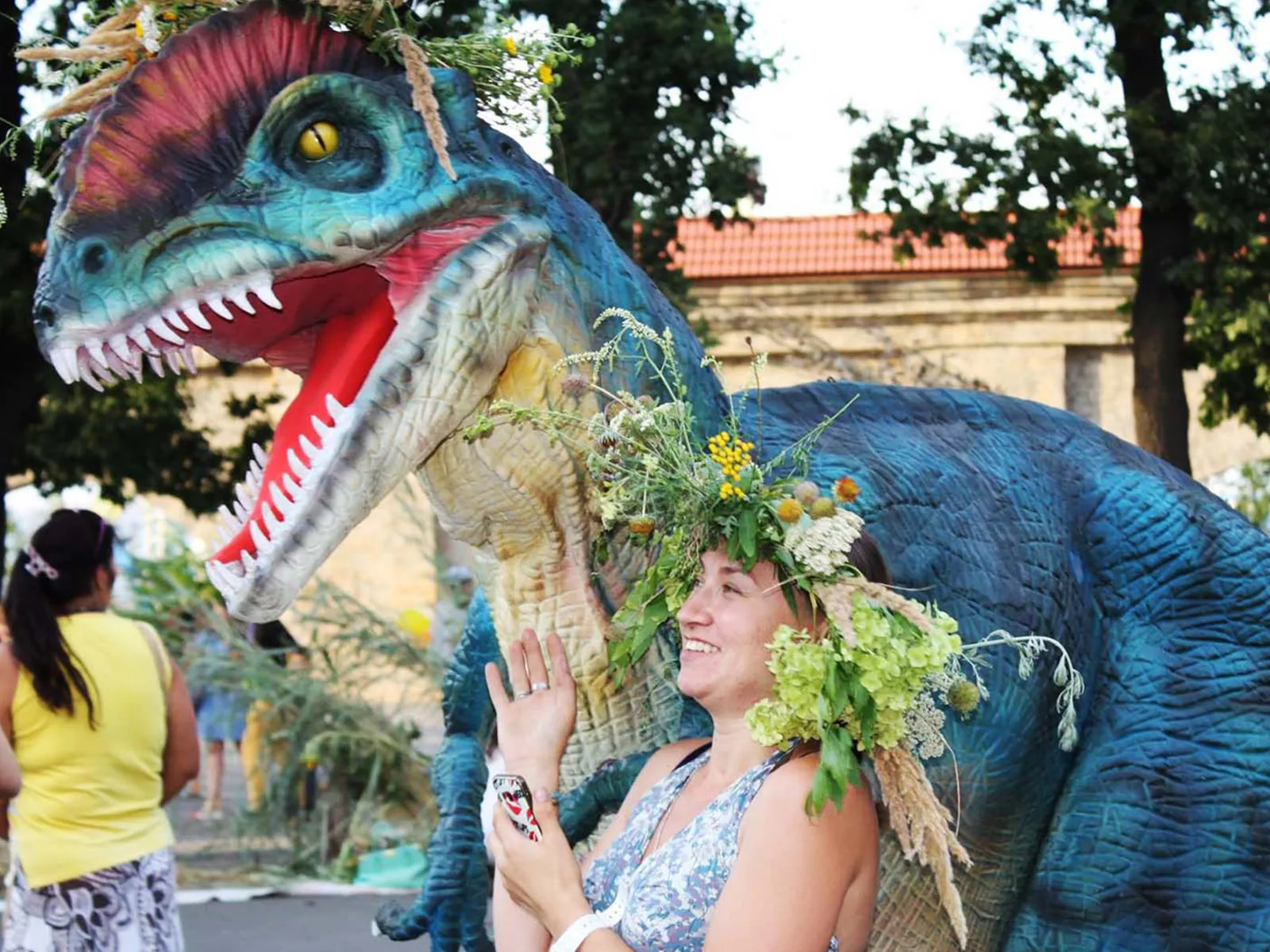
A walking dinosaur costume is not clothing. It is a wearable machine with a person inside it, and the two numbers that decide whether it works are weight and vision. Get those wrong and the suit photographs beautifully and fails on the second booking — the performer comes out dizzy, or clips a child in a crowd, or refuses to wear it again. Everything else on this page follows from those two constraints.
The Word Means Two Different Things
Search this term and you get a wall of Halloween product. That is a different trade: a polyester shell worn once, priced by the evening, judged on how it looks in a photo. The equipment on this page is bought by shopping centres, parade organisers, theme parks, film units and schools, and it has to survive a hundred outings with the same performer going back inside it.
The spec sheet is where the two part company. A consumer suit lists size and colour. A working walking dinosaur costume lists total weight, where that weight sits on the body, how long the wearer can stay in it, and whether the head is carried by a frame or by the neck. If a listing does not answer those four, it is the other kind of product, whatever the photos look like.
We build for the second category only. Which means the useful question is not “how realistic is it” but “who is going to be inside this thing at 4 pm on a Saturday, and can they still see”.
Two Weights, Two Different Jobs
Our range has two wearable builds and they are not interchangeable. Picking between them is the first real decision in a dinosaur costume for events, and it is usually settled by the booking calendar rather than by preference. Agencies describe the light one as a walking dinosaur suit and the heavy one as an animatronic; the naming is inconsistent across the trade, so go by the weight column rather than by the label.
| Walking build | Animatronic build | |
|---|---|---|
| All-up weight | Under 12 kg | 15–20 kg |
| Structure | EVA foam core on a hollow frame | High-density foam, composite silicone, faux hide over a stainless frame |
| Head | Carried on the frame, not on the wearer’s neck | Frame-mounted, articulated |
| Movement | Walk and body sway | Eye blink, jaw with roar, head turn, neck, tail sway, walk, run |
| Power | 12 V lithium, two packs supplied | Rechargeable lithium, 4–6 h per pack, up to 12 h on the large pack |
| Fits | One performer, 1.65–1.80 m standard | One performer, built to measurements |
| Best for | Walking routes, meet-and-greet, roving entertainment | Stage sets, fixed-position appearances, openings, film |
A realistic walking dinosaur costume under 12 kg is the one that gets booked repeatedly, because a performer can wear it for a two-hour window and still be useful afterwards. The animatronic dinosaur costume at 15–20 kg does more — the jaw roars, the tail moves, the eyes blink — but it buys that movement with mass, and mass is the thing that ends a shift early.
When buyers ask which is more convincing, the honest answer is that a moving jaw reads better on video and a walking suit reads better in a corridor. Film units take the heavy one. Shopping centres take the light one. Get that match wrong in either direction and the equipment gets blamed for a programming decision.
Where the Weight Sits Matters More Than the Total
Twelve kilos carried on the shoulders for two hours is a different experience from twelve kilos balanced between shoulders and hips with the head on a frame. The number on the spec sheet is the least useful part of this; the geometry is the part that decides whether the actor can do a third set.
Two design choices do most of the work on our animatronic dinosaur suit builds. The first is that the head rides on the frame, not on the wearer’s neck. A head that hangs from a helmet collar puts several kilos on the cervical spine and the performer compensates by hunching, which flattens the silhouette and makes the walk read as a person in a suit within thirty seconds.
The second is a hip belt that takes a real share of the load. It is not a costume accessory. On the heavier animated builds the waist harness is load-bearing, and if a supplier ships a suit where the whole assembly hangs from the shoulders, every performance after the first one will look tired.
Vision: The Spec Nobody Prints
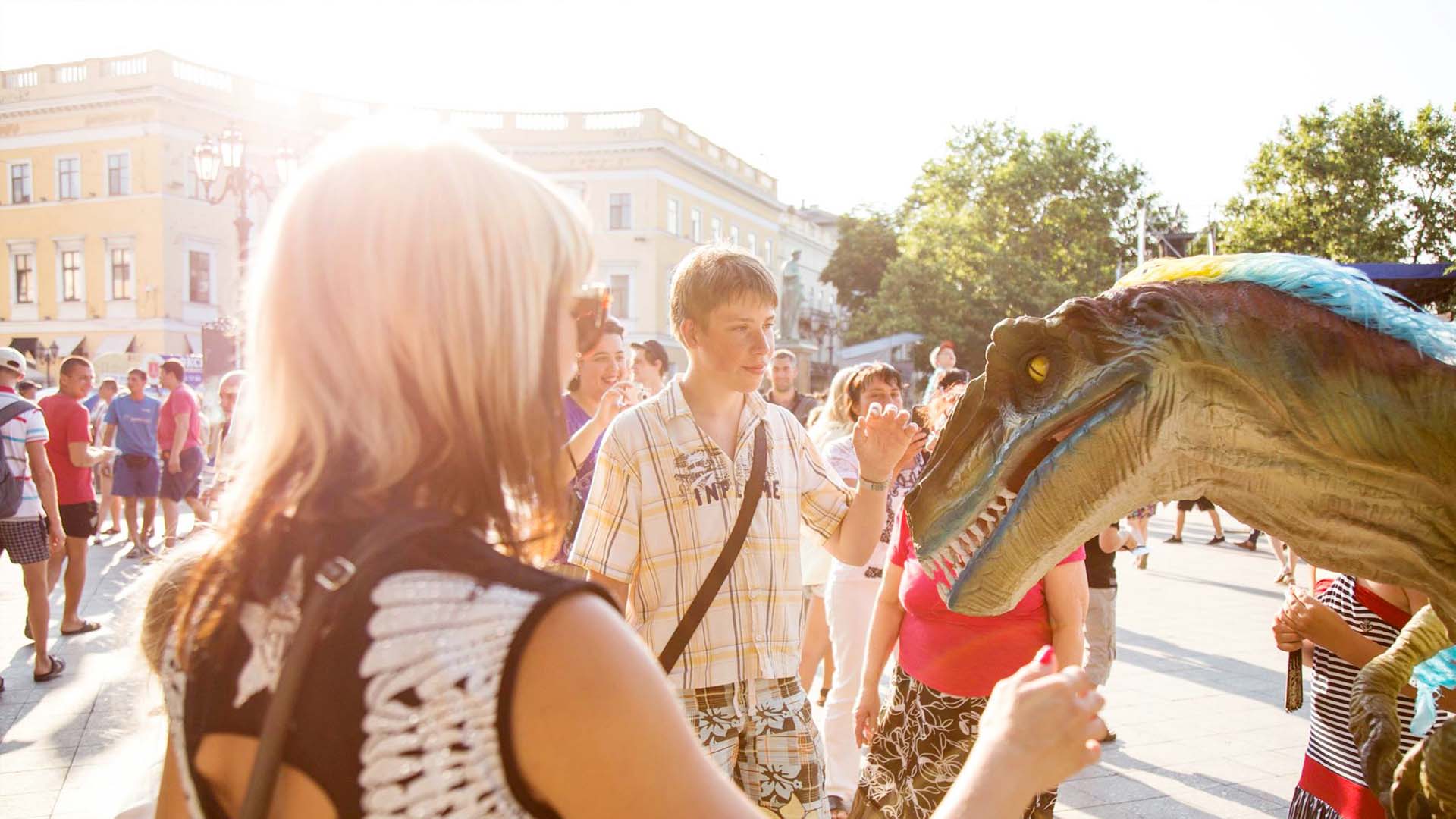
Look for the vision line on any supplier’s sheet. If it is missing, that tells you something. A performer who cannot see their feet will stand still, and a dinosaur that stands still is a statue with a person in it.
Our walking build uses mesh-covered eye openings in the head, positioned to give wide-angle visibility rather than two keyholes. The mesh is a compromise — it cuts some light and softens detail — but it is the only way to keep the eyes reading as eyes from outside while the wearer can see the floor and the edge of a crowd. Some cheap suits solve the visibility problem with a mouth-level grille and no eye openings at all. From the audience that looks like a dead animal, because the eyes never catch the light.
Two practical consequences. First, a handler is not optional in a crowded space. Even with good vision the field of view is narrower than human normal, and children move unpredictably at exactly waist height, which is where the suit’s blind spot sits. Second, rehearse the route. The single most common incident in this trade is a performer stepping on a low kerb or a cable ramp that they could not see through the mesh.
Heat: Forty-Five Minutes Is the Honest Number
Nobody buys a suit on ventilation and everybody regrets it. Enclosed foam over a moving body in a shopping centre atrium is a heat problem before it is anything else, and it sets the real length of a set.
The walking build runs a micro-fan with a filtered intake at the dorsal line, which pushes air through the shell rather than just stirring it inside the head. That is enough for roughly forty-five minutes of continuous wear in a climate-controlled mall, less outdoors in sun. We plan bookings around that: two or three sets with a break between them, not one long appearance. A performer who is overheating stops performing long before they stop walking, and the audience reads it as the suit being lifeless.
What actually helps, in order of effect: a shaded holding area within sight of the set position, cold water and a chair at the end point of the route, a second performer who can take over at the forty-minute mark, and a suit that can be opened at the back without a full dismantle. The fan matters. The break matters more.
Power, Sound and the Moving Parts
The animated build runs on a 12 V rechargeable lithium pack. On the standard pack that is four to six hours of intermittent movement; the large pack takes it to twelve, which is what you want if the suit is doing a full-day mall programme with breaks rather than a single stage set.
Two packs ship with the walking build as standard, and the second one is not a spare in the sense of gathering dust. It is the swap that keeps a booking on schedule. Charging happens at the holding area, not at the performance position, and a charging lead run across a public floor is a trip hazard that will be removed by venue staff halfway through your set.
Sound is a chest-cavity speaker with the roar on a switch and the volume on a control the performer can reach. Keep the volume lower than feels right in rehearsal. A roar at close range makes small children cry, and a crying child empties the surrounding three metres faster than any monster effect. The movement set covers eye blink, jaw with roar, head turn, neck and tail sway, walk and run; the optional extras are smoke and water spray, which are worth having for a stage show and a liability in a shopping centre with a polished floor.
Giant Suits: When One Performer Isn’t Enough
A giant dinosaur costume starts at a different scale of problem. Above roughly 3 m the wearer is no longer driving the animal from inside the head; they are walking the legs with a handler at the front calling direction, or two people are inside a frame where only one has forward vision. That changes what the equipment is for — a giant dinosaur suit is a route product, not a meet-and-greet product.
A giant build works in a controlled route — a parade with a marshalled line, a stage with a defined footprint, a fenced arena. It does not work for meet-and-greet in an open atrium, because the one thing it cannot do is react to a child who has run behind it. If your programme is photos and interaction, a giant t rex costume is the wrong purchase no matter how good it looks on the website. Buy the walking build and put it on a plinth between sets.
The same applies to mechanical dinosaur costume and dinosaur robot costume builds, where part of the structure is exposed and the drive is mounted rather than worn. A mechanical raptor costume is the version most often booked for a launch — the exposed actuator leg reads as engineering rather than costume, which is the point — and it is also the version that needs an operator standing off to the side. These photograph extremely well for a campaign and are much harder to run for a full day. They are usually hired for a launch rather than owned.
Species and Custom Work
Standard tooling covers T-Rex, Velociraptor, Triceratops and Stegosaurus, plus other species on request. The choice is not purely aesthetic — body shape decides how much room the performer has.
An animatronic raptor costume is the most requested after T-Rex and the easiest to wear, because the low, forward-leaning profile puts the wearer’s head where the animal’s chest is, giving the best sightline in the range. An animatronic velociraptor costume reads as fast even when standing still, which makes it the better choice for a roving booking with limited space.
Size is the other variable, and it is where buyers most often overreach. A life size dinosaur costume at full two-metre height — the life size t rex costume being the standard example — has the most presence and the worst balance: the centre of mass sits high and the tail needs to be long enough to look right without dragging on the floor. A full size dinosaur costume of a smaller species buys back the sightline and the balance without reading as a scaled-down toy, and for most mall programmes that is the better trade.
Custom work is mostly about proportions rather than new species. Performer height is the input that matters — the standard build fits 1.65–1.80 m and is adjusted to measurements outside that. Below 1.60 m the head-to-body ratio starts to read as juvenile, which is fine if you want a juvenile and wrong if you are selling a predator.
Getting It There
Transport is the part of the purchase that decides how often the equipment gets used, and it is almost never discussed at quotation stage.
A walking build collapses into a soft transit bag that fits a hatchback with the seats down. An animated build goes into a rigid case because the jaw and the tail cannot take a stack of other equipment on top of them. A giant build is a van. If your booking pattern is three venues a week in a city, that difference decides which suit you can actually deploy, and the cheaper purchase becomes the more expensive one.
Allow twenty minutes for a single performer to get in with a second person assisting, and forty-five for the animated build with power and sound checks. That time comes out of the booking window, not before it, so a two-hour appearance is really ninety minutes of performing.
Care, Repair and the Parts That Wear
The liner is the first thing to fail, and it fails invisibly until it smells. Removable, washable liners are worth insisting on. A suit with a bonded liner has a working life measured in dozens of outings rather than hundreds.
After that, in order of wear: the jaw hinge, the neck joint, the tail root, and the skin around the ankles where the wearer’s own boots scuff it. Hand-carved skin texture and individually painted teeth mean repairs are cosmetic work rather than part replacement, which is why a repair kit with matching pigment belongs in the case from day one.
The electronics are the part buyers worry about and the part that fails least. Packs, switches and speaker wiring are simple compared with the mechanical joints, and they are also the easiest to swap if you keep one spare of each.
Puppets: The End Nobody Asks About
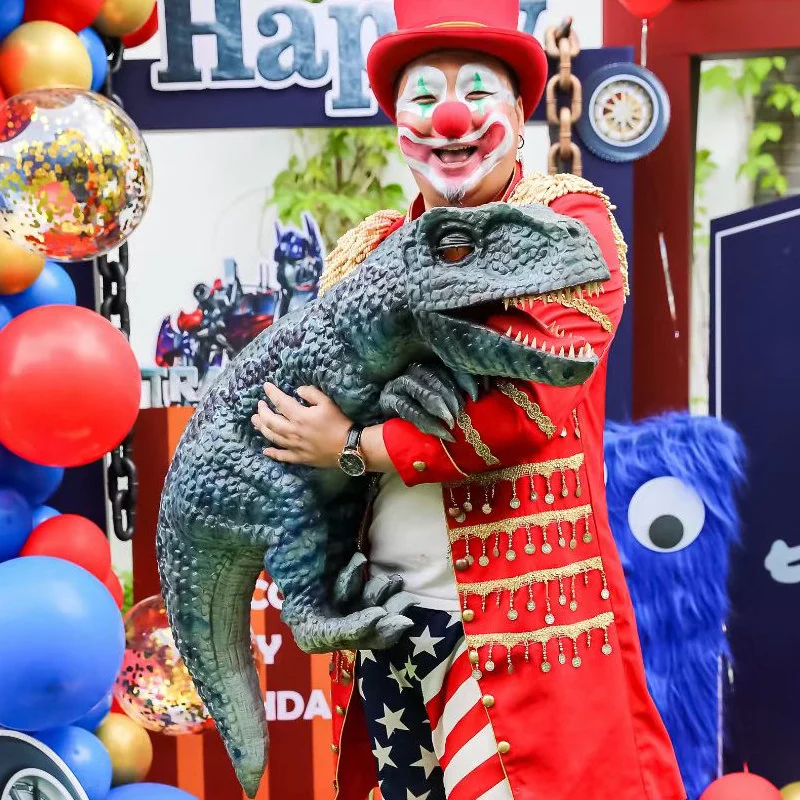
Not every booking needs a performer inside a suit. A walking dinosaur puppet or a hand puppet covers the school-visit and library end of the market at a fraction of the weight and cost, and it does something a suit cannot: it can be passed to a child.
The hand-operated build is roughly a metre nose to tail, runs on the wearer’s forearm, and has no battery, no charging and no electrical inspection requirement — which for a school or a council venue is the specification that gets it approved. The hand puppet is rated for supervised use from three years up.
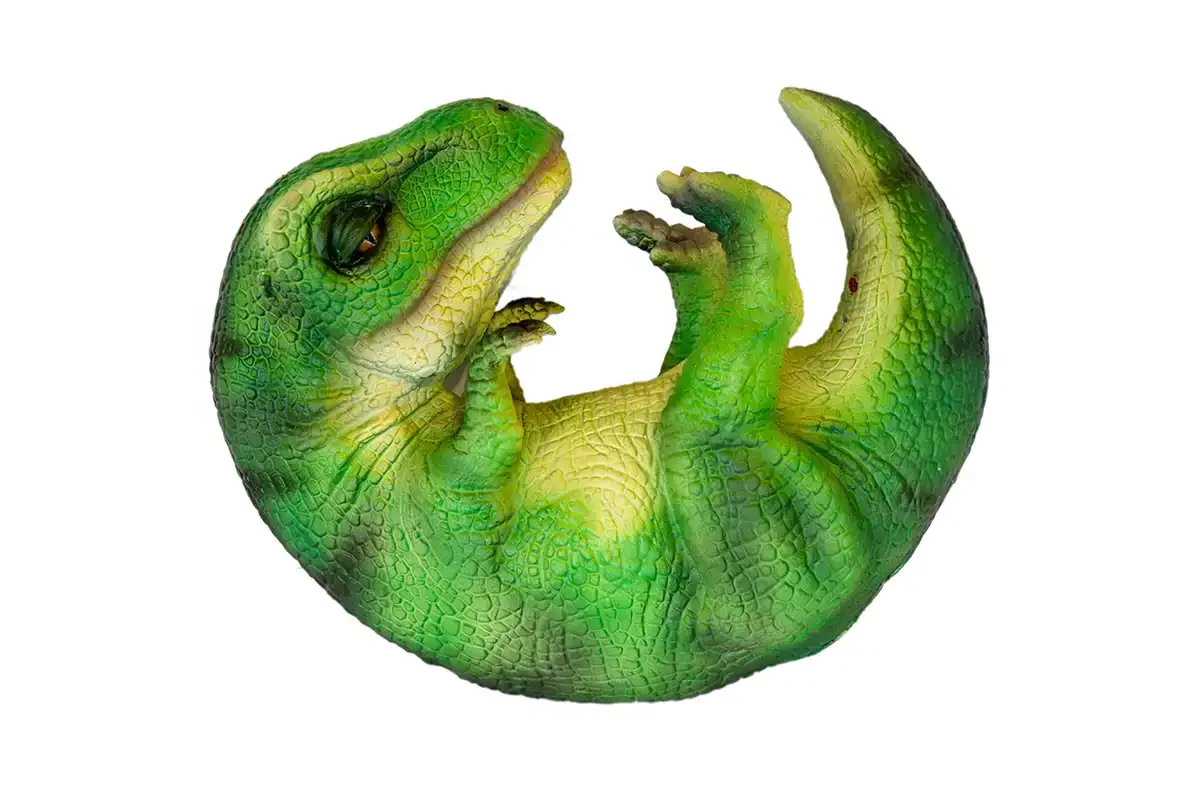
The larger interactive baby dinosaur puppet and the cuddly triceratops sit in between: 1.2–1.8 m curled as standard, up to 2.4 m custom, with the same moulded silicone skin used on the full-size exhibits. These are the pieces that make a dinosaur puppet for shows programme affordable — a museum can buy four of them for the floor price of one wearable suit and reach more children in a day.
Matching the Build to the Booking
Most dinosaur costume event entertainment is bought against a calendar rather than a brief — the venue books a date first, then works backwards to the equipment. That is fine as long as the calendar and the build agree. Where it goes wrong is a launch date booked for a giant, or a film day booked for a walking suit.
| Booking type | Build that works | What to plan for |
|---|---|---|
| Shopping mall roving | Walking build, under 12 kg | Two 45-minute sets with a break; handler in the crowd; polished floors mean no water spray |
| Parade | Walking build, or giant on a marshalled route | Route rehearsal; no kerbs or cable ramps on the line |
| Stage show | Animatronic build | Fixed position, power at the position, smoke available |
| Film and TV | Animatronic build, custom proportions | Spare jaw and spare skin panels; a second performer for long days |
| School and library | Hand puppet and baby puppets | No electrical inspection needed on the hand build; supervised from three years |
| Product launch | Mechanical or robot build, usually hired | Short sets, high visual impact, operator support on site |
Two of these are worth naming as professional dinosaur costume work and the rest are not. A movie quality dinosaur costume is a different specification again — replaceable skin panels, a jaw that can be swapped between takes, and no compromise on weight because the performer is not doing a two-hour public shift. If a supplier quotes you the same product for a film unit and a shopping centre, they are selling you one of the two badly.
What a Quote Covers
Quotes in this category are itemised, not listed, because two suits of the same species can differ by a factor of two depending on build. Three things drive it.
Build type. Walking and animated are different assemblies with different frames, not one product at two prices. Custom proportions add a fitting stage.
Movement set and effects. Blink and jaw are standard. Tail articulation, smoke and water spray are additions with their own hardware and their own maintenance load.
Performer measurements and quantity. A single suit built to one person’s measurements is a different order from four suits in standard sizes for a rota, and the second is the cheaper way to run a daily programme.
Send the species, the booking type, the number of performers who will wear it, and their heights. That is enough to specify the build and price it line by line. If you are also fitting out the venue, the mall display guide covers how a roving performer fits with static exhibits, and the ride-on range is the option when the animal needs to carry visitors rather than walk among them.
Frequently Asked Questions
How long can one person stay inside?
About 45 minutes continuous in a climate-controlled venue on the walking build, less outdoors in direct sun. Plan sets of 40–45 minutes with a real break between them, and a second performer if the booking runs over two hours. The animated build runs longer on power but not longer on heat — the limit is the person, not the battery.
Can the performer see well enough to walk in a crowd?
Wide-angle mesh eye openings give enough visibility to walk a rehearsed route and see the floor ahead. They do not give human-normal peripheral vision, which is why a handler walks with the suit in any crowded space and why the route gets rehearsed before the event.
Is a giant costume harder to operate than a standard one?
Yes, and in a different way. Above roughly 3 m the wearer cannot drive the head from inside, so direction comes from a handler and the route has to be controlled. Giants are a parade and stage product. For meet-and-greet and photos, the standard walking build does the job with far fewer operational problems.
What does it take to maintain one?
A removable washable liner, a pigmented repair kit for skin scuffs, and one spare of each electronic item. The joints that wear first are the jaw hinge, the neck and the tail root. There is no scheduled service beyond inspection — these are mechanical assemblies, not sealed units.
Do you make custom species?
Yes, where there is a reference to work from. Custom work is usually about proportions and performer fit rather than a new animal, and the build time is set by the sculpt rather than the electronics. The costume and puppet range shows what is already tooled.
How does this compare with a static exhibit?
They solve different problems and are often bought together. A wearable suit brings a crowd to a spot; a static piece holds them there. If the brief is a permanent display with no staff, the mounted skeleton route or a static animatronic is the right comparison, not a costume with a person inside it.
Tell us the species, the booking type, and the heights of the people who will wear it. We will come back with the build that fits the booking rather than the one that photographs best. Send the brief, or watch the movement sets before you decide which one you need.