Animatronic Dinosaurs
Cyberpunk Mecha T-Rex
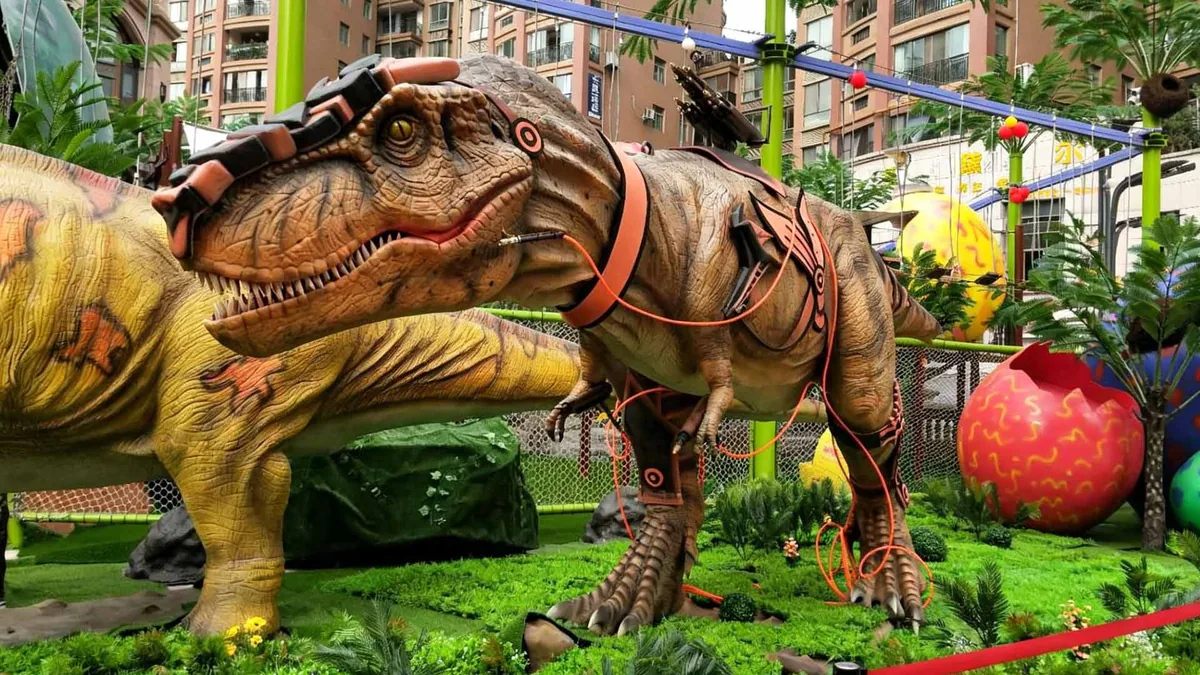
A 13 m animatronic T-rex in bolted FRP armour, with around 50 programmable LED points and two sound libraries. Built for mall atriums and pop-up events.
A 13 m animatronic T-rex in bolted FRP armour, with around 50 programmable LED points and two sound libraries. Built for mall atriums and pop-up events.
This is not a dinosaur with some lights on it. It is a working animatronic T-rex with a second skin bolted over the top: glass-reinforced armour on the skull, shoulders, forearms and flanks, cable runs between the plates, and LED points set into the seams where the armour meets skin.
The result is a model that is not trying to be accurate. It is trying to stop foot traffic in a mall atrium and get photographed. Those are different goals, and they lead to different decisions about proportion, finish and light.
| Product type | Cyberpunk armoured animatronic T-rex |
|---|---|
| Overall length | Approx. 13 m nose to tail tip |
| Overall height | Approx. 5.5 m including armour |
| Armour | Hand-laid FRP plates, brushed-metal finish, exposed bolt and rivet detailing |
| Under-skin | Composite silicone over foam, painted in a worn mechanical palette |
| Frame | National-standard steel, sectioned for transport |
| Lighting | Approx. 50 RGB LED points on seams and joints; breathe, scan, chase and strobe modes |
| Movements | Head swing, jaw open, tail sweep, shoulder armour linkage, neck turn |
| Audio | Two libraries switchable: synthetic machine roar, or natural T-rex call |
| Control | Handheld remote, or timed show cycle with programmable light scenes |
| Power | 220 V, dedicated circuit; 1.5–2.2 kW with lighting at full output |
| Environment | Indoor as standard; outdoor build adds weatherproof armour seals and IP-rated connectors |
| Assembly | 4–5 sections, 6–10 hours on site with two technicians and a small lift |
| Lead time | 45–60 days after drawing approval |
The armour is not a shell that hides the mechanism. It is bolted to the same frame that moves the head, so every plate has to clear the motion underneath it. That constraint decides the design: plates on the skull follow the jaw line and stop short of the hinge, and the shoulder plates ride on a linkage that moves with the arm rather than being fixed to the torso.
Attachment is mechanical, not adhesive. Every plate is bolted through a steel boss into the frame, which means plates can be removed for service and replaced if a mall installation takes a hit during load-in. Adhesive-mounted armour looks fine on day one and starts lifting at the first hot season.
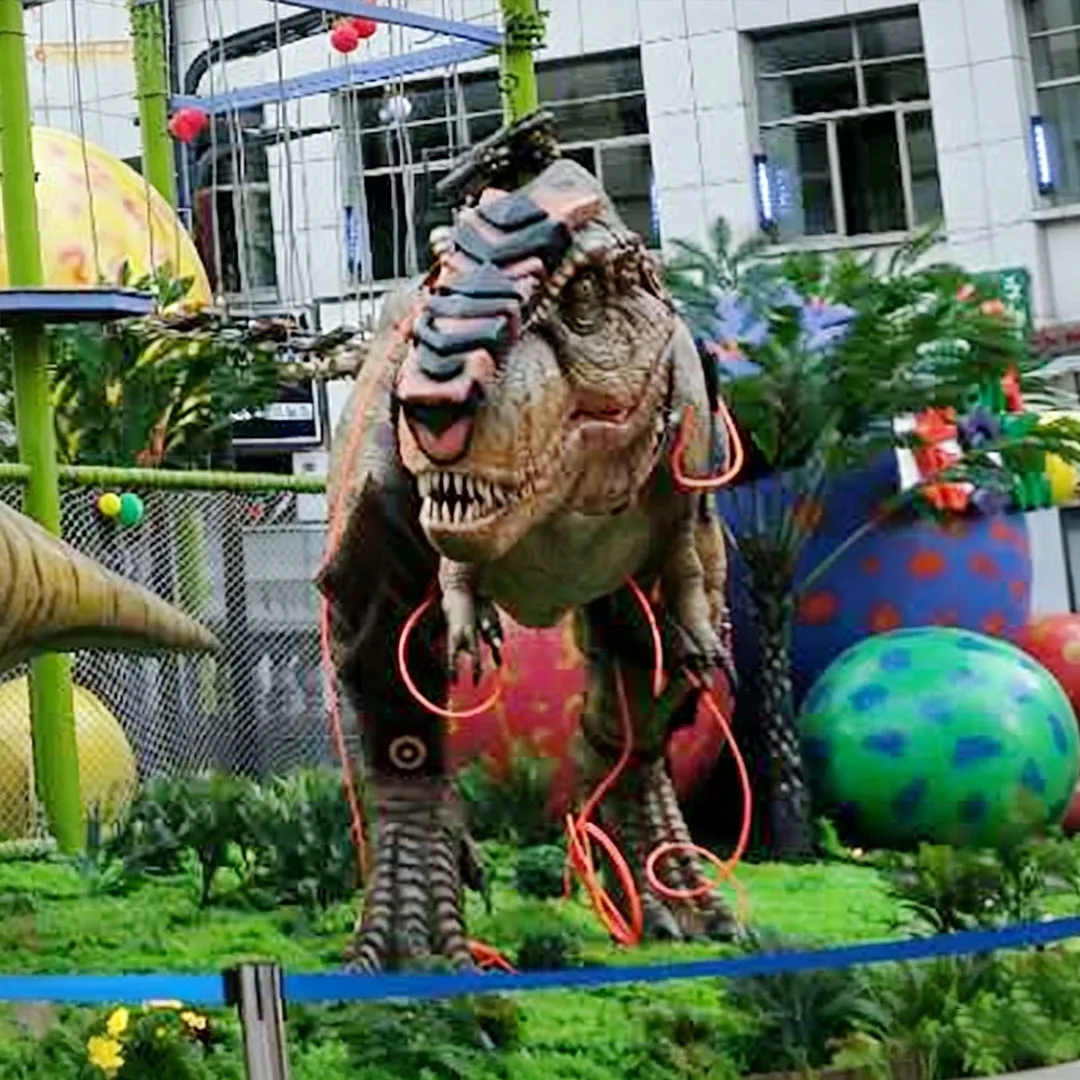
Around 50 LED points sit along armour seams and around the joints. The useful modes are fewer than the controller offers: a slow breathe for daytime, a scan that runs from skull to tail for the evening peak, and a chase that synchs with the roar. Strobe is available and almost never appropriate in a mall, because it turns every phone camera in the atrium into a problem.
Colour presets are the part that pays for itself. A mall can run amber for autumn, red and green for December, red for Lunar New Year, without touching the model. We set four presets and leave the fifth free for the client’s events team.
The machine library is a synthesised roar with metal impact layers. The natural library is a recorded dinosaur call. Switching is one button on the remote, and the two libraries are stored separately so the client’s events team cannot accidentally mix them into something that sounds broken.
Volume is the item to get right. A 13 m animal in a hard-surfaced atrium at 95 dB is uncomfortable for staff who stand near it for eight hours. We set the show cycle to drop to 80 dB outside the peak windows.
Three numbers decide whether this fits: ceiling height, floor loading, and the path from the loading dock.
Height. A 5.5 m animal needs 7 m clear to the lowest sprinkler or signage, because the head swings above the body.
Loading. The assembled unit is around 1.8 t spread over a footprint of roughly 4 m by 2 m. Most mall slabs take that without calculation, but we ask for the slab rating before signing a drawing.
Access. The longest single section is the tail at about 4.5 m. If the service lift is shorter than that, we re-section the tail rather than cut it on site.
Power is a dedicated 220 V circuit within 15 m of the base. Extension leads across a mall floor are a trip hazard and a fire inspection finding, and we will not commission a unit running on one.
This model is wrong for a natural history museum. It is wrong for a zoo education zone. It is wrong anywhere the exhibit’s job is to teach anatomy, because the armour hides the anatomy on purpose.
It is right for mall atriums, pop-up retail, brand activations, gaming and esports events, and theme park mecha zones where a realistic T-rex next door would look like a mistake. Operators who want both usually place them in different zones and let the contrast carry the story. For the realistic version, see our animatronic dinosaur range. For mall deployment patterns and traffic data, see the mall display page.
Yes, and it usually is. The FRP takes a two-pack finish in any RAL reference. We keep the brushed-metal break-up on the plate edges, because brand colour across a 5.5 m animal with no tonal variation reads as a balloon.
Six to ten hours with two technicians and a lift, usually overnight in a mall. Commissioning and light programming add another three to four hours, and we do that with the client’s events team present so the presets match their calendar.
Partly. In a skylit atrium the glow reads at about 40% of its night effect. The design accounts for this by making the armour silhouette strong enough to work without light, so the LEDs add rather than carry.
No. The walking version is a different product and needs a level pad. This one bolts to a plinth and the tail sweep is the only floor-level movement.
Plates are individual castings, so a damaged plate is replaced rather than repaired on site. We ship one spare plate for the skull and one for a shoulder with every unit, because those are the two that take hits during load-in.
Same factory and the same build standard. What changes is size, movement set and how the exhibit is meant to be used on site.
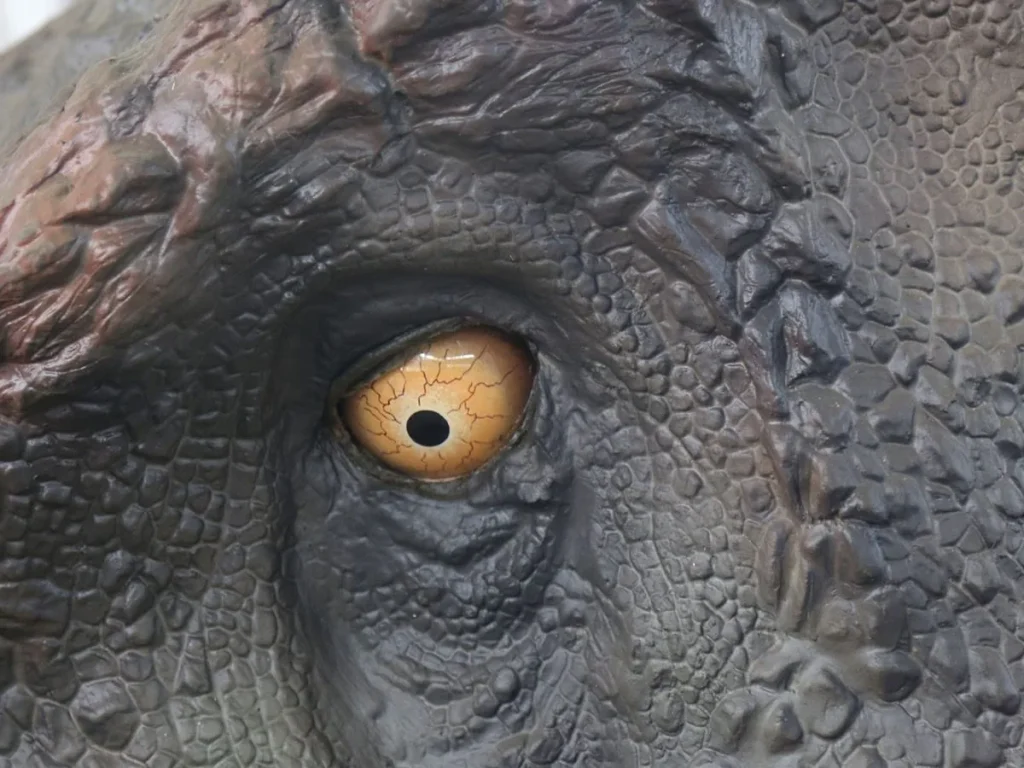
Museum-grade interactive animatronic dinosaur with 3 m proximity sensing, touch response and dual behaviour modes for science centers and parks.
View Product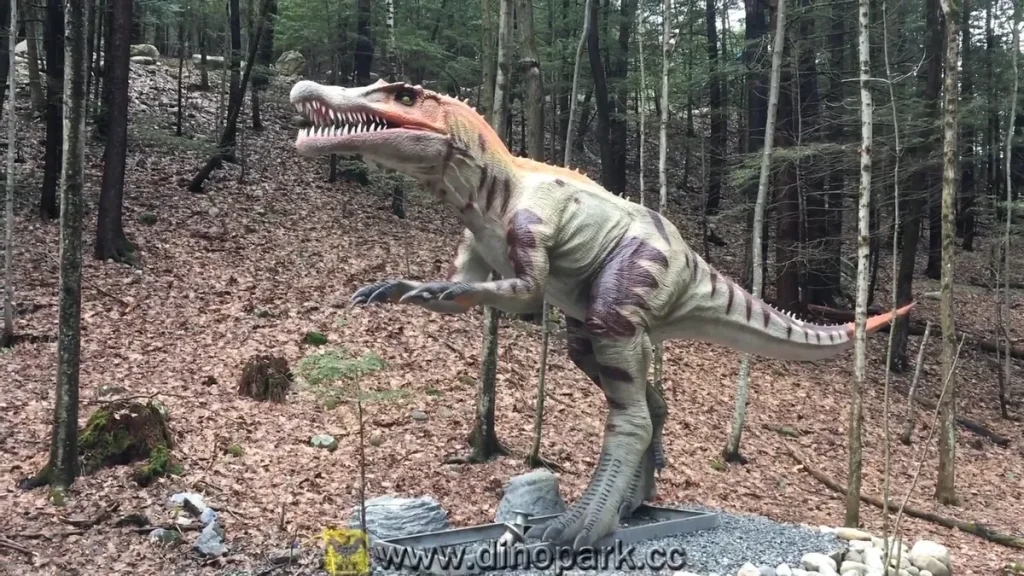
A life-size animatronic Baryonyx at 11 m — long crocodile snout, thumb claw and a fish-eater stance built for waterside exhibits and river walks.
View Product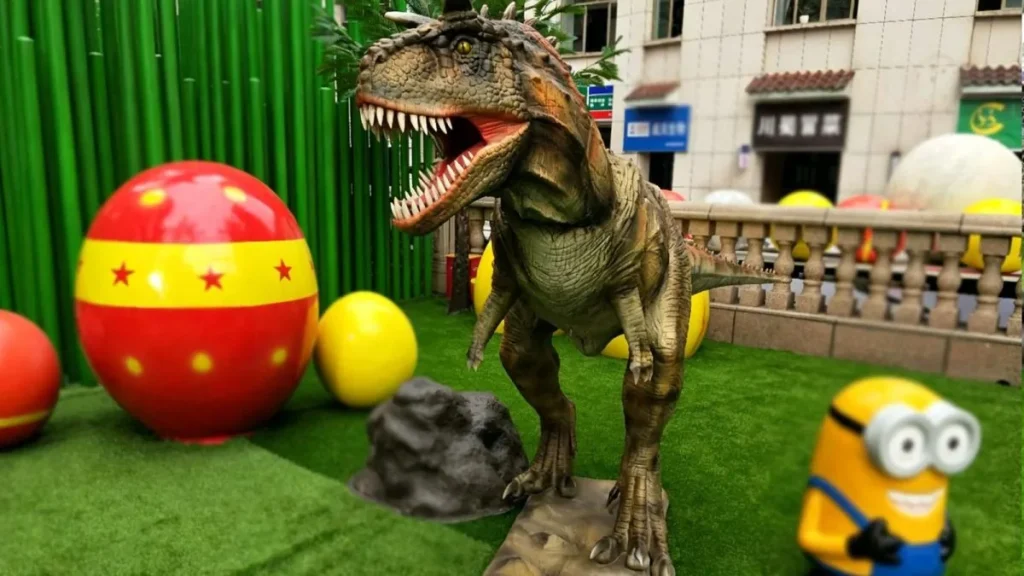
Life-size animatronic Carnotaurus in a roaring pose — articulated jaw, forward-set horns and roar audio on a rock base for outdoor display.
View ProductThree things buyers usually want settled before they ask for a drawing — what drives the number, how the piece is actually built, and what to check between suppliers.
Animatronic Dinosaur Buying Guide for Museums & Theme Parks Choosing the right animatronic dinosaur for your museum, theme park, or zoo is one of […]
Read the guide →From fossil reference to finished skin — how proportions, texture, colour and weathering are decided, and what separates a realistic build from a cartoon one.
Read the guide →Why Motor Choice Matters More Than Buyers Expect Motor selection is usually treated as a manufacturing detail. It is not. It is the decision […]
Read the guide →Send your dimensions, movement requirements and installation site. You get a realistic budget range and a dated build schedule.
Or email info@hltdino.com — we reply within one business day.