Short answer: an animatronic figure fails in the same four places on almost every build — the skin bond line, the gearbox output seal, the joint bearings, and the pneumatic fittings — and all four announce themselves weeks before they fail. Maintenance is mostly inspection rather than repair. A figure that gets a ten-minute weekly walk-around lasts roughly twice as long as one that is only touched when something breaks, and the difference is almost entirely in what somebody noticed early. This article covers the schedule, the spare kit worth holding, what service life actually depends on, and how to decide between repairing and replacing.
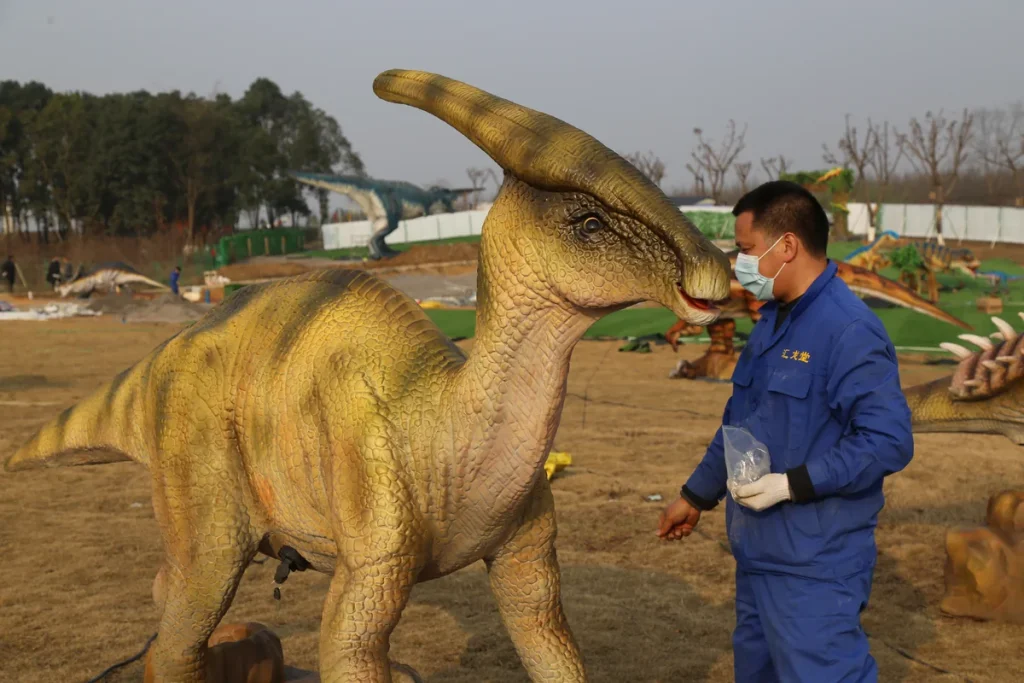
The Four Parts That Fail First
Ask anyone who services exhibits and the failure order is consistent, regardless of who built the figure.
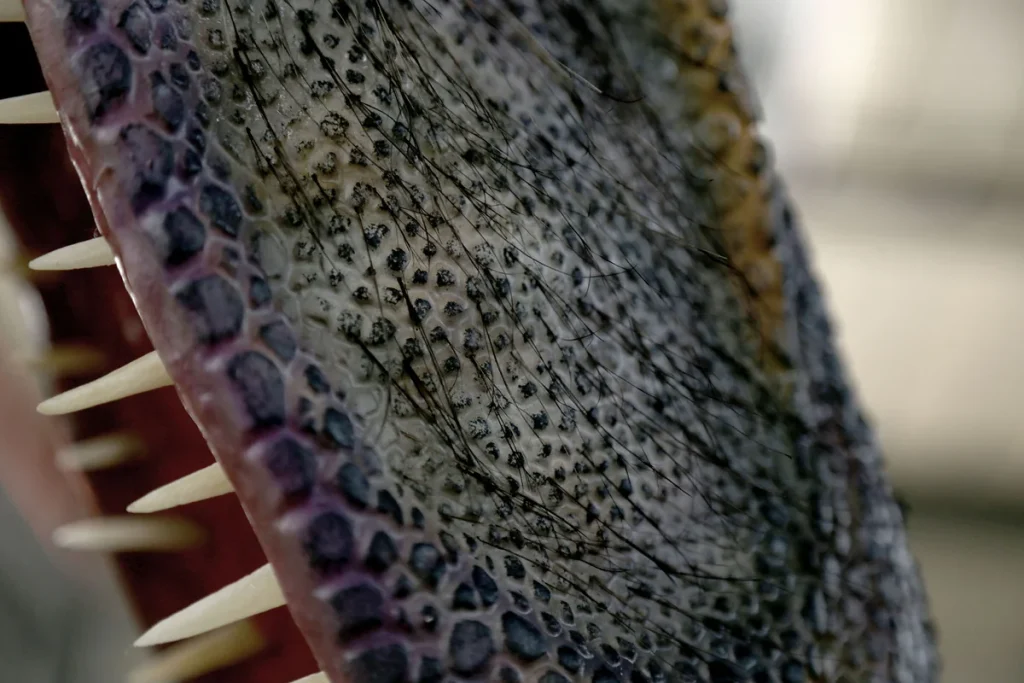
The skin bond line. Molded silicone panels are joined at seams, and that bond sees every movement cycle. On a neck that sweeps twice a minute, the seam at the base of the neck accumulates hundreds of thousands of flex cycles a year. The failure starts as a hairline lift at the edge, invisible from a metre away and obvious under a thumb. Caught there it is a twenty-minute repair with silicone and pigment. Left for a season it becomes a flap, water gets behind it, and the panel has to be replaced.
The gearbox output seal. Every geared joint has a rotating shaft passing through a seal. That seal keeps grease in and water and dust out. When it starts to weep, you get a thin film of grease on the surrounding skin — usually the first visible sign that anything is wrong on the whole figure. A weeping seal is a cheap replacement. A dry gearbox is a new gearbox.
Joint bearings and rod ends. The bearings at the shoulder, hip or jaw pivot carry the load and take the wear. Wear shows up as play: the head moves a few millimetres before the drive engages, or the jaw closes slightly off-centre. Play accelerates — a worn bearing lets the joint move off axis, which loads the seal and the gearbox in directions they were not designed for. Replacing a rod end costs a fraction of replacing what it protects.
Pneumatic fittings and tubing. Push-fit fittings and flexible tubing are the least glamorous part of a pneumatic build and the most frequent small failure. They leak slowly, the compressor runs more often to hold pressure, and eventually an action becomes sluggish. A leak-down test takes two minutes and should be part of every quarterly service.
Two more that are worth watching: cable flex at moving joints, where the conductor strands break inside intact insulation and the fault appears as an intermittent one that only happens in one position; and cabinet filters, which clog and cause overheating that looks exactly like a failing drive.
Why Maintenance Is Mostly Looking
Roughly eighty percent of the work on a healthy figure is inspection. The remaining twenty percent is what the inspection found.
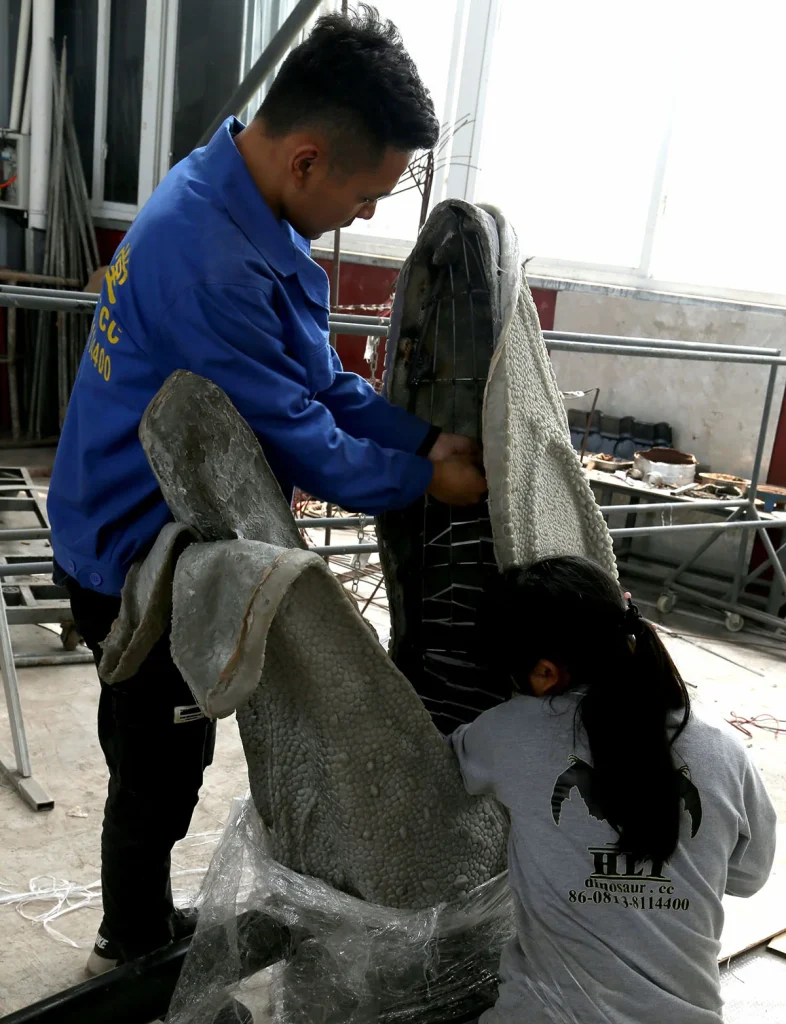
This matters because it changes who can do it. Operator-level checks do not require a technician — they require somebody who knows what normal sounds and looks like, and who writes down what they saw. The technician’s time should be spent on the quarterly and annual services, not on walking around the figure every week.
Four senses cover most early detection. Sound: a healthy figure has a consistent motor note and no clicking or grinding at any point in its cycle. Touch: a warm gearbox after ten minutes is normal, a hot one is not; a joint that has play can be felt before it can be measured. Sight: grease films, hairline lifts at seams, rust streaks at fasteners, discoloured skin. Smell: hot insulation and overheated grease both have distinct odours, and both are worth acting on immediately.
The Weekly Check: Ten Minutes
This is an operator task, done before opening or after closing, and it is the single highest-value routine in the whole schedule.
1. Run every axis slowly through its full range one at a time, and listen. Note any point where the sound changes.
2. Look along every seam on the neck, jaw, tail and flanks. Lift the edge lightly with a thumb — a bond that has started to release will show immediately.
3. Clear the drain ports at the lowest points of each cavity and confirm water runs out rather than sitting.
4. Check the cabinet filter and the interior temperature after the figure has been running for fifteen minutes.
5. Look for fresh grease films around joint shafts and rod ends.
6. Operate the emergency stop and confirm it removes drive power, then reset it.
7. Record the date, the ambient conditions, and anything that changed since the last entry.
The log is not paperwork. A line that says “slight click at neck full-left, started this week” is what turns a gearbox replacement into a bearing replacement three months later.
The Quarterly Service
Half a day for a technician, and the point where the weekly observations get resolved.
Torque-check the base anchors and the joint fasteners against the build sheet — vibration loosens fasteners and the specification tells you what they should be. Check bearing play at every pivot with the drive holding position, using a dial indicator where the joint is accessible. Grease according to the schedule for the actual duty cycle rather than the calendar, since a figure running 400 cycles a day needs it far more often than one running 40. Inspect and torque cable glands, because a gland that has worked loose is a water path. Clean the cabinet, replace the filter, and renew the desiccant. On pneumatic builds, do a leak-down test on the whole circuit. Test any backup battery and record its voltage under load rather than at rest.
This is also the right interval to check the coating. Look at the topcoat on upward-facing surfaces under low-angle light — that is where UV fade and chalking show first, and where a recoat decision gets made a year before it becomes urgent.
The Annual Service
One to two days, ideally in the off-season, and it should include a proper shutdown rather than an overnight pause.
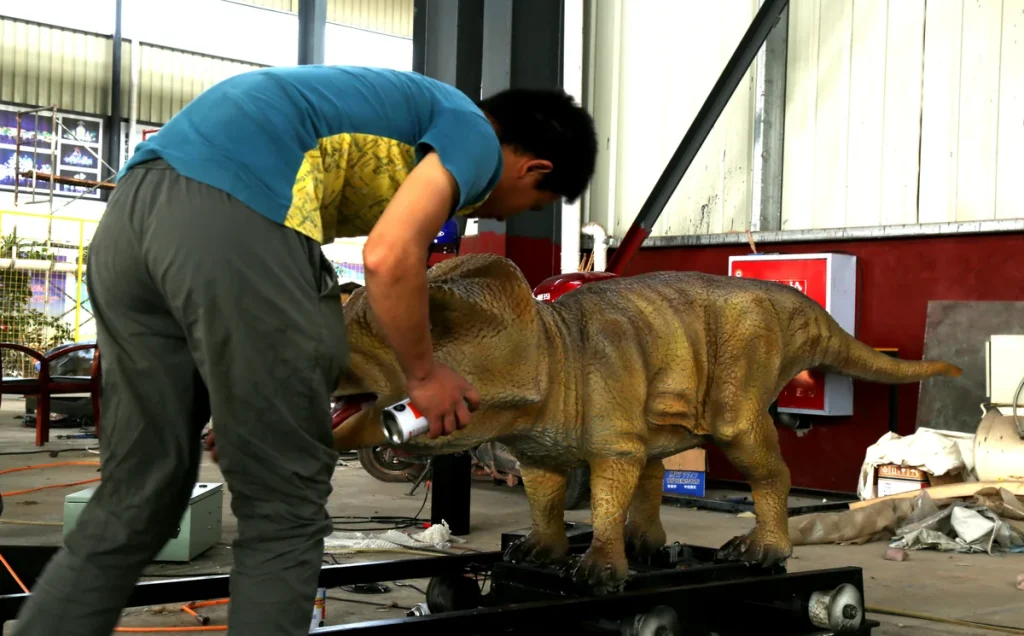
Change gearbox lubricant on every unit that has a drain plug, and on sealed units replace the unit or the seal according to the manufacturer’s interval — sealed-for-life gearboxes are sealed for a defined life, not forever. Replace rotating seals on the highest-cycle joints whether or not they are weeping, because the cost of the seal is trivial against the cost of the gearbox it protects. Open the access panels and inspect the frame for corrosion at weld joints and at the plinth, which is where standing water does its work. Perform an insulation resistance test on the electrical installation. Back up the control program and store the file somewhere that is not the machine, because obsolete controllers are the most common reason a functioning figure cannot be repaired. Re-torque the anchor bolts after inspection. And run a full sequence for a complete cycle, timing each axis against the original commissioning record to catch slow degradation.
The Spare Kit Worth Holding
Lead times are what hurt. A failed servo drive on a figure that is open to the public six days a week is not a maintenance problem, it is a closure. The kit below covers the failures that actually stop a show.
| Item | Why hold it | Typical quantity |
|---|---|---|
| Servo drive, the size used most on the build | Most common electronic failure; sourcing a replacement can take weeks | 1 per site |
| Gearbox of the dominant ratio | Second most common mechanical failure | 1 per 8–10 axes |
| Rod ends and pivot bearings | Cheap, fast-wearing, and easy to change before they damage the joint | 2 full sets |
| Rotating seal kit | Turns a gearbox replacement into a seal replacement | 2 per axis type |
| Silicone repair compound and pigments | Seam repairs are only cheap if done immediately | 1 kit, colour matched |
| Pneumatic fittings and 5 m of tubing | The most frequent pneumatic failure and the cheapest fix | Assorted |
| Contactor, fuse set, cabinet filter | Consumables that stop the cabinet | 1 set each |
| Control program backup, off-machine | Without it, a dead controller can strand the whole figure | 2 copies, separate locations |
Two things to check when the kit is assembled: that the drives are the same firmware revision as what is installed, and that the seals are the right material for the environment. A nitrile seal on an outdoor unit in a hot climate will not give the service the specification promised.
What Maintenance Actually Costs
Operators typically plan maintenance as an annual percentage of the original build cost rather than as a fixed sum, because the driver is the number of moving axes and how hard they work.
A planning band most operators work to is 1.5 to 3 percent of build cost per year for indoor figures in a controlled environment, and 3 to 5 percent for outdoor figures in daily service. Within that, the split is roughly half labour, a quarter consumables and small parts, and a quarter provision for the occasional larger failure. Recoating is not in that band — it is a separate cycle every three to five years, and it should be budgeted as a planned event rather than treated as a surprise.
These are planning ranges, not a quotation. The actual figure depends on duty cycle and environment, and a trail of figures triggered by visitor presence costs less per unit than a single figure running continuously in a mall.
Service Life: What Actually Determines It
Well-maintained animatronic figures commonly stay in daily service for eight to twelve years before needing a major refurbishment. The range is wide because four factors move it more than anything else.
Duty cycle. This is the biggest single factor. A figure running a 90-second sequence with 40 cycles a day accumulates about 13,000 cycles a year. One running continuously at 20 cycles an hour in a mall accumulates over 100,000. The second figure is doing eight years of wear per year, and no maintenance schedule closes that gap entirely.
Environment. Outdoor units see thermal cycling that indoor units do not. Every temperature swing moves the skin against the frame, works the seams and cycles the cabinet. Salt air and irrigation spray add corrosion to the list. Outdoor service life is typically shorter, which is why the maintenance interval is shorter too.
Storage between seasons. A figure stored badly for four months undoes a season of good maintenance. Damp storage grows mould into the skin pores, which cannot be cleaned out; a figure stored in its operating position with weight on a joint can flat-spot a bearing.
The original build. Frames that were under-specified for the figure’s own weight, or joints built with bearings at their load limit, wear out on a schedule set at the factory. This is the argument for over-specifying the frame at the order stage, and it is the part of a quotation that is hardest to compare between suppliers.
What usually ends a figure’s life is not structural failure. It is the combination of electronics obsolescence — controllers and drives that can no longer be sourced — and skin that has reached the end of its repairable life. The steel frame typically outlives both.
Repair or Replace
Three tests, in this order.
Frame integrity. If the frame is sound at the welds and the plinth, the figure is worth keeping. Frame corrosion at load-bearing joints is the one finding that argues for replacement rather than repair, because repairing it properly means stripping the figure.
Drive availability. If the servos and drives are still sourceable, a drive refresh extends life economically. If they are obsolete, price the refresh before deciding, because a full control retrofit on a large figure can approach a third of the cost of a new build.
Skin coverage. If more than about a third of the panel area needs replacement, a new skin is usually the better purchase — and at that point the cosmetic result is close to a new figure anyway.
When two of the three pass, repair. When two fail, replace, and plan the replacement around the off-season rather than waiting for a failure to force the decision during opening weeks.
Off-Season Storage
Park the figure with joints in a neutral position so no bearing sits loaded for months. Clean the skin with pH-neutral soap and water rather than solvent, and let it dry fully before covering. Cover with a breathable sheet, never plastic — plastic traps condensation against the skin for the entire off-season. Clear the drain ports and leave the cabinet open a crack with fresh desiccant inside. Remove batteries. Check for rodent access, which is a genuinely common cause of chewed wiring over a winter. And write the park date and the condition into the log so that the restart inspection has something to compare against.
Frequently Asked Questions
How often does an animatronic dinosaur need maintenance?
Weekly operator checks of about ten minutes, a quarterly technician service of half a day, and an annual service of one to two days. Outdoor units in daily service should have the quarterly interval shortened, because thermal cycling wears seals and seams faster than indoor operation does.
How long does an animatronic dinosaur last?
Eight to twelve years in daily service is typical for a well-built, well-maintained figure. Duty cycle is the dominant variable: a mall figure running continuously accumulates roughly eight times the wear of a park figure triggered by visitors. The steel frame usually outlives both the electronics and the skin.
What wears out first?
The skin bond line at the highest-flex seam, the gearbox output seal, the pivot bearings, and on pneumatic builds the push-fit fittings. All four give warning before they fail, which is why the weekly inspection matters more than any repair skill.
Can we do the maintenance ourselves?
Operator-level weekly checks, cleaning and drain clearing, yes. Quarterly and annual services need torque values, bearing measurements and an insulation test, and getting them wrong is more expensive than the service. Many operators do the weekly routine in-house and contract the rest.
What spare parts should we keep on site?
At minimum one servo drive of the size used most, a gearbox of the dominant ratio, a full set of rod ends and pivot bearings, rotating seals, a colour-matched silicone repair kit, pneumatic fittings, and cabinet consumables. The control program backup matters as much as any physical part.
Does maintenance affect the warranty?
Wear items — seals, bearings, skin repairs and filters — normally sit outside a warranty regardless of supplier, which is exactly why the log matters. A documented service history is what distinguishes a wear failure from a manufacturing defect when a claim is made.
Planning the running costs for an exhibit and want the maintenance interval that matches your duty cycle? Send us the site type and how many hours a day the figure will run and we will lay out the schedule. For what the schedule is protecting, read the six systems inside an animatronic dinosaur; for how the skin is built and repaired, see molded silicone skin.