Dinosaur Skeletons & Fossils
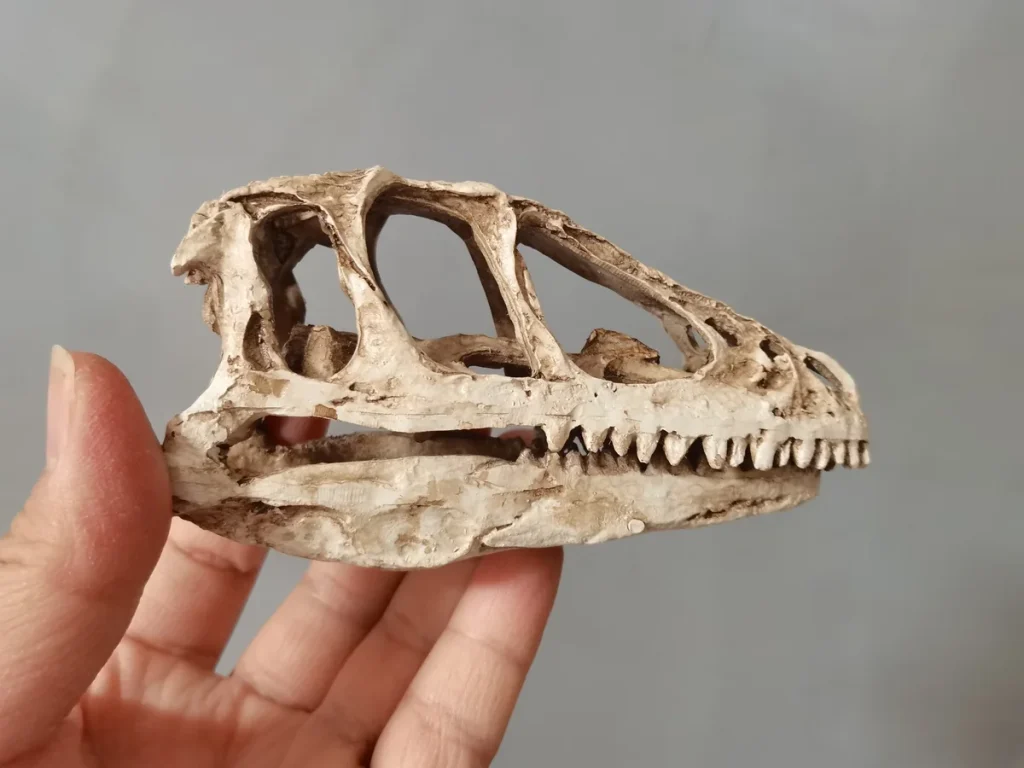
Everything about a small skull is thinner. The walls of the braincase on Microraptor are a millimetre or two thick, the postorbital bars are slender rods, and the teeth are the size of a grain of rice. Scaling a large theropod skull down does not produce this object; it produces a lumpy miniature.
The casting difficulty is not the size, it is the undercuts. A skull this small has fenestrae that a rigid mould will not release, so the piece has to be cast in sections and assembled, or cast in a flexible mould that wears out after a handful of pulls. Both routes are slow. Both are why small skulls are usually the most expensive thing per gram in a fossil range.
What you should check on arrival is the thin bars. Hold it against a light: the postorbital bar and the jugal should show as separate struts with daylight between them. If those have filled in solid, the mould was over-filled and the piece lost the anatomy that makes it worth having.
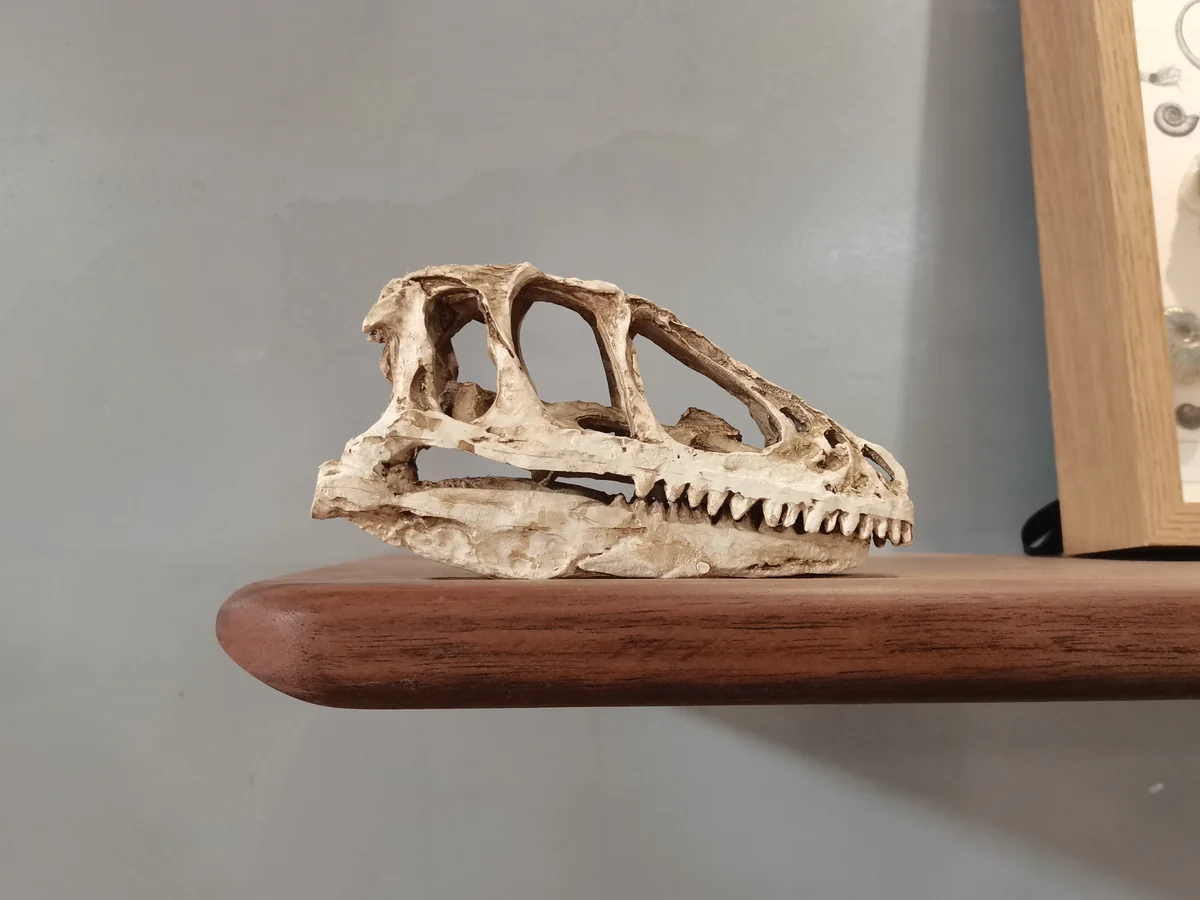
Microraptor carries teeth in the front half of the jaw only, and they are small, recurved and tightly packed. Behind them the jaw narrows and the tooth row stops well short of the eye. That gap is one of the quickest ways to separate this skull from a small Velociraptor, which carries teeth further back and has a distinctly flatter profile above the snout.
The snout itself is short relative to the skull, and the antorbital fenestra, the large opening in front of the eye, is proportionally enormous. Those two proportions together are what make the animal read as Microraptor rather than as a generic small theropod.
Microraptor is one of the few dinosaurs that carried long feathers on all four limbs. The hind limbs are built like wings, with flight feathers running down the metatarsals, and the animal is generally reconstructed as a glider working between trees rather than as a bird-like flyer.
That makes it the strongest single object for explaining the origin of flight, better than Archaeopteryx for a general audience, because the four-wing arrangement is visually strange enough to stop people. A skull alone does not tell that story, so we finish this piece to match the feathered body models in the same range and most buyers display them together.
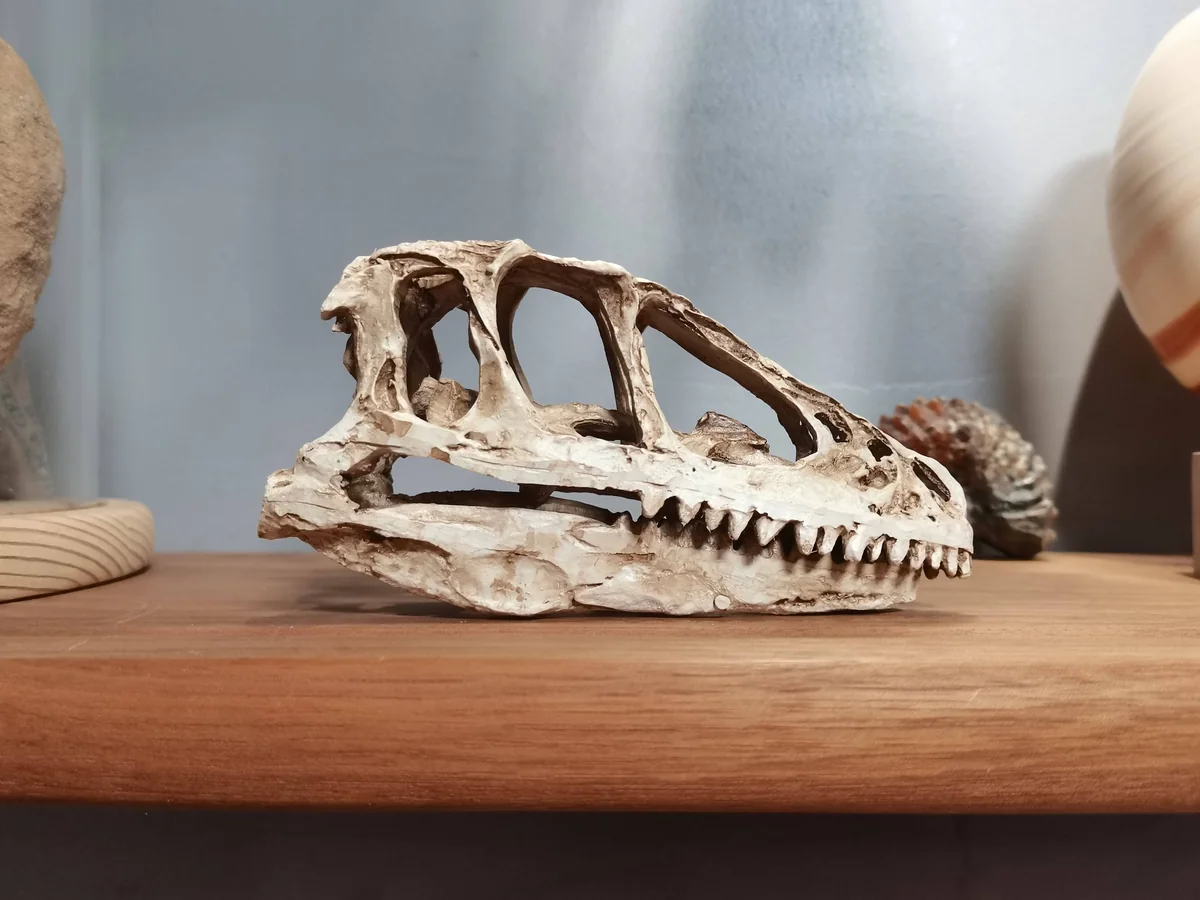
A skull this small needs to be at eye height or slightly below, and it needs to be close to the visitor. At 1:1 the object is about 90 mm long, which means it disappears in a large case and reads perfectly in a small one.
Our standard mount is a low plinth with a steel pin, holding the skull about 120 mm above the shelf. For a case, a small acrylic riser works better than a pin because it gives the object a base rather than a stalk. Light from one side at a shallow angle: the fenestrae are what the eye is looking for, and a frontal light fills them in.
We produce this skull at 3:1 as well, at 270 mm, usually for galleries where a 90 mm object would need a case of its own to be noticed. The proportions carry over exactly, but the surface does not: at three times life size the grain of the bone becomes visible as texture, and texture that is invisible at 1:1 suddenly looks coarse.
So we finish the enlarged version differently, with a smoother surface and a tighter colour range. It ends up reading as a study cast rather than as a specimen, which is the correct impression to give. An enlarged skull presented as though it were life size is the kind of thing a school group will spot and a curator will resent.
Label the enlarged version with its scale. It costs nothing and it prevents the piece from being read as a mistake.
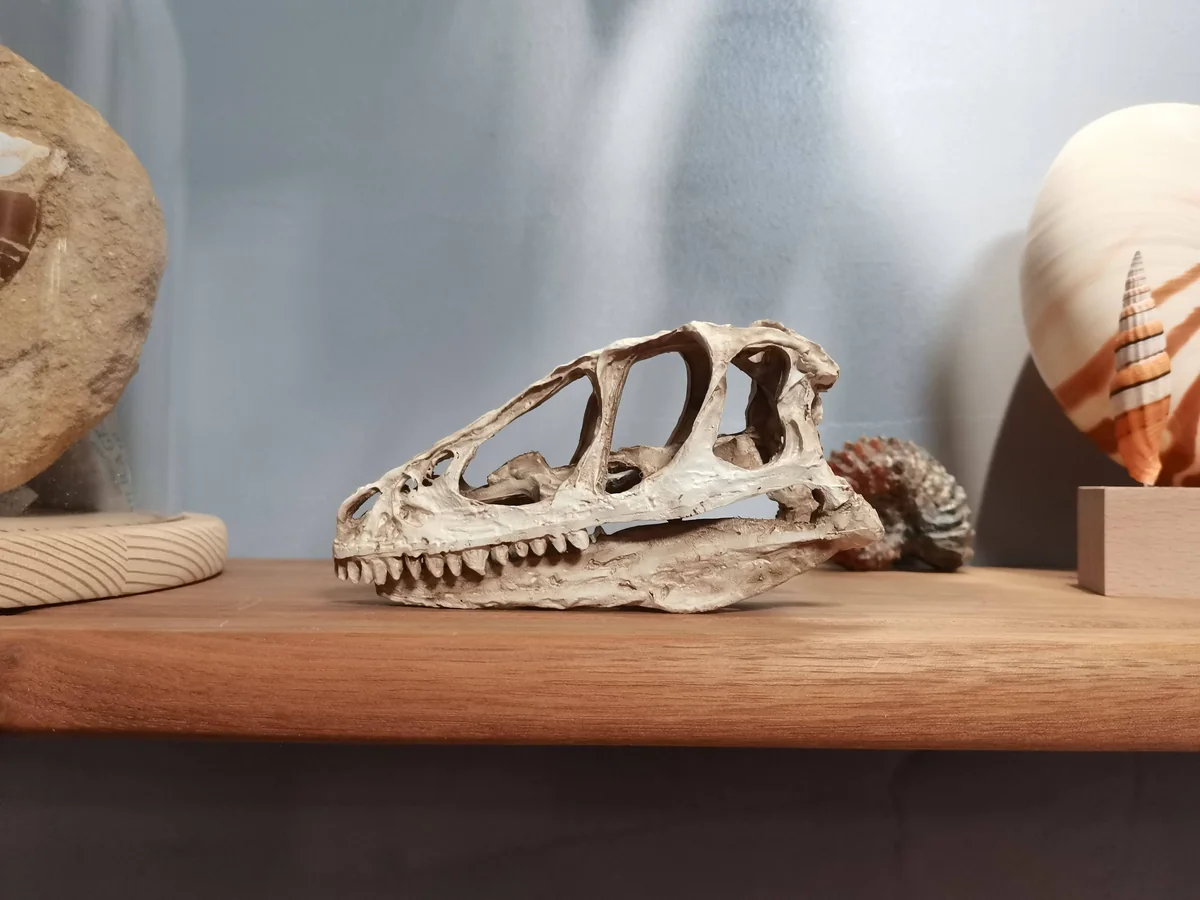
Microraptor comes from the Yixian Formation in Liaoning, a lake deposit that preserved feathers, soft tissue and stomach contents in fine volcanic ash. A case built around that deposit is one of the few dinosaur displays where the story is visual rather than textual, because the animals are small, feathered and strange.
The line-up that works: Microraptor as the four-winged glider, a small feathered dinosaur without flight capability beside it, and a fish or an early bird from the same beds to show what shared the lake. Keep the whole case at 1:1 or at a single consistent scale, and keep the lighting low and warm, because the Yixian material reads as dark impressions on pale stone.
We finish Microraptor skulls to match the feathered body models in the same range, so a case assembled over two orders still reads as one exhibit.
| Species | Microraptor zhaoianus |
|---|---|
| Age | Early Cretaceous, roughly 120 million years ago |
| Type | Skull replica at 1:1. Static, no mechanism |
| Skull length | 90 mm; 3:1 enlarged version also produced at 270 mm |
| Features | Deep antorbital fenestra, short snout, teeth in the front half only |
| Material | Cast composite with mineral pigment finish, matte sealed |
| Finish | Hand-tinted, sealed matte; aged variant available |
| Mount | Low plinth with steel pin, or acrylic riser for case display |
| Weight | About 60 g with mount |
| Duty | Indoor |
| Customisation | Scale, mount type, aged or clean finish, matched to feathered body models |
Is the enlarged version accurate? It is a faithful scale-up with the same proportions. What changes is the surface: at 3:1 the grain of the bone becomes visible in a way it never is at life size, so the enlarged version reads as a study piece rather than as a specimen.
Why is the skull so small? Microraptor was a small animal, roughly the size of a crow. At 1:1 the skull fits in the palm, which is exactly why it works as a handling object.
How do I tell it from a Velociraptor skull? The tooth row stops short of the eye and the snout is shorter. Velociraptor has a flatter skull roof and teeth that run further back.
Can it be displayed with a feathered body? Yes, and most buyers do. We finish the skull to the same tone as the body models so the pair reads as one exhibit.
Will the thin bars break? They are the most delicate part. The piece ships in a foam cradle with the bars unsupported, and we recommend leaving it in the cradle until it is on the mount.
Is a stand included? Yes, the low plinth and pin are included. Specify if you would rather have an acrylic riser for a case.
Do you supply the whole animal? We build feathered body models in the same range. Send the display length and we will quote the pair.
Same factory and the same build standard. What changes is size, movement set and how the exhibit is meant to be used on site.
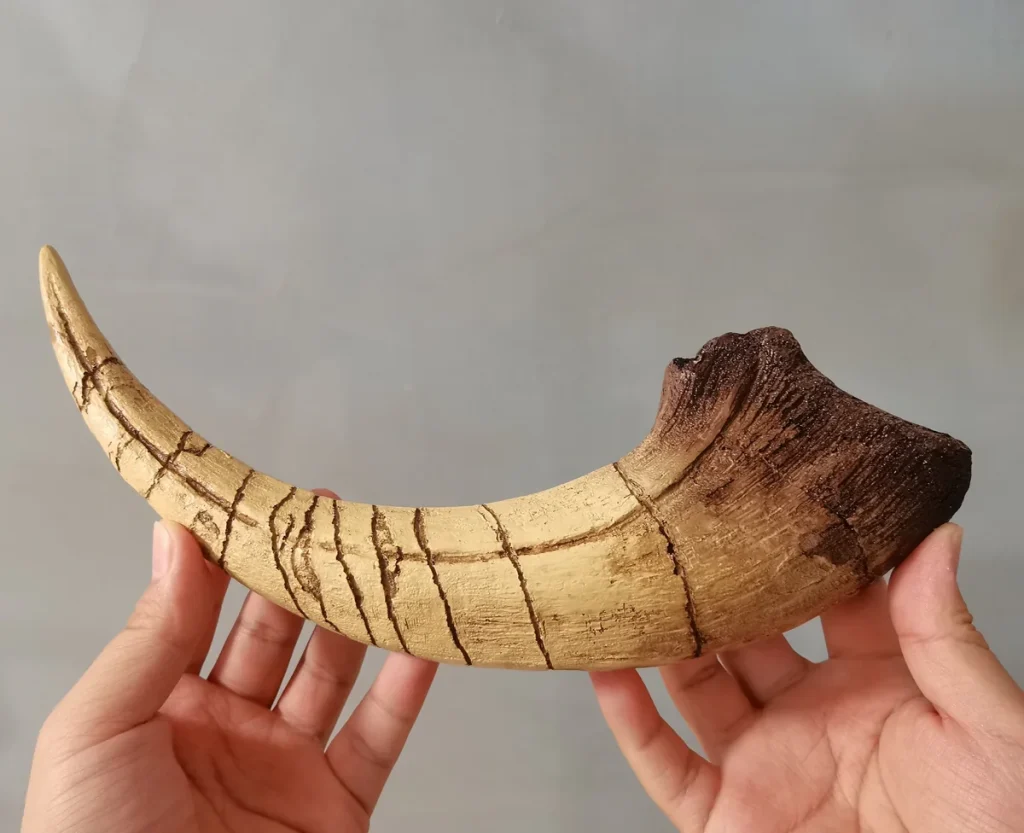
A Claw Is Judged at the Tip The tip is where a cast either works or does not. On a real claw the bone […]
View Product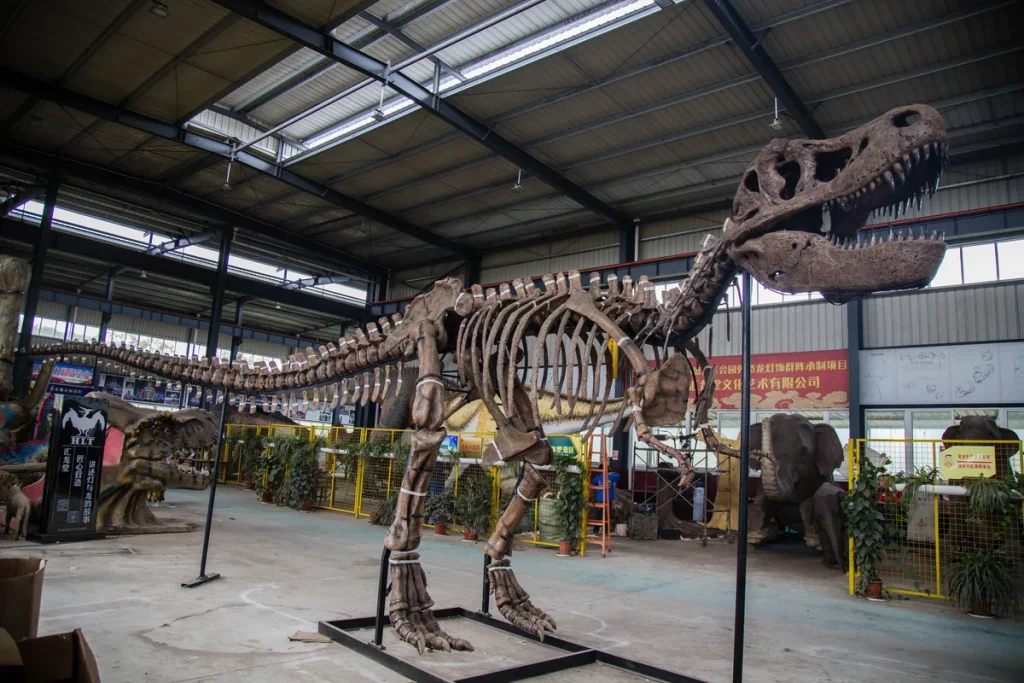
A skeleton reads differently from a mounted animal, and the difference is the gaps. There is no skin to hide the joints, no pose […]
View Product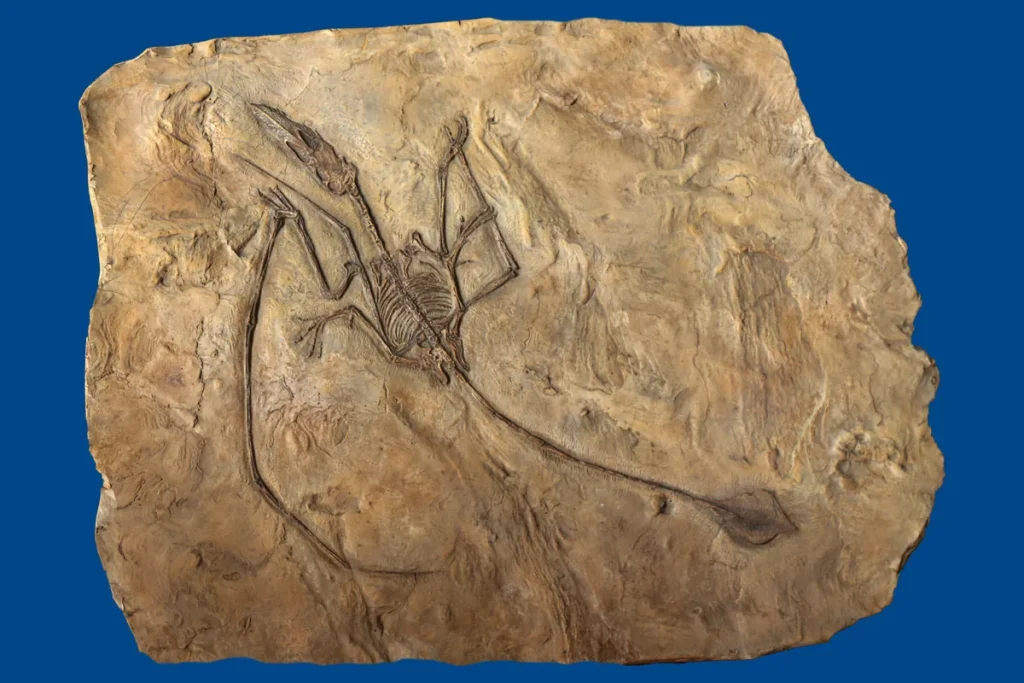
A pterosaur is the one prehistoric exhibit where the skeleton cannot be separated from the membrane. The wing is the fourth finger, drawn out […]
View ProductThree things buyers usually want settled before they ask for a drawing — what drives the number, how the piece is actually built, and what to check between suppliers.
From fossil reference to finished skin — how proportions, texture, colour and weathering are decided, and what separates a realistic build from a cartoon one.
Read the guide →Frame, drives, skin, sensors, sound and weatherproofing — the six systems behind every animatronic dinosaur, and how each one changes cost and behaviour.
Read the guide →Choosing the right animatronic dinosaurs for your venue is not just about picking the most famous species — it is about matching each dinosaur […]
Read the guide →Send your dimensions, movement requirements and installation site. You get a realistic budget range and a dated build schedule.
Or email info@hltdino.com — we reply within one business day.