Dinosaur Skeletons & Fossils
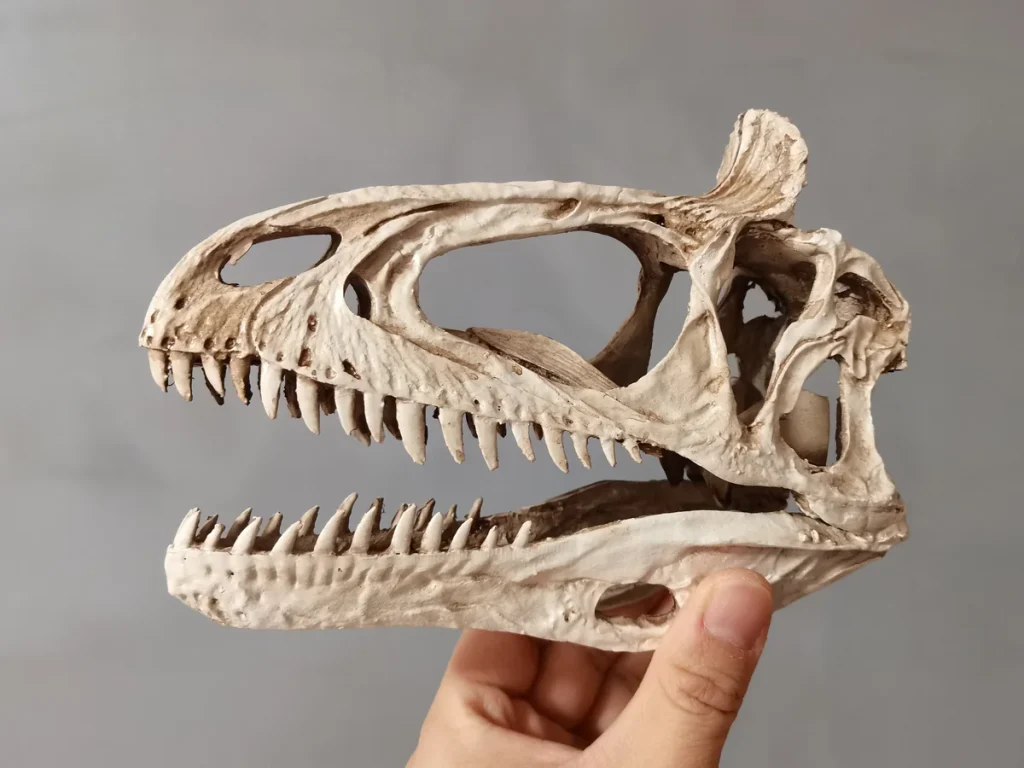
Cryolophosaurus is identified by one feature: a thin, high crest that rises across the skull roof in front of the eyes and runs from side to side rather than front to back. Nothing else in the Early Jurassic carries one. Get the crest right and the skull is unmistakable at any scale. Soften it into a ridge and you have a generic theropod with an interesting name.
On the living animal that crest was a bony sheet, thin enough to have flexed slightly, sitting above the nasal passages. A cast that models it as a solid block loses the two things that make it read: the thinness at the top edge, and the hollows where it meets the skull. We cast it as a separate thin section and bond it on, which keeps the edge sharp and stops the crest reading as a fin.
This is also the part that breaks in transit. Every skull leaves the workshop in a crate with the crest supported from both sides, and the packing instruction is printed on the crate rather than buried in a document.
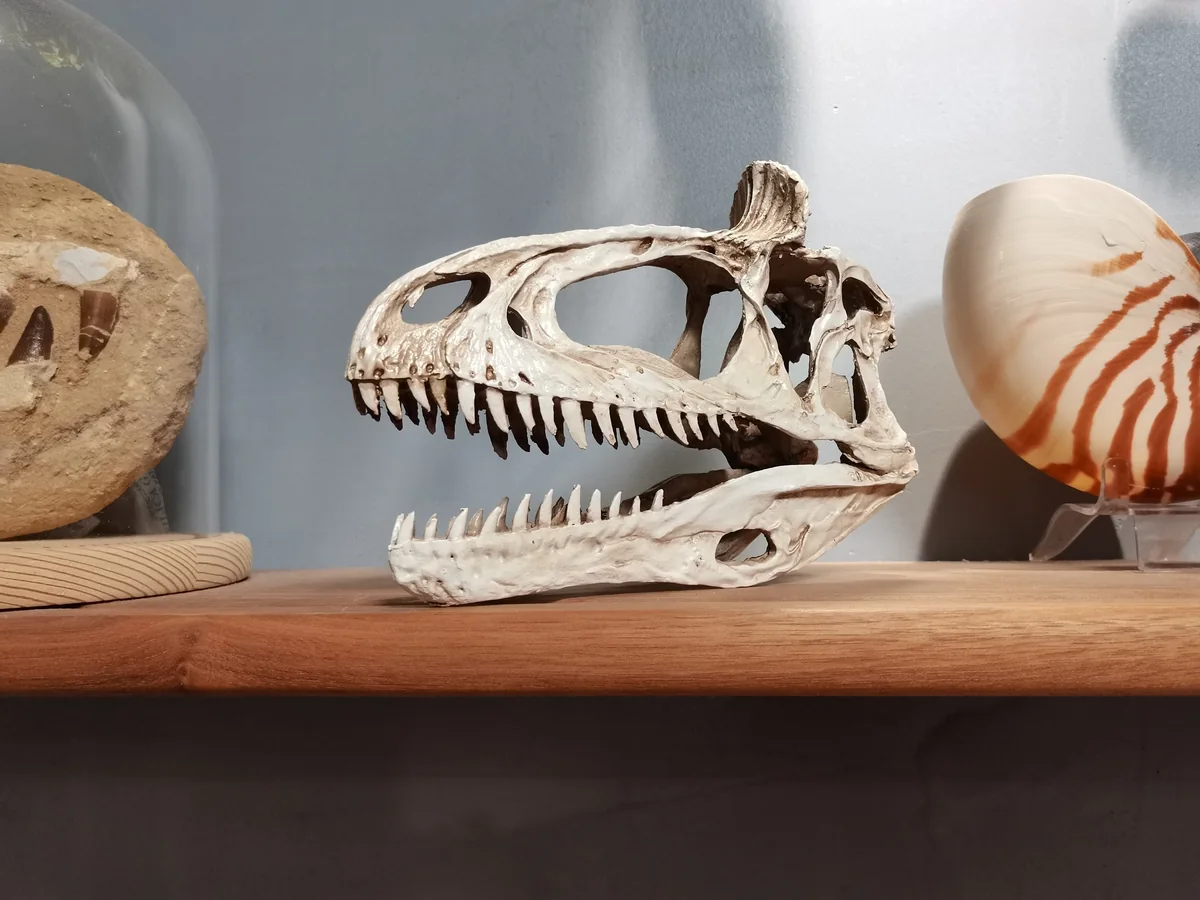
The upper jaw carries teeth that are long relative to the skull, curved slightly backwards, with fine serrations on both edges. In a display cast the jaw is normally closed and the teeth read as a row of points along the line where the jaws meet rather than as individual elements.
Each tooth is cast separately and set into the jaw, which is slower than casting the tooth row as part of the maxilla and it is the difference between a row of points and a saw blade. Where the skull is going into a case with close viewing, this is the detail people lean in for.
The lower jaw is a separate casting, articulated on a steel pin, so it can be set open or closed. A jaw moulded shut cannot be corrected later, and a slightly open jaw reads better in a case than a closed one because it separates the upper and lower tooth rows.
This is a reconstruction built from published measurements and photographs of the known material, not a mould taken from the original fossil. That is the honest description and it matters if your institution intends to cite a specimen number on a label.
Cryolophosaurus is known from a single partial skeleton from the Hanson Formation in Antarctica, and the skull is incomplete. Any complete-looking skull you see anywhere is a reconstruction with missing sections filled in. We will tell you which parts are inferred if you ask, because a museum label that says cast when it means reconstruction is a label that will be corrected by a visitor.
If you need a cast of a specific specimen, that requires a caster working from the original material in Antarctica, and it is a different product at a different order of cost. We will say so rather than imply otherwise.
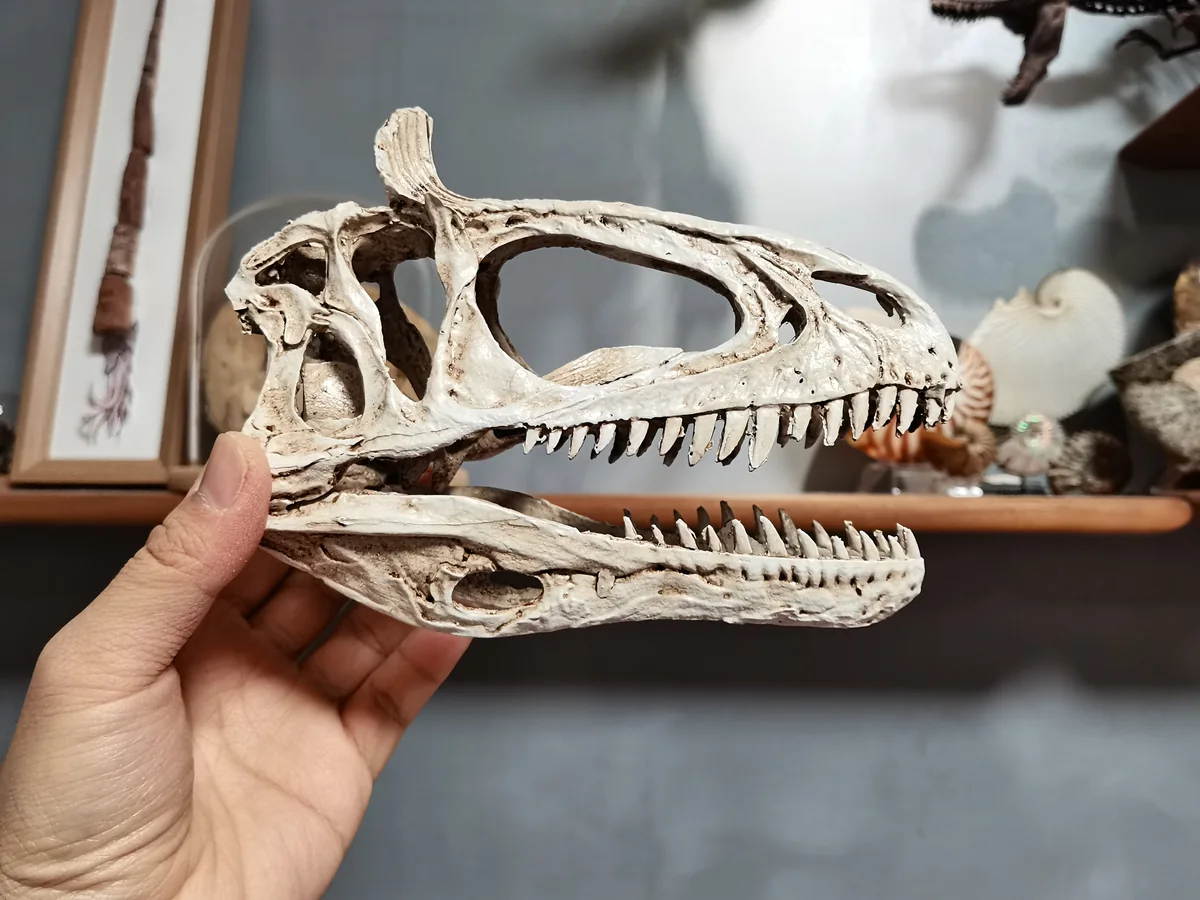
Three mounting options. A wall bracket holds the skull at eye height with the jaw line horizontal, which is the position that reads best from a standing distance. A plinth mount sets it on a steel rod at about 1.4 metres, good for a gallery where visitors walk around the piece. A low case mount tilts the skull forward slightly so it reads from above.
The bracket is a separate assembly, so a piece can be moved between wall and plinth later. If you plan to do that, order both fittings at the start; matching them afterwards is possible but the mounting holes will not line up.
At 580 mm the skull weighs about 4.2 kg with its bracket, which is one hand for a fitter and two hands for anyone else. That matters more than it sounds: a skull on a wall bracket gets taken down for cleaning, and a piece that is awkward to lift gets cleaned less often than it should.
The 1:2 version comes in at about 900 g and can be handled freely. It is the version we recommend for teaching collections and for any display where the object is passed around, because the crest survives being set down on a table and the full-size one does not.
Balance is the other consideration. A theropod skull is front-heavy, so a plinth rod should be set behind the jaw hinge rather than under the centre of the skull. Get that wrong and the piece tips forward every time it is touched.
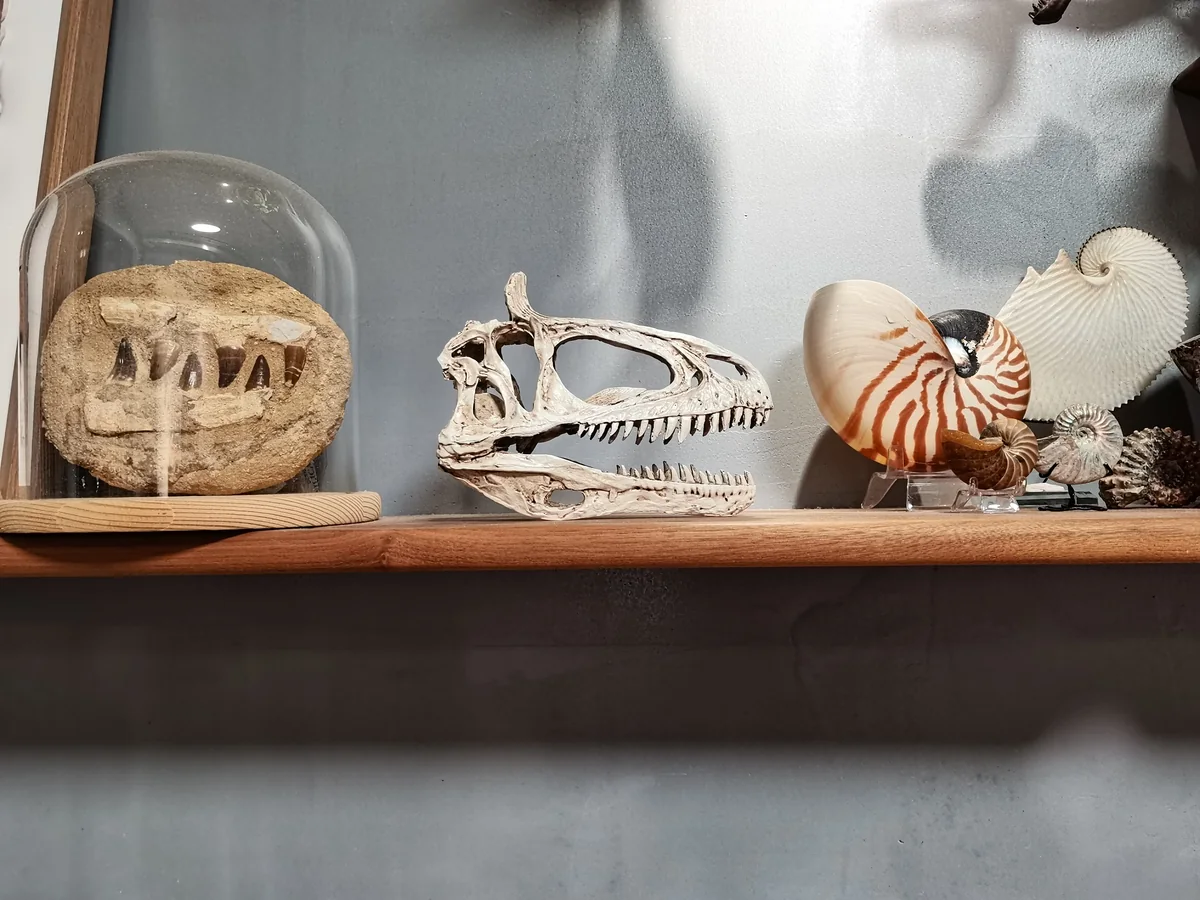
Cryolophosaurus reads best next to something larger and something smaller. Pair it with a tyrannosaur skull to make the crest look as odd as it is, or with a small dromaeosaur to show how much of the theropod body plan is shared across two hundred million years of separation.
If the case is being built around the comparison, keep the skulls at the same scale rather than at the same size. Mixing scales is the fastest way to turn a scientific comparison into a row of objects, because the visitor starts comparing sizes rather than anatomies.
We finish comparative orders to a single tone so the pieces read as a set. That is a decision worth making at the start rather than after the first two arrive and turn out to be different shades of bone.
| Species | Cryolophosaurus ellioti |
|---|---|
| Age | Early Jurassic, roughly 194 to 188 million years ago |
| Type | Skull reconstruction. Static, no mechanism |
| Skull length | 580 mm as standard; 1:2 scale also produced |
| Crest | Transverse sheet across the skull roof, cast separately and bonded |
| Teeth | Individually cast and set into the maxilla and dentary |
| Material | High-density resin with mineral pigment ageing finish |
| Mount | Steel wall bracket, plinth rod or low case mount, supplied to order |
| Weight | About 4.2 kg with bracket |
| Duty | Indoor as standard. Outdoor specification adds a UV-stable topcoat |
| Customisation | Scale, crest thickness, jaw position, mount type, label plate |
Is the crest fragile? It is the most exposed part, yes. We cast it as a thin section bonded to the skull rather than moulded with it, so it flexes instead of cracking, and it ships in a crate with two-sided support.
Can the jaw be posed open? Yes. The lower jaw is a separate casting on a steel pin, so it can be set at any angle and fixed with the set screw behind the hinge.
Is this a cast of the real fossil? No. It is a reconstruction from published measurements. The Antarctic material is incomplete, so any complete skull is partly inferred, including this one.
Do you supply a plinth? The plinth rod and the wall bracket are both available. Tell us the display height and we set the rod length before shipping.
Can it go outdoors? Only with the outdoor specification: UV-stable topcoat and a drainage path at the mount. Indoor is the default because that is where most are sited.
What scale should I order for a small gallery? At 580 mm the skull reads from about four metres. For a case under a metre wide, the 1:2 version holds the crest and the tooth row without crowding the space.
Can you match a specimen number for a label? We can supply the measurements we worked from so your label is accurate. We cannot supply a cast of a specific specimen.
Same factory and the same build standard. What changes is size, movement set and how the exhibit is meant to be used on site.
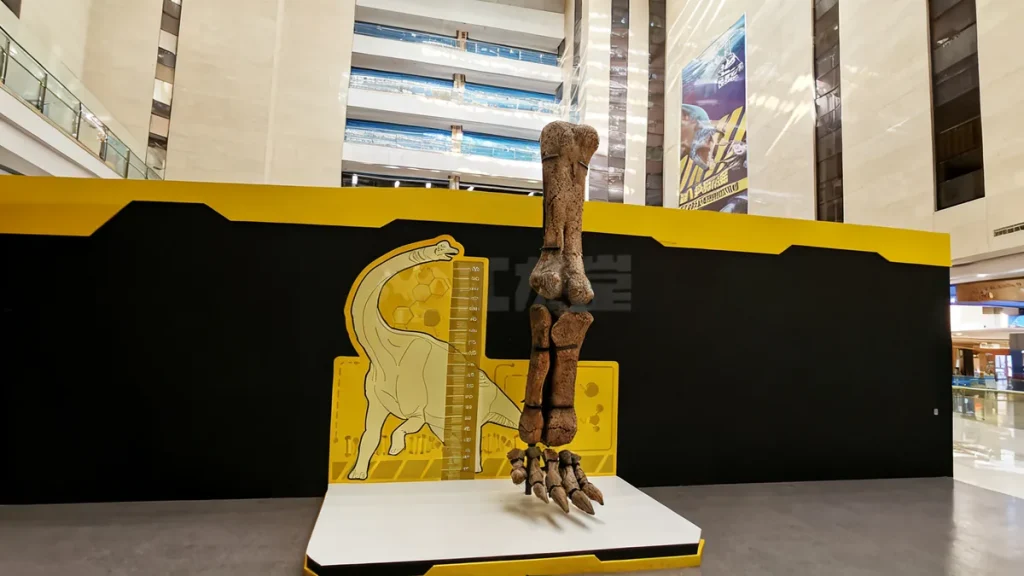
Single bones are the least glamorous thing we make and the most useful thing a museum can buy. They go on handling tables, into […]
View Product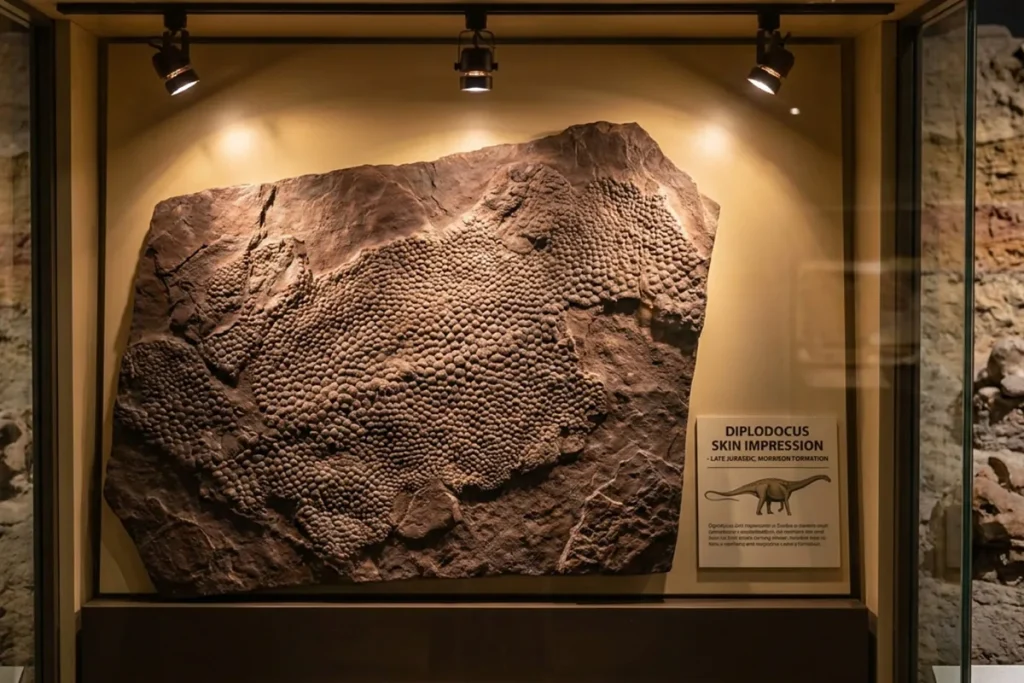
Skin impressions are the hardest fossil to fake and the easiest to ruin. Everyone knows what dinosaur skin is supposed to look like, which […]
View Product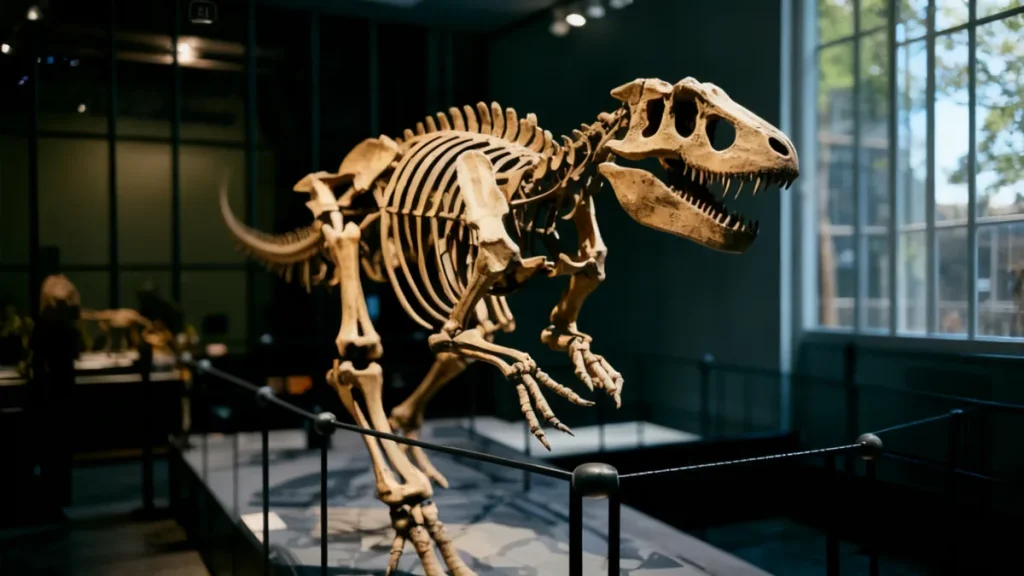
Above about ten metres a dinosaur skeleton stops being an exhibit and becomes a structure. The engineering changes category: wind load replaces handling as […]
View ProductThree things buyers usually want settled before they ask for a drawing — what drives the number, how the piece is actually built, and what to check between suppliers.
From fossil reference to finished skin — how proportions, texture, colour and weathering are decided, and what separates a realistic build from a cartoon one.
Read the guide →Frame, drives, skin, sensors, sound and weatherproofing — the six systems behind every animatronic dinosaur, and how each one changes cost and behaviour.
Read the guide →Choosing the right animatronic dinosaurs for your venue is not just about picking the most famous species — it is about matching each dinosaur […]
Read the guide →Send your dimensions, movement requirements and installation site. You get a realistic budget range and a dated build schedule.
Or email info@hltdino.com — we reply within one business day.