Animatronic Animals
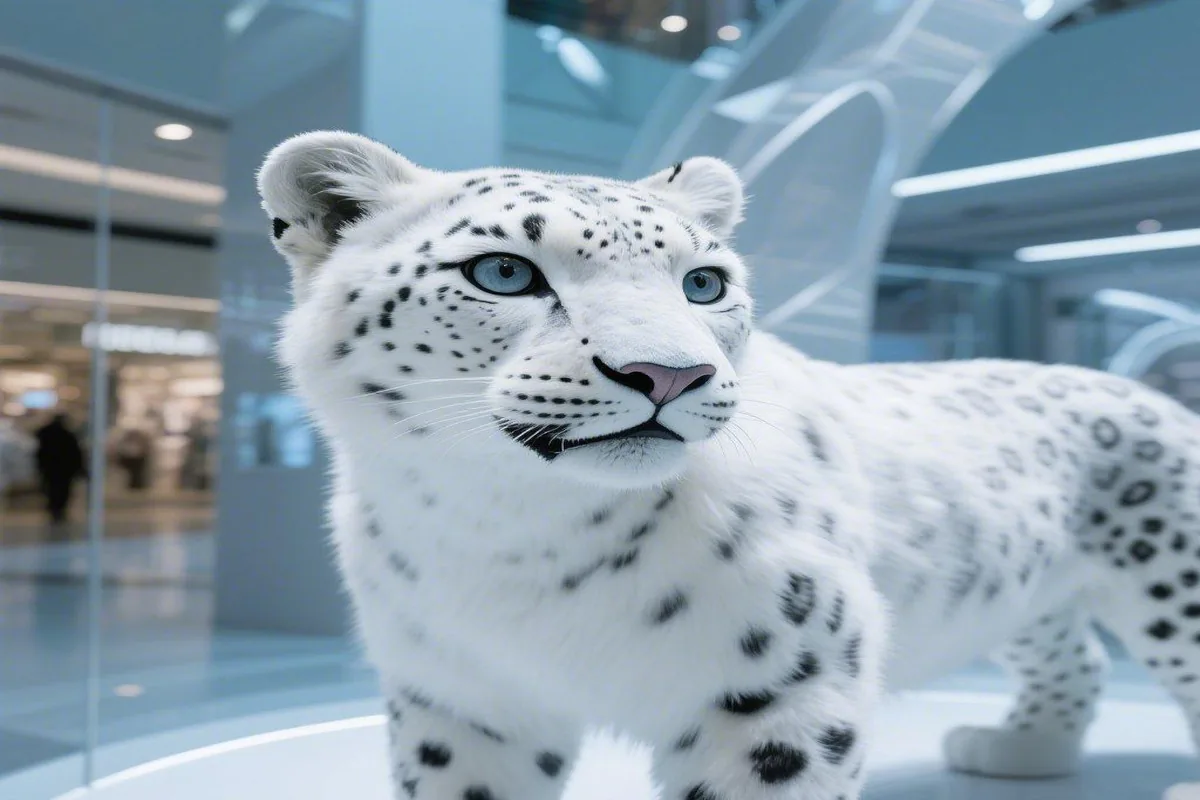
Animatronic Snow Leopard
Life-size animatronic snow leopard with a full-length balancing tail, rosette-painted coat and chuff call. Built for mountain zoo zones and highland halls.
Life-size animatronic snow leopard with a full-length balancing tail, rosette-painted coat and chuff call. Built for mountain zoo zones and highland halls.
Snow leopards are built for cliffs, not for flat ground. They have short forelimbs, huge paws, a tail nearly as long as their body, and a chest deep enough to hold the lung volume for altitude. That combination gives the animal a silhouette that is easy to describe and hard to model, because the proportions look wrong until you see them all together.
We build the animatronic snow leopard at life size, on that skeleton, with a working tail and a call library that matches the animal rather than the lion everyone expects.
| Product type | Animatronic snow leopard (Panthera uncia) |
|---|---|
| Body length | 1.0–1.3 m head to tail base |
| Tail length | 0.85–1.05 m, thick, articulated in three sections |
| Shoulder height | 0.55–0.65 m |
| Head | Short muzzle, heavy jaw ruff, articulated jaw, moving eyes |
| Coat | Hand-set fibre 25–45 mm with a 60 mm ruff and tail plume |
| Pattern | Hand-painted rosettes, no two models identical |
| Skin | Composite silicone over high-density foam |
| Frame | Galvanised steel, base plate or rock-mount bracket |
| Movements | Head turn and dip, jaw, blink, ear rotate, tail curl and sway, breathing, foreleg shift |
| Control | Sensor trigger, timed loop, handheld remote |
| Audio | Chuff, mew, moan and hiss; no roar (the species cannot) |
| Power | 110 V / 220 V, 300–600 W |
| Lead time | 30–40 days after drawing approval |
A snow leopard’s tail is close to body length and thick with fat and fur. It works as a balance counterweight on rock and as a blanket across the face in cold weather. On a model it does two jobs: it fixes the proportions, and it gives you a movement that costs almost nothing and reads immediately.
We build the tail in three articulated sections with a fibre plume that thickens toward the tip. The motion is a slow curl, not a cat flick. A quick flick reads as a domestic cat and undercuts the animal at once.
If the model is mounted on rock rather than a base plate, the tail is what we use to hide the structural link between the animal and the rock. That is a design decision worth making early, because retrofitting a tail route through a finished rock build is expensive.
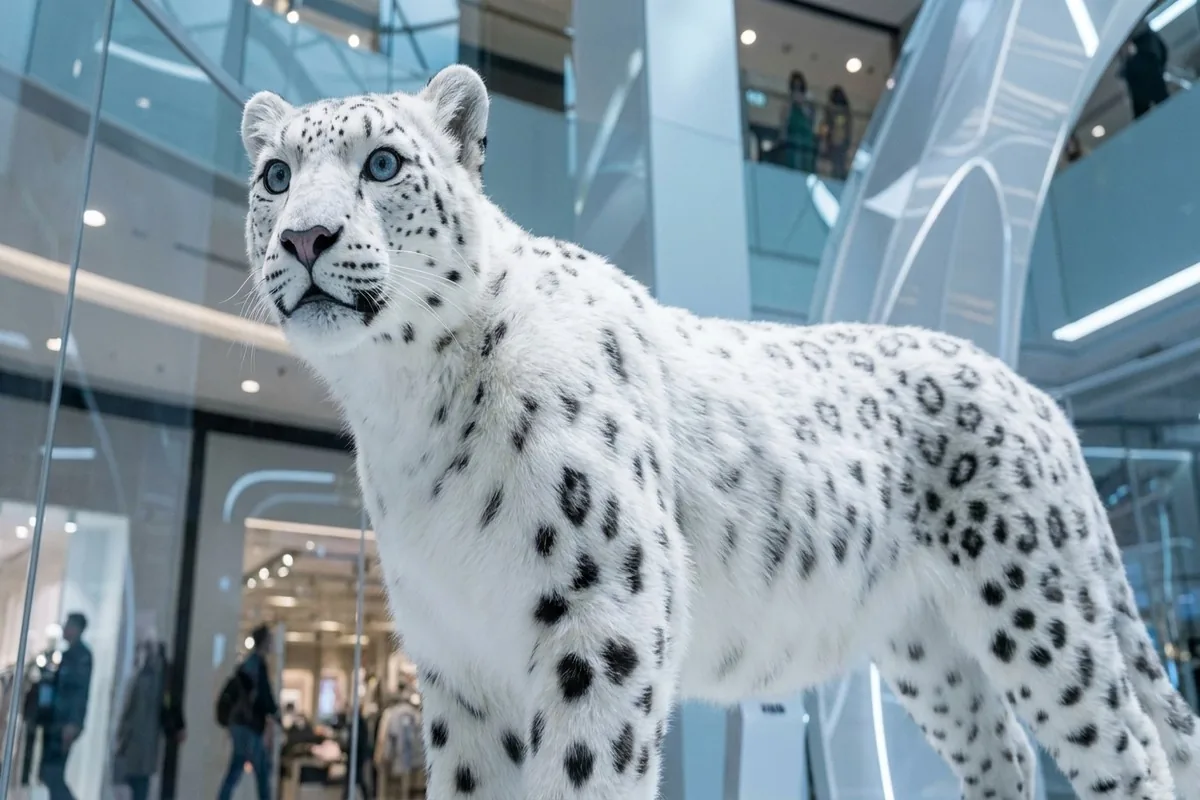
Snow leopard markings are rosettes: dark rings with a paler centre, larger on the flanks and smaller on the head and legs. The base coat is a smoky grey-white that gets paler on the belly. The ruff around the jaw is nearly white with dark edging.
Every model is painted individually. We work from a reference set of photographs and vary rosette density, size and ring thickness between units, because two identical snow leopards standing next to each other is the fastest way to make an exhibit look manufactured. If the client supplies a reference animal, we match it.
Two paint details decide whether the face works: the dark tear line from the inner eye down the muzzle, and the black edging under the jaw ruff. Both are small. Both are what people recognise without being able to say why.
Snow leopards lack the fully ossified hyoid that lets big cats roar. What they do instead is chuff: a short, soft, repeated breath through the nose, used as a greeting. They also mew, moan and hiss.
Almost every cheap snow leopard prop ships with a lion roar, and it makes the exhibit wrong in a way most visitors feel without being able to name. Our standard library is chuff, mew, moan and hiss. If the site wants something more dramatic, the honest option is to add a wind or rockfall sound to the scene rather than to make the animal roar.
Two mounting conventions cover most sites. The floor set is a fibreglass rock base with the animal standing or stepping, which is what a zoo uses when the model goes into a landscaped zone. The cliff set bolts the animal to a wall or rock face with the forelegs on a ledge, and it is what museums use when the exhibit has to occupy vertical space.
The cliff set reads better because it matches how the animal actually lives, but it needs a structural fixing rated for the model’s weight plus the moment arm of a moving head. We ask for the wall construction before drawing, not after.
Mountain and highland zones are the obvious placement. Zoos running a Himalayan or Central Asian section use it next to a giant panda for the same altitudinal story, and next to a tiger when the theme is big cats across habitats. Our animatronic animal range is built at consistent scale for exactly this kind of grouping.
Malls use it too, and it works better than a lion or a tiger in that setting. The pale coat photographs well under cool retail lighting, and the animal is unfamiliar enough that people stop to work out what it is.
Yes, and it is the most convincing pose. A resting animal uses fewer axes, costs less than a standing build, and matches the way snow leopards are usually seen in the wild and in zoos.
About 2.1–2.3 m nose to tail tip. Allow 2.5 m of floor or ledge length so the tail curl does not foul a wall.
Yes with the outdoor specification, which adds a UV-stable fibre treatment and a sealed enclosure. The pale coat is the part that ages fastest outdoors, so we recommend a cover for units in direct summer sun.
We recommend it. Base coat tone, rosette density and ruff size are all varied between units at no extra cost, and a pair that differs reads as two animals rather than one product.
Yes, internal speaker with the four-call library. For a cliff set high on a wall we can run the speaker at the ledge rather than in the body, so the sound arrives at visitor height instead of above their heads.
Same factory and the same build standard. What changes is size, movement set and how the exhibit is meant to be used on site.
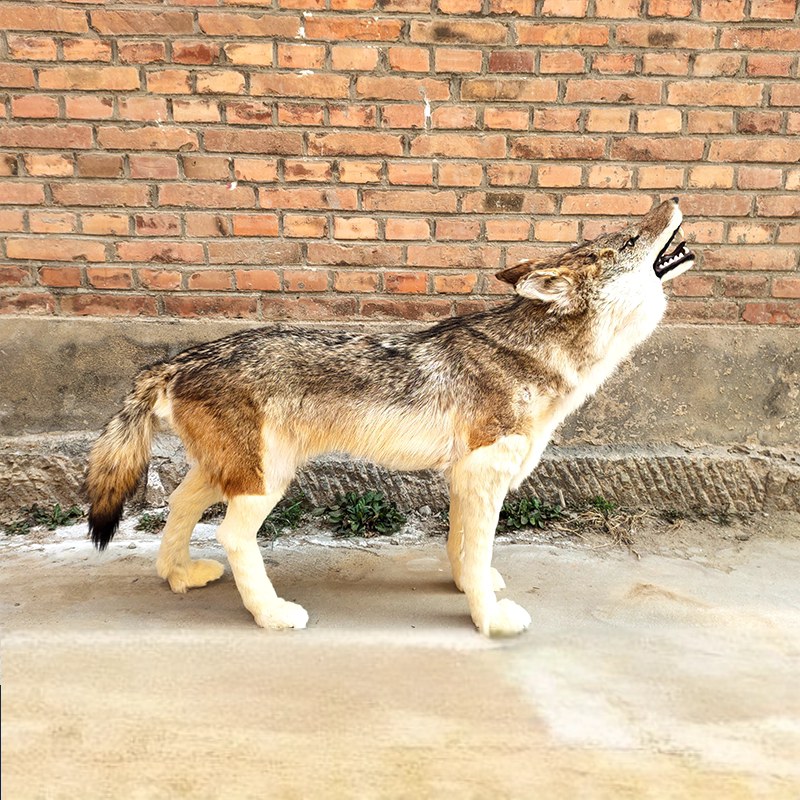
A wolf is read from the head and the coat — the upright ears, the long muzzle and the thick layered fur are what […]
View Product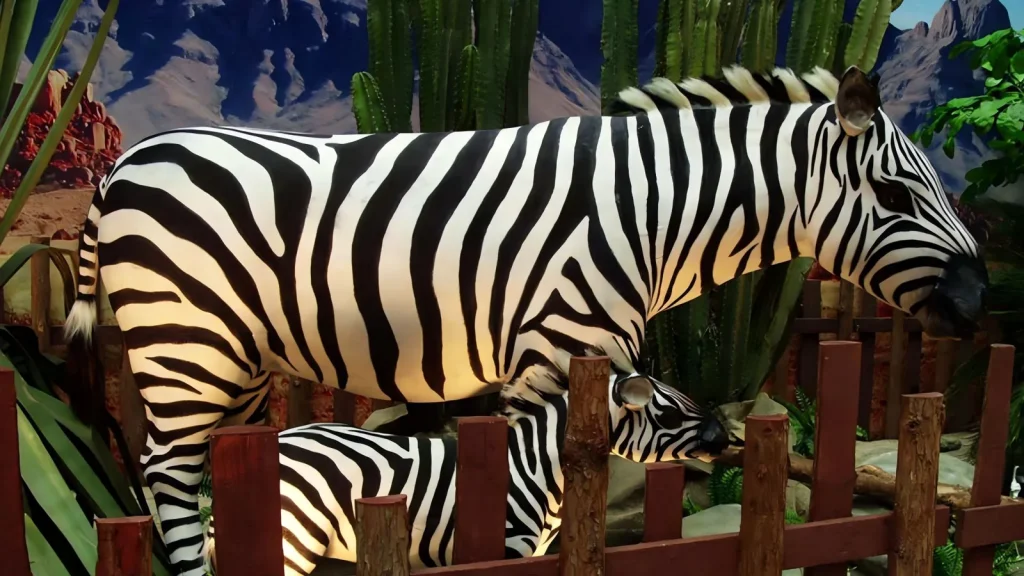
Life-size animatronic zebra mare and foal with individually painted stripes and coordinated mother-and-offspring behaviour for savanna exhibits.
View Product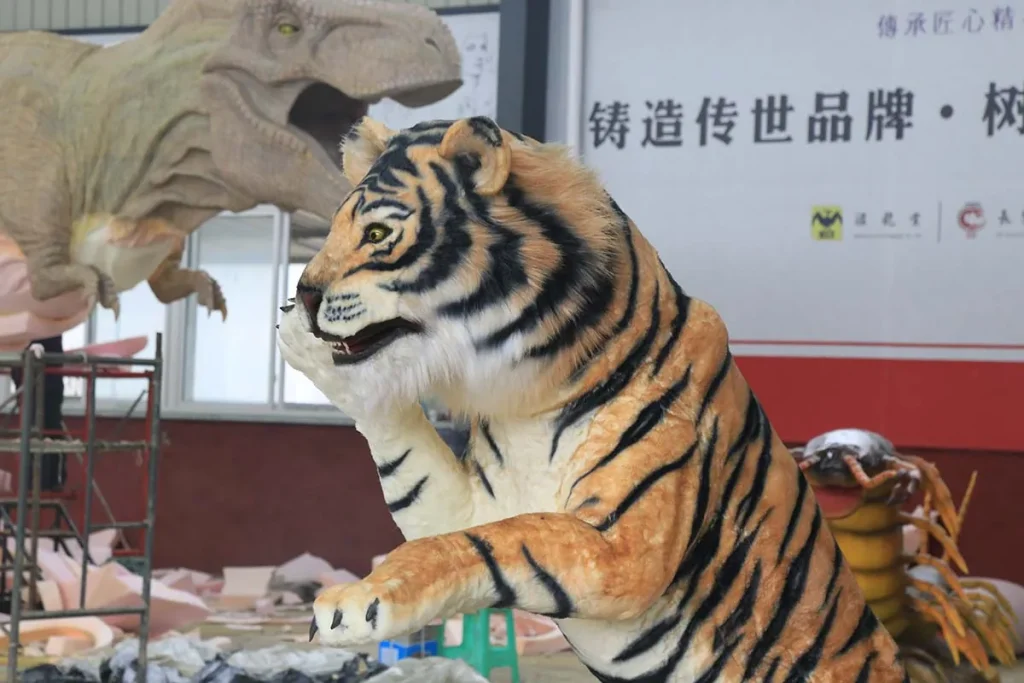
A life-size tiger built to zoo-grade anatomy — 2.6–3.1 m, slow stalking motion, painted stripe detail.
View ProductThree things buyers usually want settled before they ask for a drawing — what drives the number, how the piece is actually built, and what to check between suppliers.
Extinct and hard-to-keep species, sculpted to anatomy keepers can check — where animatronic animals earn a place beside a living collection.
Read the guide →From fossil reference to finished skin — how proportions, texture, colour and weathering are decided, and what separates a realistic build from a cartoon one.
Read the guide →How Much Does an Animatronic Dinosaur Cost? Understanding the Key Cost Factors If you are planning a museum exhibition, theme park attraction, or promotional […]
Read the guide →Send your dimensions, movement requirements and installation site. You get a realistic budget range and a dated build schedule.
Or email info@hltdino.com — we reply within one business day.