Ice Age Animals
Animatronic Dire Wolf
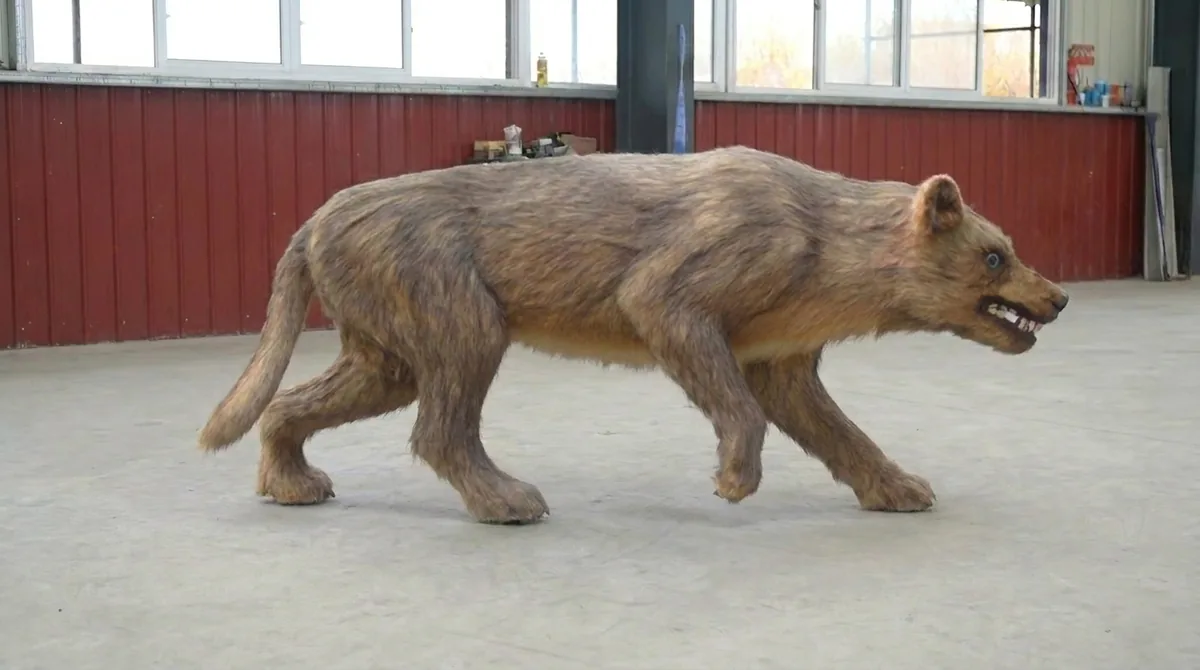
Life-size animatronic dire wolf built on the Aenocyon skeleton: heavy skull, short legs, deep chest. Single animal or pack staging for ice age halls.
Life-size animatronic dire wolf built on the Aenocyon skeleton: heavy skull, short legs, deep chest. Single animal or pack staging for ice age halls.
Most visitors cannot tell a dire wolf from a grey wolf, and that is the whole problem with building one. If the model looks like a big wolf, the exhibit fails, because the point of the animal is that it was not a big wolf. It was heavier, shorter in the leg, thicker in the jaw, and built to crush rather than to chase.
We build the animatronic dire wolf on the Aenocyon dirus skeleton, at life size, as a single animal or as a staged pack. Here is what actually differs, and what the mechanics have to do to make the difference visible.
| Product type | Animatronic dire wolf (Aenocyon dirus) |
|---|---|
| Overall length | 1.7–1.9 m nose to tail base |
| Shoulder height | 0.75–0.85 m |
| Body mass reference | Roughly 25% heavier than a grey wolf of the same height |
| Head | Oversized skull, heavy zygomatic arches, articulated jaw with cast canines |
| Coat | Hand-set fibre, 30–70 mm, coarse guard hair over a dense underlayer |
| Skin base | Composite silicone over high-density foam, cast muscle groups |
| Frame | Galvanised steel, bolted base plate |
| Movements | Head turn and dip, jaw open and close, blink, ear flick, tail sway, breathing |
| Control | Sensor trigger, timed loop, handheld remote |
| Audio | 2–5 vocalisations, 75–85 dB at 1 m, night volume limit |
| Power | 110 V / 220 V, 300–600 W |
| Weather | Indoor standard; outdoor build adds sealed enclosure and drainage base |
| Lead time | 25–35 days after drawing approval |
Two measurements do most of the work. The skull is large relative to the body, and the legs are short relative to the torso. In a side view that combination gives the animal a low, forward-weighted profile. In a three-quarter view it gives the shoulders a bulk that a grey wolf does not have.
At model scale this is easy to get wrong in the direction of exaggeration. Push the head too large and the animal looks like a cartoon. We work from skull measurements on published Aenocyon material and keep the head inside the range those give, then let the neck muscle and the shoulder cast do the rest.
The jaw is where visitors read the species. Dire wolf jaws are deep, and the jaw-closing muscles had room that a modern wolf’s skull does not offer. We cast the masseter and temporalis groups as visible planes under the coat rather than smoothing them out, because a smooth cheek removes the one feature that makes the head look heavy.
A single dire wolf standing neutral reads as a large dog. The same model in a walking stance with the head carried low reads as a predator. We build three standard rest poses and recommend the walking stance for standalone display:
Walking, head low. The default. Reads as hunting without being aggressive, and works in front of mixed-age audiences.
Standing over a kill. Head down, shoulders forward, jaw partly open. Pairs with a cast carcass prop. Strong in tar pit and La Brea style exhibits, less suitable for family zones.
Pack arrangement. Three to five animals at different angles around a shared prop, with the sensors daisy-chained so only the nearest animal triggers. This costs less than most operators expect, because the pack shares one controller and one audio source with per-unit addressing.
Dire wolf reconstructions vary in colour, so the honest approach is to pick a defensible palette and commit. We use a tawny base with a darker dorsal stripe, pale underside and a grey mask around the muzzle, which is close to the common reconstruction and photographs well under mixed museum lighting.
The fibre itself is set in three passes: a dense underlayer punched close to the skin, a mid layer at 45–55 mm, and a guard layer set at the shoulder, neck and tail at up to 70 mm. Brushing after the last pass is what stops the coat looking like a carpet. It is also the step most factories skip.
The natural home is an ice age gallery next to a woolly mammoth and a woolly rhino, with the wolf as the predator that explains why the herbivores are armoured and enormous. Our ice age range is sized so the three read as one scene at a common horizon line.
Zoos use it in Pleistocene zones for the same reason. The comparison with a living wolf enclosure thirty metres away does the interpretation without labels, and it is the cheapest way to add a second, contrasting predator story to a site that already has living canids.
Drawing, then a one-sixth maquette for proportion sign-off, then full-size foam sculpture over a galvanised frame. The skin is moulded in three sections, the head is separate, and the coat is set after assembly so the seams disappear under fibre instead of showing at the join.
Crated weight is 60–110 kg depending on pose. One person can move a single animal; the bolted base plate takes four bolts into a concrete or timber deck. We send a commissioning sheet and a short video of the animal running its cycle before packing.
Yes. Packs of three, four or five share a single controller with per-animal addressing, and only the nearest animal triggers on approach. Beyond five the cabling run gets long enough that we usually recommend a second controller.
The jaw closes to a stop, not under load. For a prop in the mouth we cast it as a separate light piece and fix it to the lower jaw so the movement does not carry its weight.
75–85 dB at one metre, adjustable. For indoor halls with glass nearby we set a night limit and a softer call library, because a wolf howl in a hard-surfaced gallery is louder than the meter suggests.
The walking stance is deliberately built not to be. If the site is family-oriented we reduce jaw amplitude and swap the aggressive call for a social whine, which changes how the same model reads more than any paint change would.
Yes, and it is the cheapest variant. A resting animal needs no walking frame, uses fewer axes and ships in one piece. Museums with limited floor space often take one standing and one resting animal rather than two standing.
Same factory and the same build standard. What changes is size, movement set and how the exhibit is meant to be used on site.
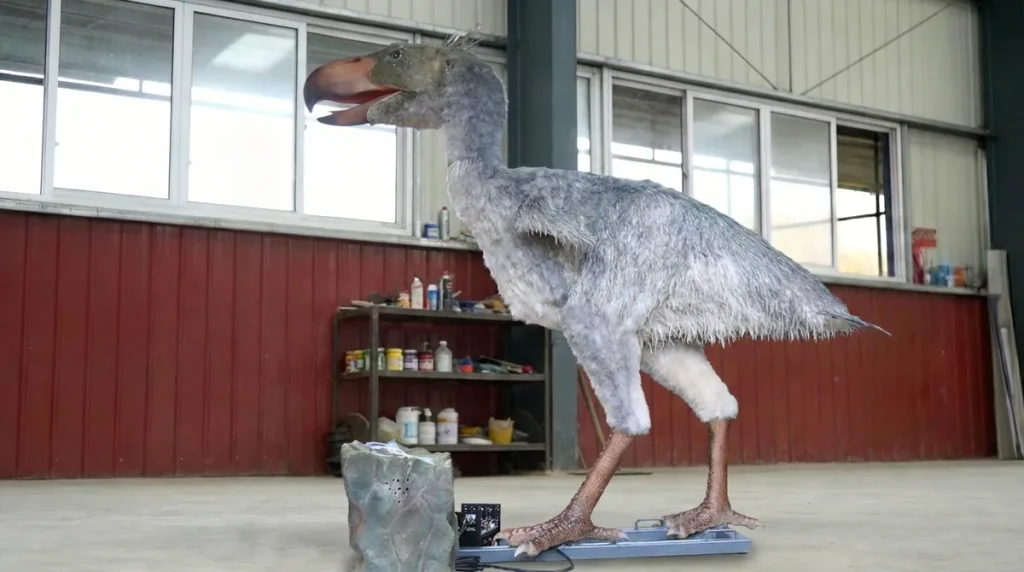
Life-size animatronic terror bird with a 65 cm hooked skull, bare legs and a striking cycle. A flightless South American predator for fossil halls.
View Product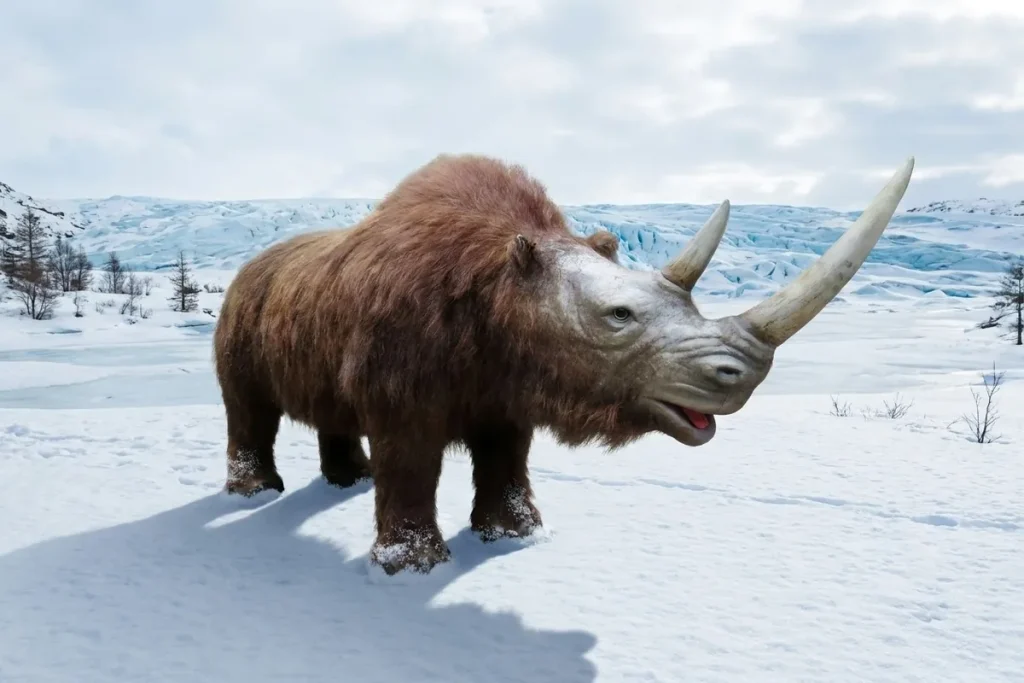
Life-size animatronic woolly rhino with a two-horn head, hand-layered coat and a slow walking cycle. Built for ice age halls, zoo zones and museum dioramas.
View Product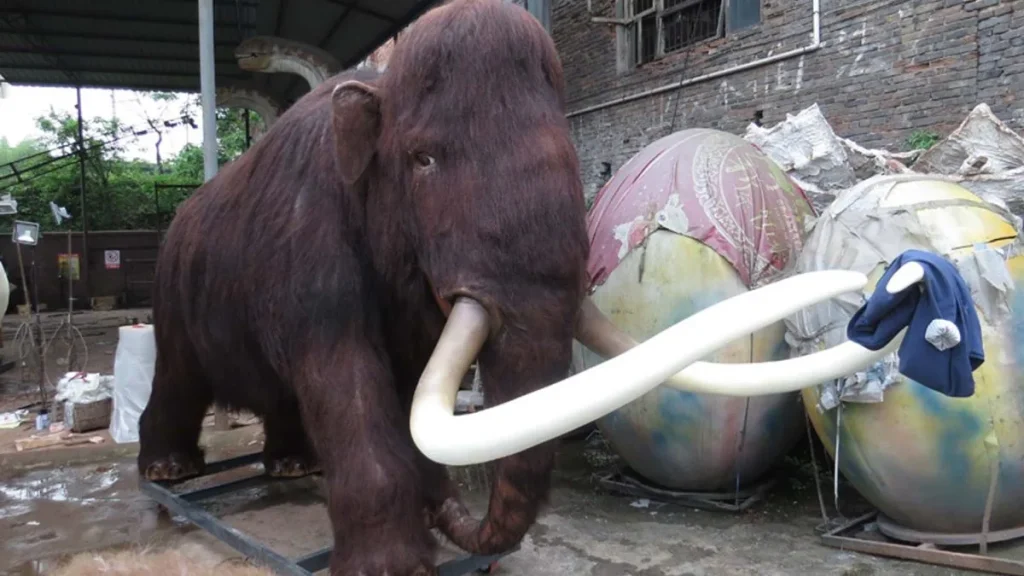
Life-size animatronic woolly mammoth — 4 m at the shoulder, 3 m tusks, articulating trunk and proximity triggers for Ice Age halls.
View ProductThree things buyers usually want settled before they ask for a drawing — what drives the number, how the piece is actually built, and what to check between suppliers.
Extinct and hard-to-keep species, sculpted to anatomy keepers can check — where animatronic animals earn a place beside a living collection.
Read the guide →From fossil reference to finished skin — how proportions, texture, colour and weathering are decided, and what separates a realistic build from a cartoon one.
Read the guide →If you are planning a museum exhibition, theme park attraction, or shopping mall event, you have probably asked this question: How much does a life […]
Read the guide →Send your dimensions, movement requirements and installation site. You get a realistic budget range and a dated build schedule.
Or email info@hltdino.com — we reply within one business day.