Animatronic Dinosaurs
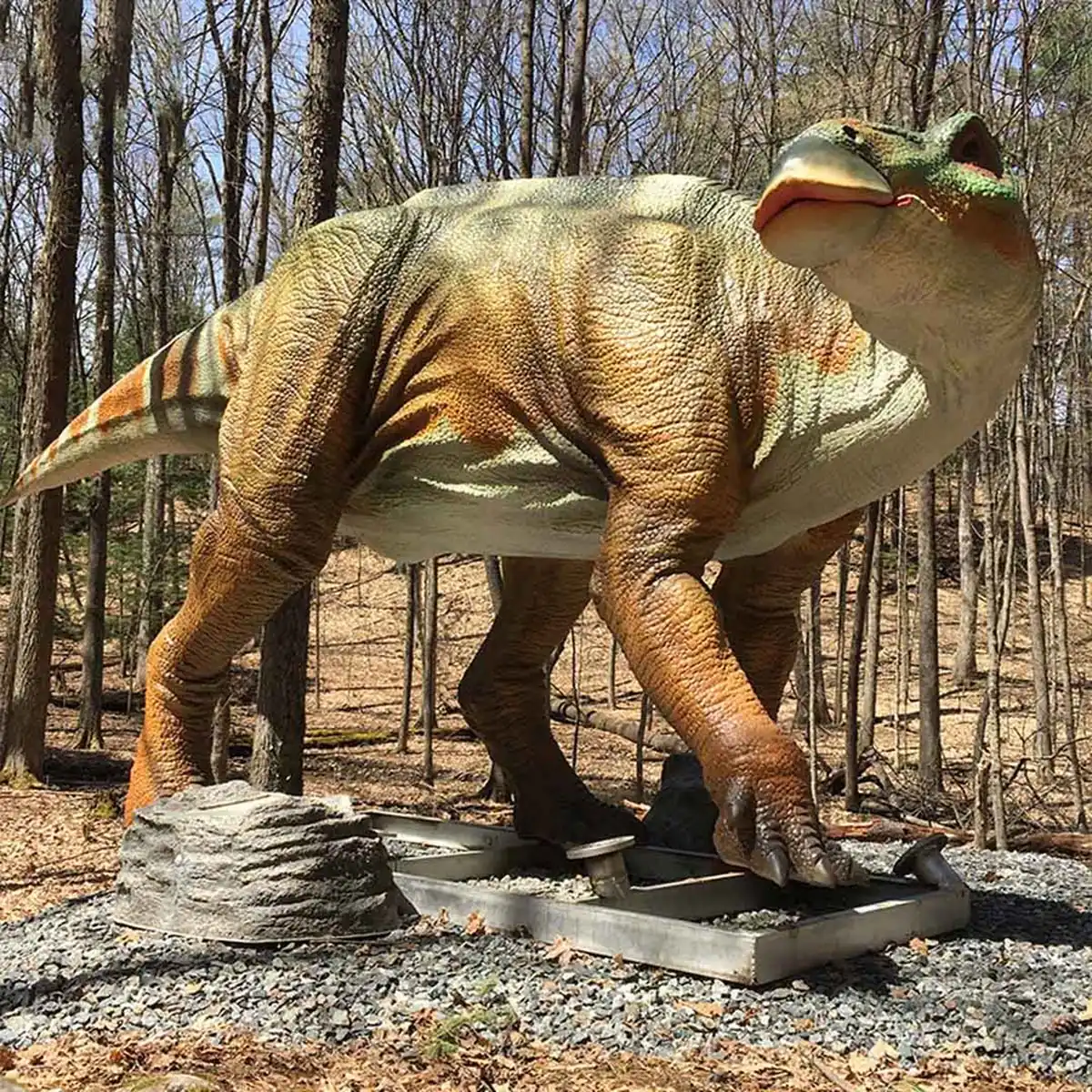
Life-Size Animatronic Iguanodon
A 10 m animatronic Iguanodon with the correct thumb spike, a two-or-four-legged stance and a museum-grade finish — built for education trails.
A 10 m animatronic Iguanodon with the correct thumb spike, a two-or-four-legged stance and a museum-grade finish — built for education trails.
Iguanodon has a specific problem that no other dinosaur exhibit has: almost every visitor arrives with a wrong picture of it. The animal was reconstructed as a squat, four-legged rhinoceros-like creature for most of the nineteenth century, and the image stuck in popular culture long after the science moved on. A build that gets the anatomy right will be quietly doubted by people who are certain they already know what an Iguanodon looks like.
| Product type | Large electric animatronic dinosaur model |
|---|---|
| Overall size | Length 10 m, height 3 m in the bipedal stance — full custom sizing |
| Power | 110 V / 220 V, specified per site |
| Power draw | 400–1400 W depending on movement count |
| Control | Industrial single-chip controller · sensor trigger · remote · coin-op optional |
| Materials | National-standard steel frame · first-tier servo motors · high-density foam · composite silicone skin · elastic fibre mesh reinforcement |
| Movements | Jaw open and close · head turn and nod · neck raise and lower · tail sway · eye blink · breathing · forelimb raise |
| Weather rating | −20 °C to +60 °C, outdoor rated |
| Lead time | 30–45 days after drawing approval |
The single cone-shaped spike on the first digit is the animal’s diagnostic feature and the part most often placed incorrectly. It does not sit on the palm, it does not point forward like a weapon, and it is not a claw on the second digit.
It sits on the thumb, angled up and slightly inward, and on a life-size build it is roughly 30 cm long. Get the angle wrong and the hand reads as a generic three-fingered claw — which is what most models in the market have, because the hand is small and nobody checks.
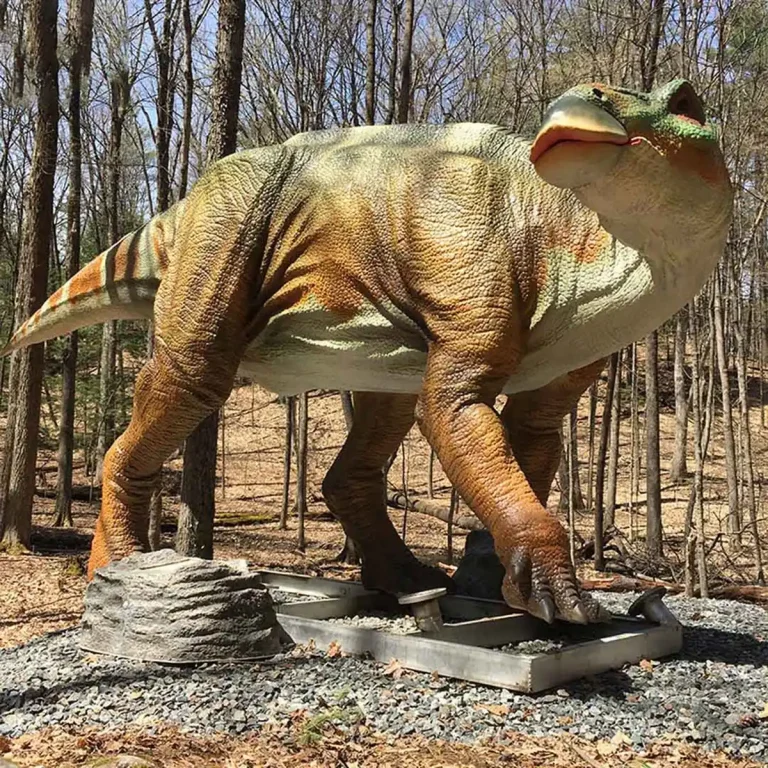
We cast the spike separately in a harder compound and mount it on its own boss on the hand, so it holds a sharp edge under its own weight. It is also the first thing that gets broken by visitors, so it is designed to be replaced without re-skinning the arm.
Iguanodon was originally restored as a quadruped and is now understood as an animal that walked and fed on four legs but could rear and move on two. Both are defensible, and the choice should be made against the site rather than against a preference.
Bipedal at 3 m makes a better silhouette on a trail and reads as active from a distance. Quadrupedal at 2 m puts the head at child height and works better in a walk-through or a discovery zone where the exhibit is meant to be examined rather than seen.
The frame is the same either way, but the balance weights, the hip drive and the tail base all change. Specify the stance at brief stage — converting afterwards is a rebuild of the hips, not an adjustment.
The head is the second place a build succeeds or fails. Iguanodon has a beak — a genuine keratinous cropping beak on the upper jaw, not a pointed snout — and a jaw joint set below the tooth row, which gives the face its slightly down-turned profile.
That down-turn is what makes the animal look like it is chewing rather than snarling. Build the jaw hinge in line with the teeth and the face becomes a theropod face on an ornithopod body, which is exactly the mistake a visitor who only knows the old reconstructions will not be able to spot but will feel.
The skin is finished with a matte, slightly coarse surface rather than a glossy one. Large ornithopods are usually restored with a hide that reads as thick, and a high-gloss finish makes a three-metre animal look inflated.
Bipedal or quadrupedal? Both are available. Bipedal for trail silhouette, quadrupedal for close viewing and education zones. Decide before the frame is laid out.
Can the stance be changed later? No — not without rebuilding the hip assembly. This is a brief-stage decision.
Is the thumb spike likely to break? It is the most exposed part on the model, and on a public site it will eventually be knocked. It is a replaceable part with a stock spare, and swapping it takes minutes.
How much does the historical story matter? More than usual for this species. If the exhibit is in an education setting, we supply the corrected reconstruction notes and can quote a graphic panel explaining what changed since 1825.
Can it run on a sensor? Yes, standard. A trigger that starts the head and jaw sequence as visitors approach works well here, because the animal’s movement is slow and the reaction reads as curiosity.
A ten-metre animal ships in four sections with the head and hands crated separately. Assembly is typically one day with a small crane, followed by a full motion test and a hand and spike inspection before handover.
Every project ships with a spare-parts list, a maintenance guide and the wiring diagram. Servo units and the jaw drive are individually replaceable on site.
Related. the full animatronic dinosaur range, the Hadrosaurus build, museum placement and layout.
Same factory and the same build standard. What changes is size, movement set and how the exhibit is meant to be used on site.
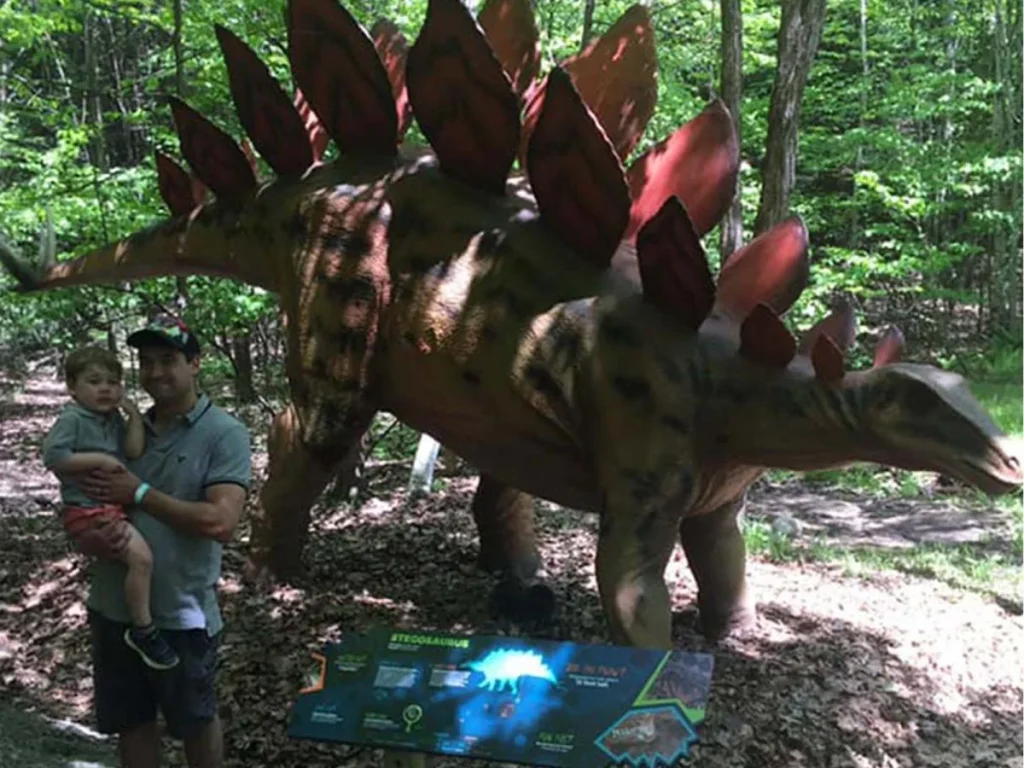
A Stegosaurus is the easiest dinosaur to recognise and one of the harder ones to build. The plates are the reason: a 7-metre animal […]
View Product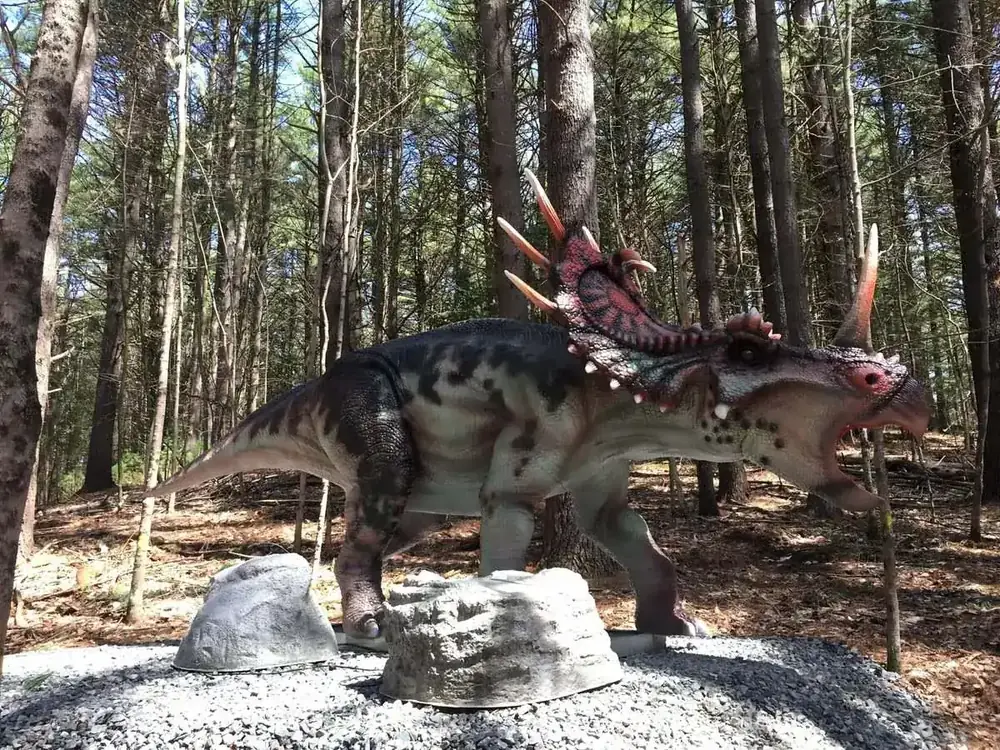
Styracosaurus gets mistaken for a Triceratops more than any other animal in the catalogue, and the mistake is worth correcting because it is the […]
View Product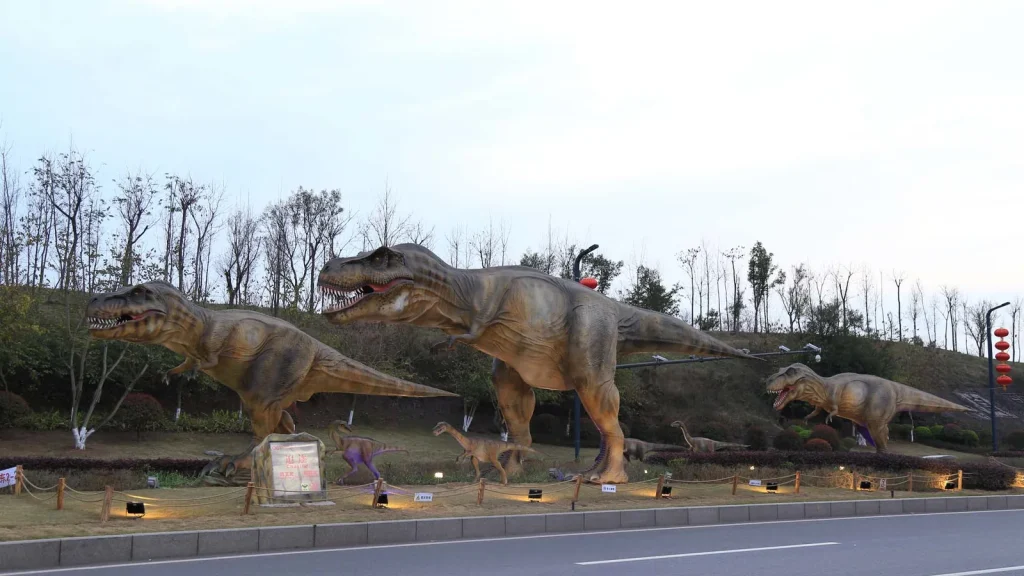
A life-size animatronic T-Rex built to your dimensions — 4–12 m body length, six to twelve motion axes, sensor or remote control.
View ProductThree things buyers usually want settled before they ask for a drawing — what drives the number, how the piece is actually built, and what to check between suppliers.
Animatronic Dinosaur Buying Guide for Museums & Theme Parks Choosing the right animatronic dinosaur for your museum, theme park, or zoo is one of […]
Read the guide →From fossil reference to finished skin — how proportions, texture, colour and weathering are decided, and what separates a realistic build from a cartoon one.
Read the guide →Why Motor Choice Matters More Than Buyers Expect Motor selection is usually treated as a manufacturing detail. It is not. It is the decision […]
Read the guide →Send your dimensions, movement requirements and installation site. You get a realistic budget range and a dated build schedule.
Or email info@hltdino.com — we reply within one business day.