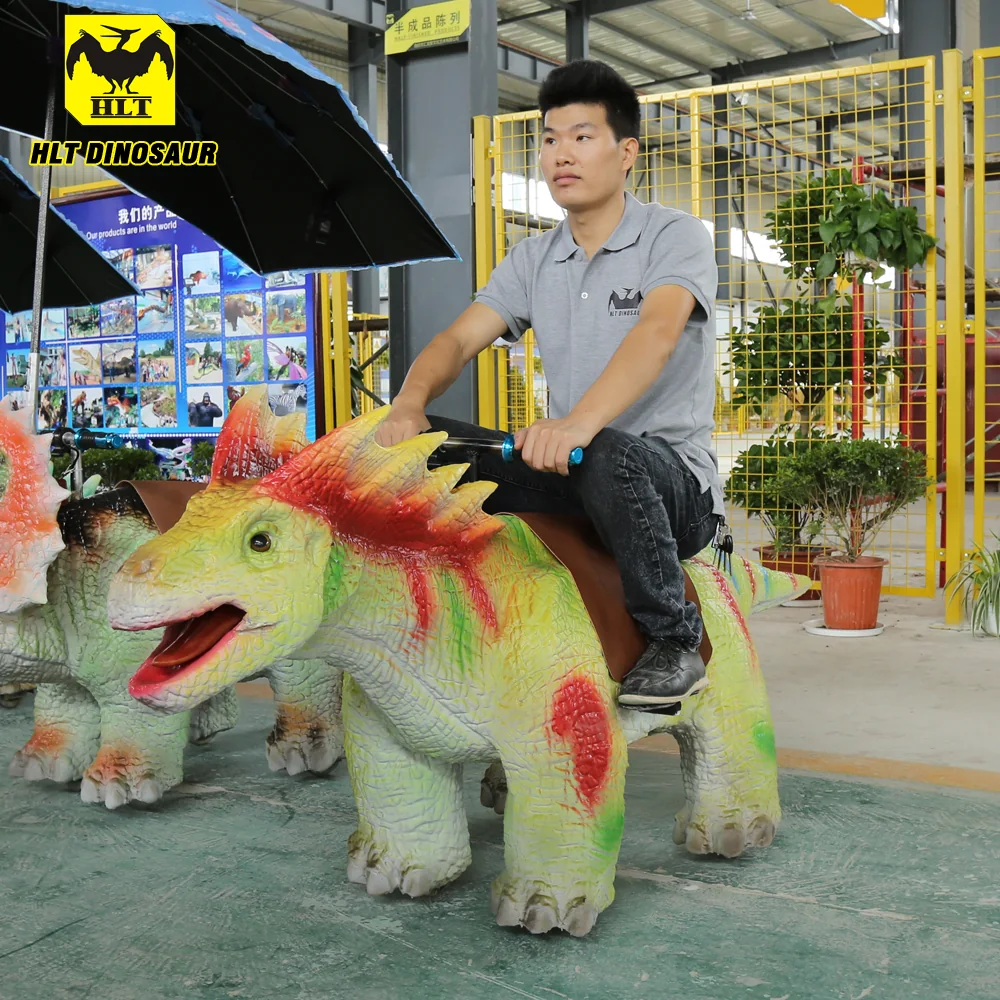
Dinosaur Rides
A single-seat kiddie ride earns per child and queues per child. A four-seat unit earns four times per cycle on the same footprint and the same staff attention, which is the entire commercial case for a larger machine — and the entire engineering problem, because four riders means four load paths and a drive that has to move them together without one seat bucking while another is still.
This is the four-seat version of our dinosaur ride: independent saddles on a shared platform, a full animatronic head above them, and a control system that runs either from coins or from an attendant.
| Species | Generic theropod — species styling to order |
| Era | Cretaceous styling, fictional-friendly |
| Type | Multi-seat coin-operated ride, four independent saddles on a shared platform |
| Size | About 4.5 m long × 2.2 m wide; 1.9–2.3 m at the head; saddle height 0.9–1.0 m |
| Material | Welded steel chassis, foam body, patented silicone skin (ZL 2022 1 0224489.5); saddles in moulded composite with steel subframe |
| Surface | Hand-painted UV-resistant pigment, scuff-resistant saddle finish, sealed body |
| Animation | Head rotation, jaw open and close, LED eye illumination, body sway on the ride cycle |
| Sound | Directional speaker, roar loop and ride jingle, volume capped at commissioning |
| Power | 110/220 V AC, four drive units about 1.1 kW each, dedicated circuit recommended |
| Installation | Level floor, no anchoring for supervised indoor use; 2 technicians, one day |
| Customisation | Species styling, colour scheme, ride duration, coin or attendant, seat belts, signage |
| Support | 12-month warranty; drive unit, coin mechanism and saddle pads field-replaceable |
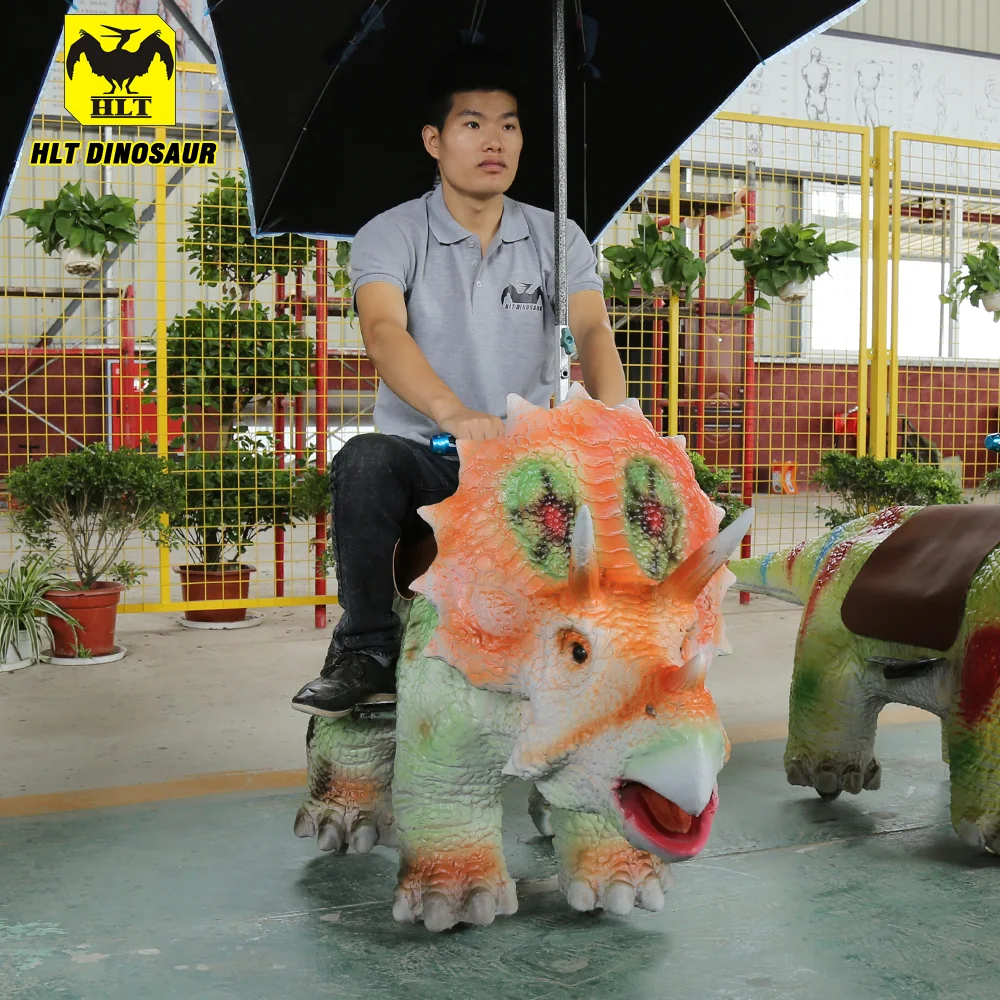
Each saddle sits on its own steel subframe tied into the chassis rather than sharing one spine. That matters because riders are not synchronised: an adult lifting a child off one saddle while another child bounces on the next produces a torsional load a single-spine frame handles badly.
It also makes the units serviceable individually. A failed drive on one saddle takes that seat out of service and leaves three earning, rather than stopping the whole machine for a parts order.
The head rotates, the jaw opens and closes, and the eyes illuminate on each cycle. That is deliberately a small movement set: on a four-seat machine the riders are watching each other and the parents are watching the head, so the head needs to be readable from three metres away rather than intricate up close.
The jaw cycle is timed to the ride rather than to a motion sensor. On a machine that is continuously occupied, a sensor-triggered reaction fires constantly and stops reading as a response. A timed cycle that restarts with each new ride reads as part of the attraction.
Coin operation on a four-seat ride has one practical complication: four children rarely arrive together. Either each saddle takes its own coin, which needs four mechanisms, or the machine runs as a single paid cycle with all four seats, which needs a short window for loading.
The second arrangement is what most operators choose, and it makes the attendant model attractive — a member of staff starts the cycle when the seats are full, which keeps throughput high and removes four mechanisms from the maintenance list.
It wants a level solid floor, indoors or under cover. Four drive units at about 1.1 kW each is a dedicated circuit rather than a shared socket, and the machine should not share that circuit with lighting on the same phase.
Noise is the item that gets underestimated. Four riders plus a roar loop in a mall concourse carries further than a single-seat ride, and volume is capped at commissioning for that reason. Where the position is close to retail frontage, the sound is usually set well below what the machine can deliver.
Yes. The same chassis is built with two saddles, which suits smaller footprints and lower-traffic positions. The head and drive specification stay the same.
Set at commissioning, typically ninety seconds to two minutes. Longer cycles raise dwell and lower throughput, so the setting is a trade-off the operator usually wants to make on site rather than at order.
A weekly check on saddle fixings and belts, a monthly check on the coin mechanism if fitted, and an annual inspection of the drive units and the head mechanism. Drive units are field-replaceable as complete assemblies.
For supervised indoor use on a level floor, no. Where it is sited outdoors or in an unsupervised area, the chassis is anchored — that is a site decision, and we supply the anchor points either way.
Same factory and the same build standard. What changes is size, movement set and how the exhibit is meant to be used on site.
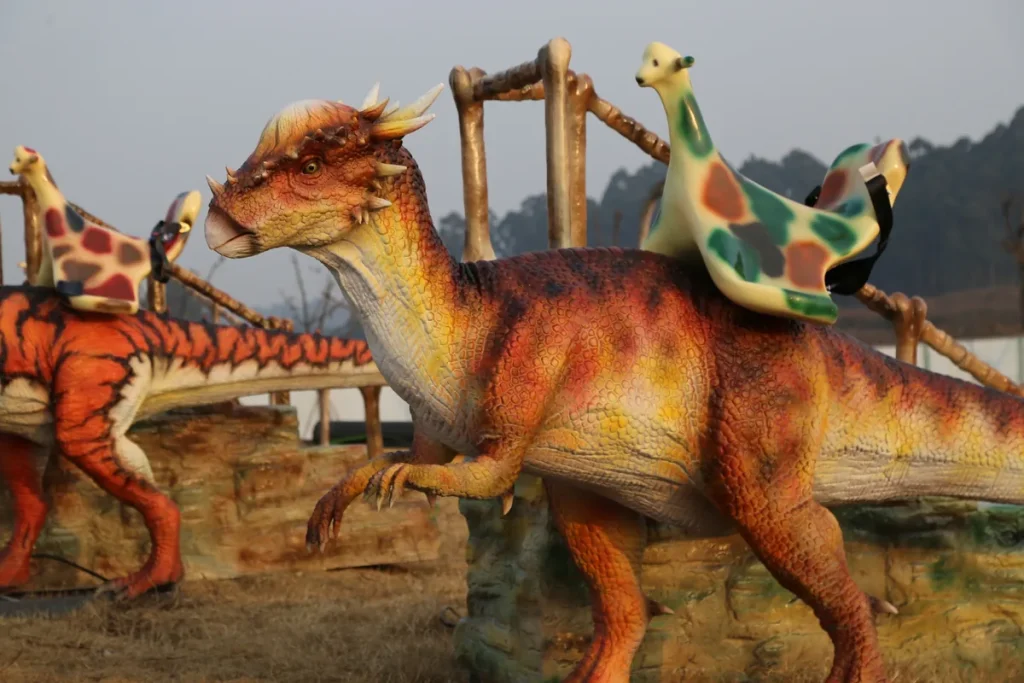
The Pachycephalosaurus is the quiet one. A low-noise drive, a soft-skinned body and a motion set that rocks rather than swings — this is […]
View Product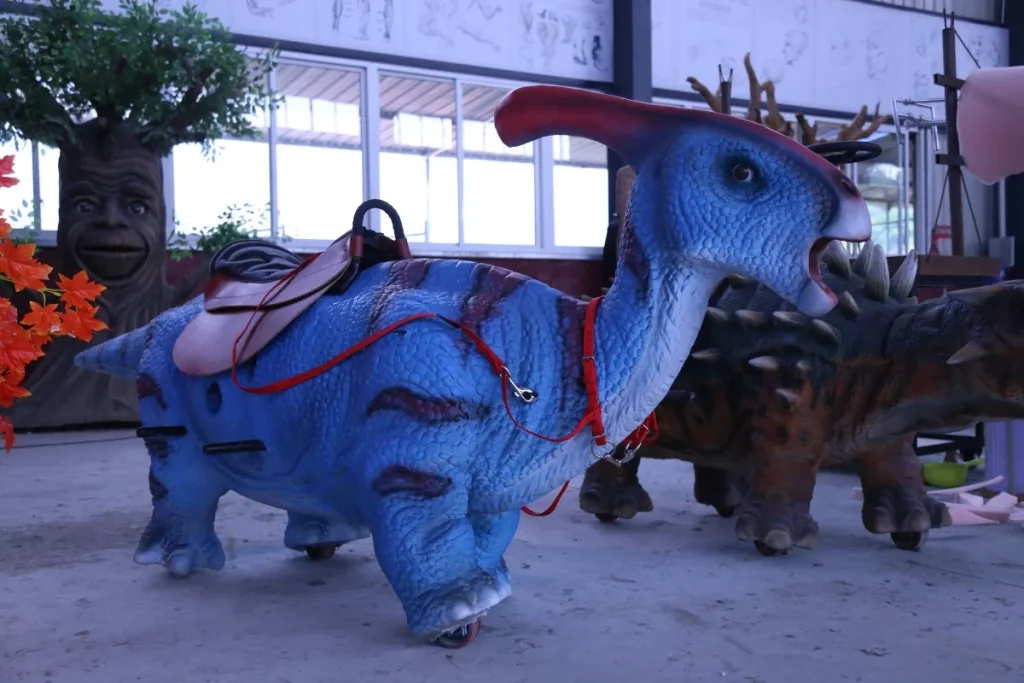
This is the small one in the fleet, and in a shopping mall it is usually the unit that earns. A 1.6-metre Parasaurolophus on […]
View Product
Most children’s rides in a park are the same three things: a horse on a pole, a car on a track, a rocker. They […]
View ProductThree things buyers usually want settled before they ask for a drawing — what drives the number, how the piece is actually built, and what to check between suppliers.
What Animatronic Products Are Actually Used For Buyers come to animatronic products with one of two jobs in mind, and the job determines almost […]
Read the guide →Which drive system actually suits an animatronic dinosaur? A factory-side comparison of force, precision, noise, maintenance and weather.
Read the guide →If you are planning a museum exhibition, theme park attraction, or shopping mall event, you have probably asked this question: How much does a life […]
Read the guide →Send your dimensions, movement requirements and installation site. You get a realistic budget range and a dated build schedule.
Or email info@hltdino.com — we reply within one business day.