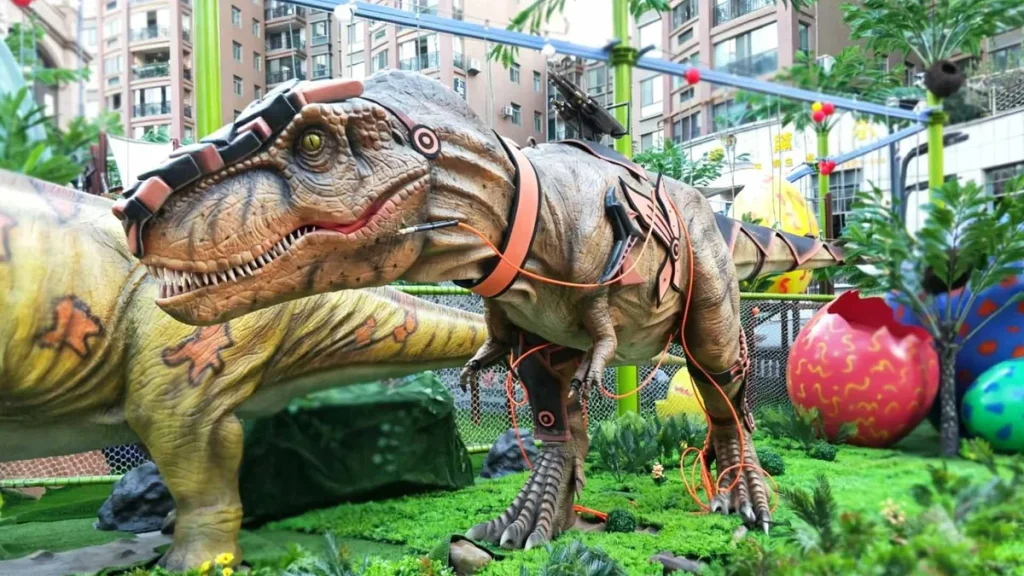
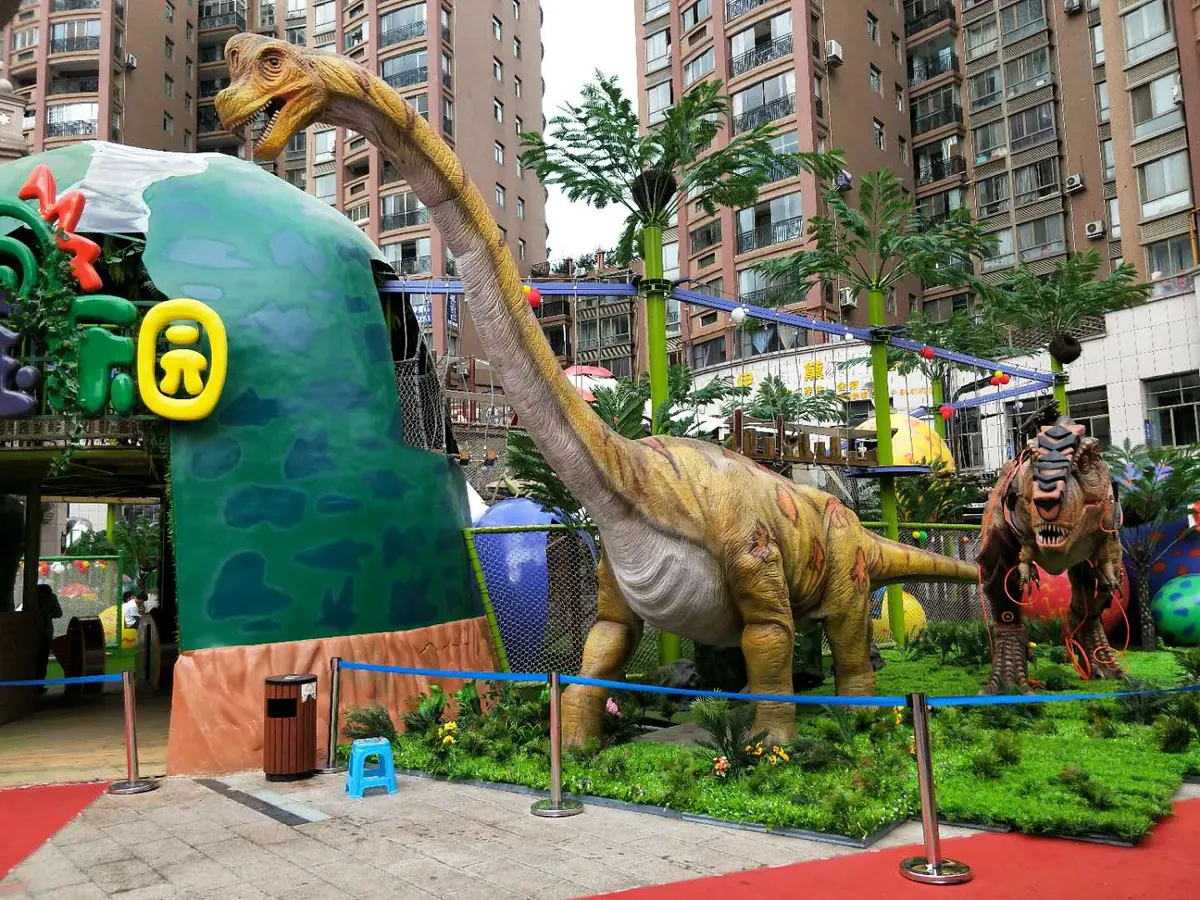
A static dinosaur exhibition has a ceiling, and most operators hit it in the first season. Visitors walk the route, take the same photographs, and leave. The build in Guiyang was designed around that problem: the animals are not only looked at, they are shot at, and the shot changes what the animal does.
An interactive animatronic dinosaur target is a life-size animatronic figure fitted with a hit sensor, a scoring address and a motion trigger, so that a hit from a visitor’s emitter produces an immediate physical response — a roar, a tail swing, a wing beat — and a recorded score. Built as a set, the targets turn a walk-through display into a competitive attraction with a leaderboard, a repeat-play loop and a reason for groups to book ahead.
This case file covers how the target layer works, what goes into a build, how the scoring is weighted, and what the operator reported after launch.
Key Takeaways
– The build combines animatronic dinosaurs, animatronic insects and an electronic target system, so a hit produces both a motion response and a score.
– Scoring is weighted by target difficulty: large dinosaurs carry high values but are easy to hit, insect targets carry low values and move.
– The set shipped as roughly a dozen animated targets of four types, plus emitters, a control system and themed landscaping.
– Everything above the targets — game modes, scoring rules, leaderboard display — is software, and can be re-themed without rebuilding the animals.
– The operator reports a 40% lift in daily visitors and a rise in average stay from 1.5 to 2.8 hours after launch.
The Problem With a Static Dinosaur Display
Dinosaur exhibitions have become easy to source, which is the problem. A regional park can now buy ten realistic animals, install them along a trail, and open within a season. The result is that the same ten species appear in a dozen venues within driving distance of each other, and the visitor who has seen one has seen them all.
The commercial consequence shows up in dwell time. A trail of static animals holds a general visitor for roughly the length of the walk — forty minutes at most, often less when the weather is bad. A short stay pulls down every number attached to it: spend per head, food and beverage attachment, retail conversion, and the likelihood of a return visit.
Adding more animals does not fix this. Adding a reason to interact with the animals that are already there does. That is the entire design premise of the Guiyang build.
How the Target System Works
The system has three layers: a sensor that registers a hit, a controller that decides what the animal does about it, and a server that keeps score. Each layer is independent, which is what makes the format maintainable in a seasonal attraction.
Hit sensing
Each target carries a receiver module behind a strike zone on the body. Visitors fire with an infrared emitter; the receiver registers the hit and passes the event to the controller with a positional error of under five centimetres, which is tight enough that a near miss reads as a miss and a hit reads as a hit. The emitter carries a unique ID, so the system knows which player fired and which team they belong to.
Motion response
A hit triggers a preset motion sequence through the target’s PLC — jaw open and roar, tail sweep, head turn, wing beat, depending on the animal. The motion is not random: each target has a small library of responses so that a group firing repeatedly does not see the same action twice in a row, which is what keeps the illusion alive on the tenth hit.
Scoring and the leaderboard
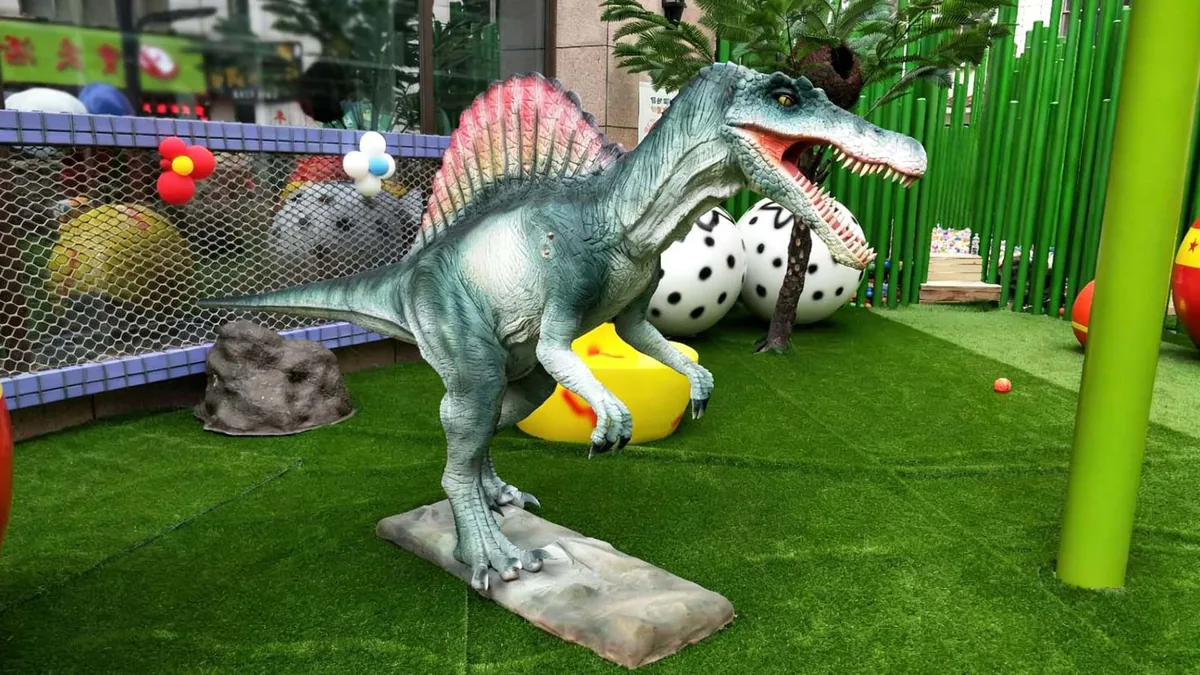
The server weights each hit by target difficulty. A large theropod is worth a high score but presents a big, slow target; a small insect target is worth less and moves, so hitting it takes more attempts. That weighting is what turns shooting into a game with a strategy rather than a rate-of-fire contest — a team that only shoots the big animals loses to a team that splits its players between the easy high-value targets and the difficult small ones.
Scores display live on a leaderboard screen and are compiled into a battle report at the end of a session, which can be printed or pushed to a phone. That report is the piece that gets shared, and the leaderboard is the piece that makes a group book a second session to beat their own score.
What Goes Into a Build
The Guiyang set was specified as a complete attraction rather than a set of animals, which is the right way to scope one of these. A target without an emitter, a scoring server and a safe play area is a statue with a sensor in it.
| Category | Item | Quantity / spec |
|---|---|---|
| Dinosaur target | Animatronic Tyrannosaurus, motion plus sensor | 2 units, 8–10 m |
| Dinosaur target | Animatronic Triceratops, motion plus sensor | 2 units, 6–8 m |
| Dinosaur target | Animatronic raptor, motion plus sensor | 3 units, 3–4 m |
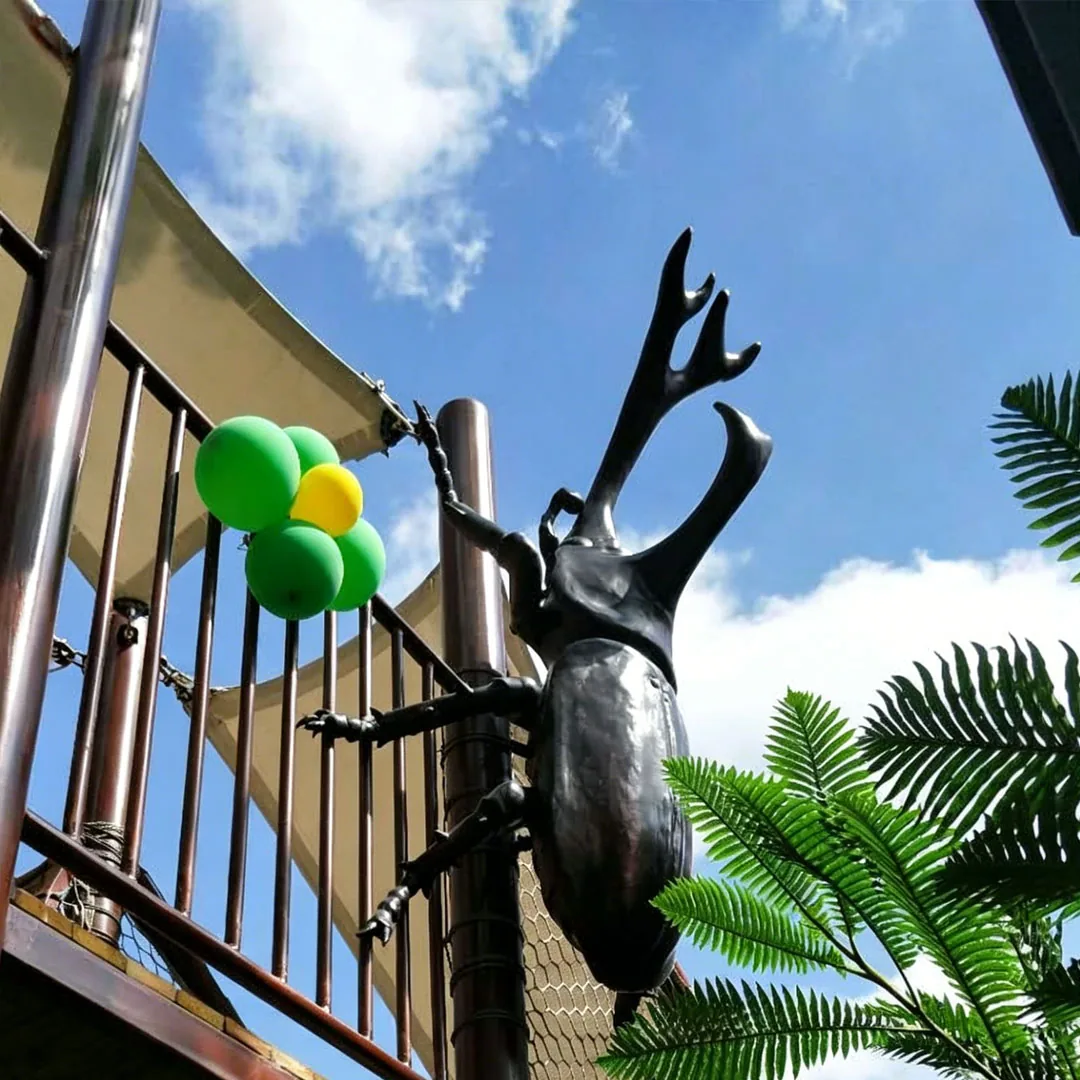
| Insect target | Animatronic bee and beetle, motion plus sensor | 5 groups, 0.5–1.2 m |
| Shooting hardware | Infrared emitter plus protective equipment | 20 sets |
| Control system | Scoring server, leaderboard display, battle-report printing | 1 set |
| Set dressing | Jungle-themed landscaping, sound and lighting effects | Full site |
| Safety | Perimeter fencing, buffer zones, first-aid point | Full site |
Two details in that list are routinely under-specified. The first is the emitter count: twenty sets for a dozen targets lets four to five teams play at once, and throughput drops sharply below that. The second is the safety buffer, which has to be sized to the motion arc of the largest animal rather than to the fence line — a swinging tail needs more room than a static one, and the buffer is what keeps a fast-moving group out of it.
Game Modes and Group Formats
The software layer is what makes one set of hardware sellable to several audiences, and it is worth treating as the primary product rather than an accessory.
Team versus team
The default format. Two to four teams, each with an emitter set, shooting the same targets from different positions. Scores display live, which produces the shouting. This is the mode that fills weekend slots and corporate bookings.
Individual score attack
Single players against the clock, ranked on a daily and all-time board. This is the walk-up mode: it needs no booking, it fills gaps between group sessions, and the leaderboard gives a solo visitor a reason to come back and move up.
Family co-op
Adults and children on one score, with the smaller insect targets worth comparatively more so that a child’s hits matter to the team total. This is the mode that converts a family visit into a paid add-on rather than a walk-past.
Where This Format Works
Anywhere a dinosaur display already exists, or is being planned, and the operator needs a second revenue line attached to it:
- Theme parks and dinosaur parks — the shooting gallery becomes the anchor activity rather than a side attraction.
- Scenic areas and rural tourism sites — adds an entertainment layer to a landscape visit and extends the stay into a meal.
- Science-education centres — the scoring format carries species knowledge as game content rather than as wall text.
- Shopping malls and mixed-use developments — indoor and outdoor versions both work; the indoor version needs the ceiling-height and floor-loading check described in our indoor exhibition case file.
- Corporate team-building sites — the team-versus-team mode is the product, and it books midweek when leisure traffic is thin.
What the Operator Reported
The figures below are the operator’s own post-launch numbers, reported after the first operating period rather than projected at the planning stage. They have not been independently audited.
| Metric | Before | After |
|---|---|---|
| Average daily visitors | ~800 | ~1,120 |
| Average length of stay | 1.5 hours | 2.8 hours |
| Visitor satisfaction | 82% | 95%+ |
| Secondary spend rate | 25% | 48% |
| Social media mentions | ~200 / month | ~1,500 / month |
Read the stay-time figure as the leading indicator rather than the visitor count. A jump from 1.5 to 2.8 hours is what drives the secondary spend number, because a visitor who stays through a meal buys one. The visitor count then follows from word of mouth, which is what the social-mention line is measuring.
Running It: Staffing, Throughput and Maintenance
A shooting gallery is an operating business, not an installation. Three numbers decide whether it works after opening.
Throughput. A session runs 20–30 minutes including briefing and the battle report. With twenty emitters and a dozen targets, one site can turn four to five groups an hour. Below about twelve emitters the queue becomes the constraint rather than the targets.
Staffing. One attendant per session is enough for briefing, equipment issue and safety, provided the scoring and leaderboard run themselves. The attendant’s real job is the safety brief, not the technology.
Maintenance. The animals need the same schedule as any animatronic exhibit — motion calibration, joint inspection, skin cleaning. The target hardware adds two items: receiver lens cleaning, which matters more than it sounds because a dusty sensor reads as a miss, and emitter battery rotation on a fixed cycle so that a session never starts with a dead unit.
FAQ
How accurate is the hit sensing?
The receiver registers a hit within roughly five centimetres of the aim point, which is precise enough to distinguish a hit from a near miss at typical shooting distances in a play area. Accuracy is limited by the emitter’s beam alignment rather than by the sensor, so emitters are zeroed at commissioning and checked as part of routine maintenance.
Can the targets be repositioned or re-themed?
Yes. The animals are free-standing on ballasted bases, and the target positions are planned on a modular grid, so a site can rotate the layout between seasons or expand the set without re-engineering the control system. New game modes and scoring rules are software changes.
What happens when a target is hit repeatedly?
Each target holds a small library of motion responses and cycles through them, so a group firing continuously does not see the same action twice in a row. The controller also rate-limits responses so that the drive system is not asked to perform a full movement cycle faster than its duty cycle allows — that limit is what protects the mechanics during a busy weekend.
Do you need staff to run a shooting gallery?
One attendant per session for briefing and safety. Scoring, leaderboard display and battle reports run automatically. Groups of twenty or more usually warrant a second attendant at the equipment issue point to keep the session on schedule.
Can this be added to an existing dinosaur display?
Usually yes, if the existing animals have the payload capacity for a receiver module and the motion range to perform a response. Retrofitting is cheaper than a new build but depends on the age and drive type of the figures already on site, so it starts with a survey of what is there.
Turning a Display Into a Game
If you already run a dinosaur attraction and the dwell time has flattened, the question is not how to buy more animals. It is what would make a visitor interact with the ones already there. A target layer, a scoring system and a leaderboard is one answer, and it can be scoped as an addition to an existing site or designed into a new one from the start.
See interactive dinosaur exhibits for the animatronic side, how gesture and proximity sensing trigger a response for the underlying technology, or send us the site plan and target count for a feasibility read. More installations are documented in our project case files.