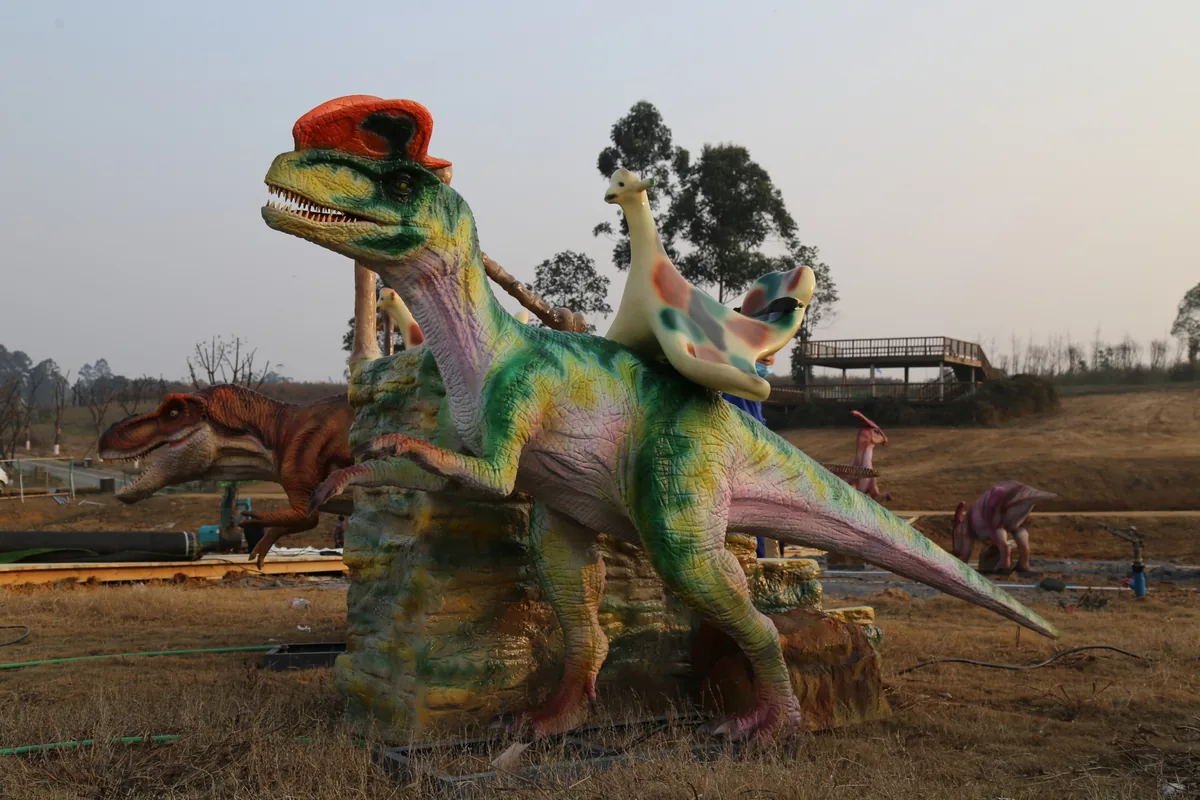
Dinosaur Rides
The Dilophosaurus is the unit that gets filmed, and not because of the twin crest. It is the spray. A mouth-level atomiser that puffs a visible cloud on a timer turns a ride into something people stop and record, and a recorded ride is free advertising in a way that a ride nobody photographs never is.
| Overall size | 3.2 m long × 1.1 m wide × 2.0 m high, saddle included |
|---|---|
| Rider weight | Up to 75 kg |
| Rider age | 3 to 10 years |
| Motion | Quiet electric drive — body sway, head nod, tail swing |
| Audio | Short, sharp Dilophosaurus call; volume adjustable |
| Spray effect | Optional ultrasonic atomiser at the mouth |
| Sensor | Microwave radar, welcome action triggered within 2 m |
| Lighting | LED strip inside the crest, soft red at night |
| Body | High-density foam with silicone skin over glass fibre |
Two half-moon plates on top of a moving head is a structural question, not a decorative one. On this build the crest is part of the head mould rather than a bolted-on panel, so there is no seam for a child to pick at and no screw line that opens after a season of head-nodding.
The LED strip runs inside the crest, which means the light source is behind the skin instead of in a housing on top of it. That is why the glow is even along the whole plate rather than a bright spot in the middle.
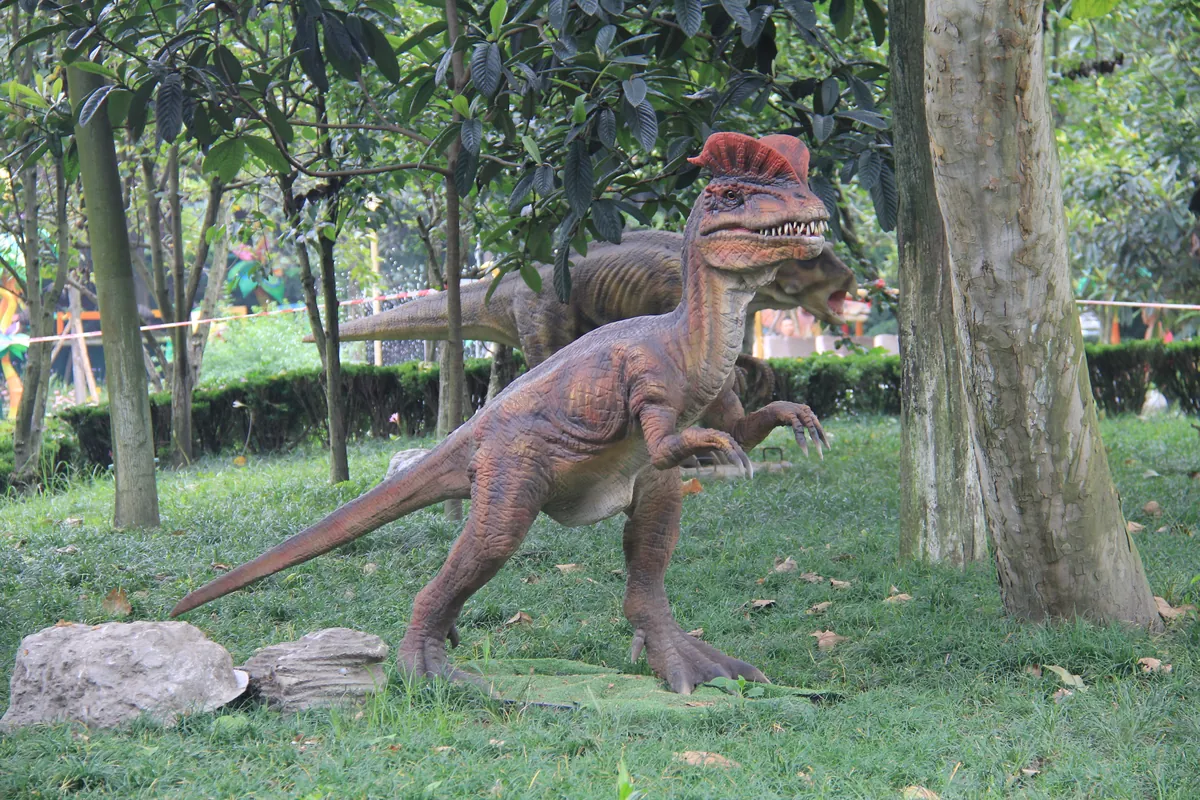
An ultrasonic atomiser sits behind the lower jaw and feeds a nozzle at the mouth. Water only, no additives — anything with glycol in it leaves a film on the teeth that is difficult to remove and looks like grime.
The mist is on a timer rather than continuous, for two reasons: the reservoir lasts a shift instead of an hour, and a permanent cloud stops reading as an effect. Sites with air conditioning moving air across the ride will need the interval shortened, because the cloud disperses faster than it does in still air.
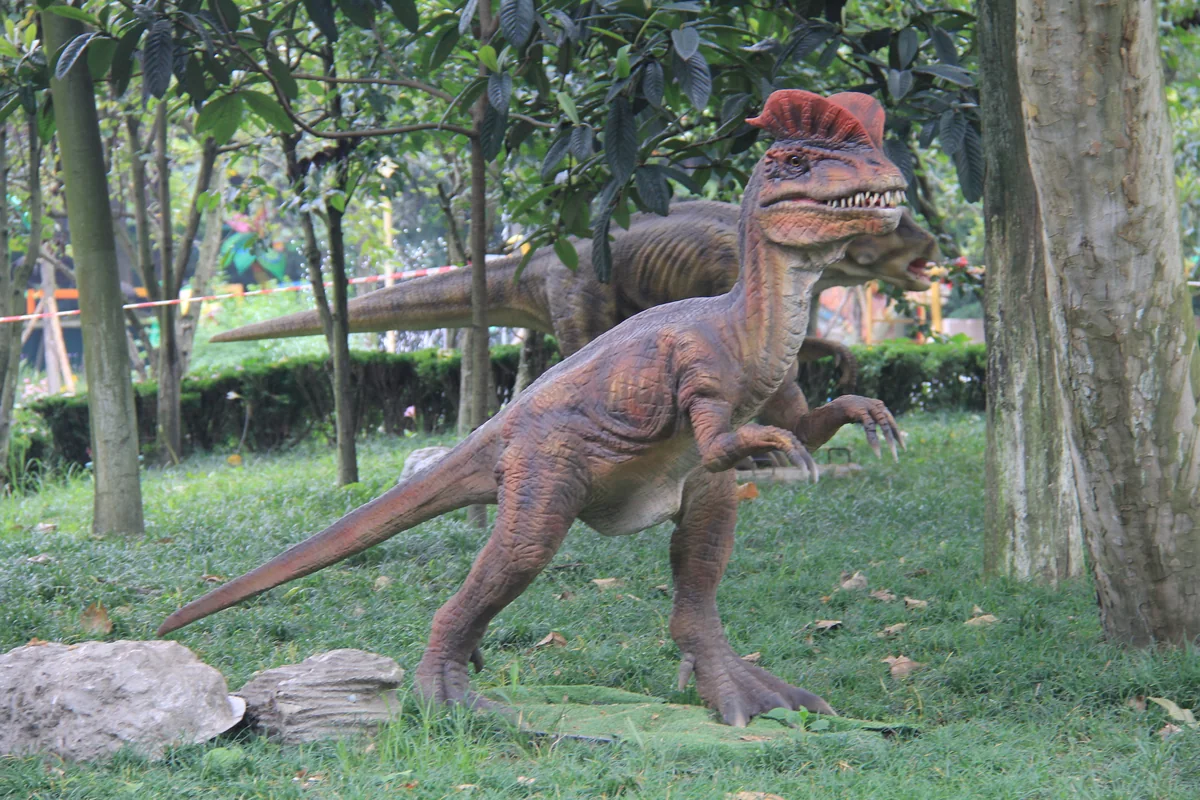
A 2-metre microwave sensor starts the welcome sequence: head turn, call, and a body sway. Microwave rather than passive infrared because it reads through glass and does not care about a warm afternoon, which is what makes it reliable in a mall entrance where the temperature swings.
The distance is set at commissioning against how visitors actually approach your ride. Setting it too wide means the unit performs constantly and the reservoir empties; too narrow and only the boldest children trigger it.
Is the spray included? No, it is an option. Sites that run indoors without drainage usually skip it.
Can the spray be disabled? Yes, and it should be when the ride is used at a party booking where children sit close to the mouth.
How often does the reservoir need filling? Per shift on a timer setting. There is a level window on the tank so staff can see it without opening anything.
Does it run outdoors? Yes, with the outdoor drive setting. The atomiser must be drained before storage in freezing weather.
The ride itself is the easy part to power. The atomiser is not: it needs a water reservoir refilled per shift, and the water needs to be clean. Tap water left standing in a transparent tank grows a film within a week, and that film ends up on the teeth. Drain the tank at the end of every shift rather than topping it up.
Position matters more than people expect. The spray is visible against a dark background and nearly invisible against a bright shop window, so the ride should be set with its back to something solid. The 2-metre radar field also needs to be clear of the queue rail — a sensor that fires on people queuing rather than approaching will run the reservoir dry by mid-afternoon.
If the site is outdoors, drain the atomiser before cold weather. A frozen nozzle body cracks and the replacement is a whole assembly rather than a part.
The unit arrives assembled. Commissioning is a half-day and it is mostly about three settings: the radar distance, the spray interval and the volume of the call.
The radar distance is set by watching how visitors actually walk in. In a wide concourse people approach from an angle and the field has to catch them early; in a narrow unit they arrive head-on and the default is too wide. The spray interval is set against the air movement — an entrance with a draught or an air curtain needs a shorter interval because the cloud disperses faster.
The operator training happens in the same session: filling and draining the tank, checking the nozzle, and the one thing that matters most — knowing when to switch the spray off, which is any time children are sitting close to the mouth.
Materials. High-density foam body with silicone skin over glass fibre, electric drive, leather-textured saddle.
Related. the full ride range, mall installations, the Parasaurolophus ride, request a quote.
Same factory and the same build standard. What changes is size, movement set and how the exhibit is meant to be used on site.
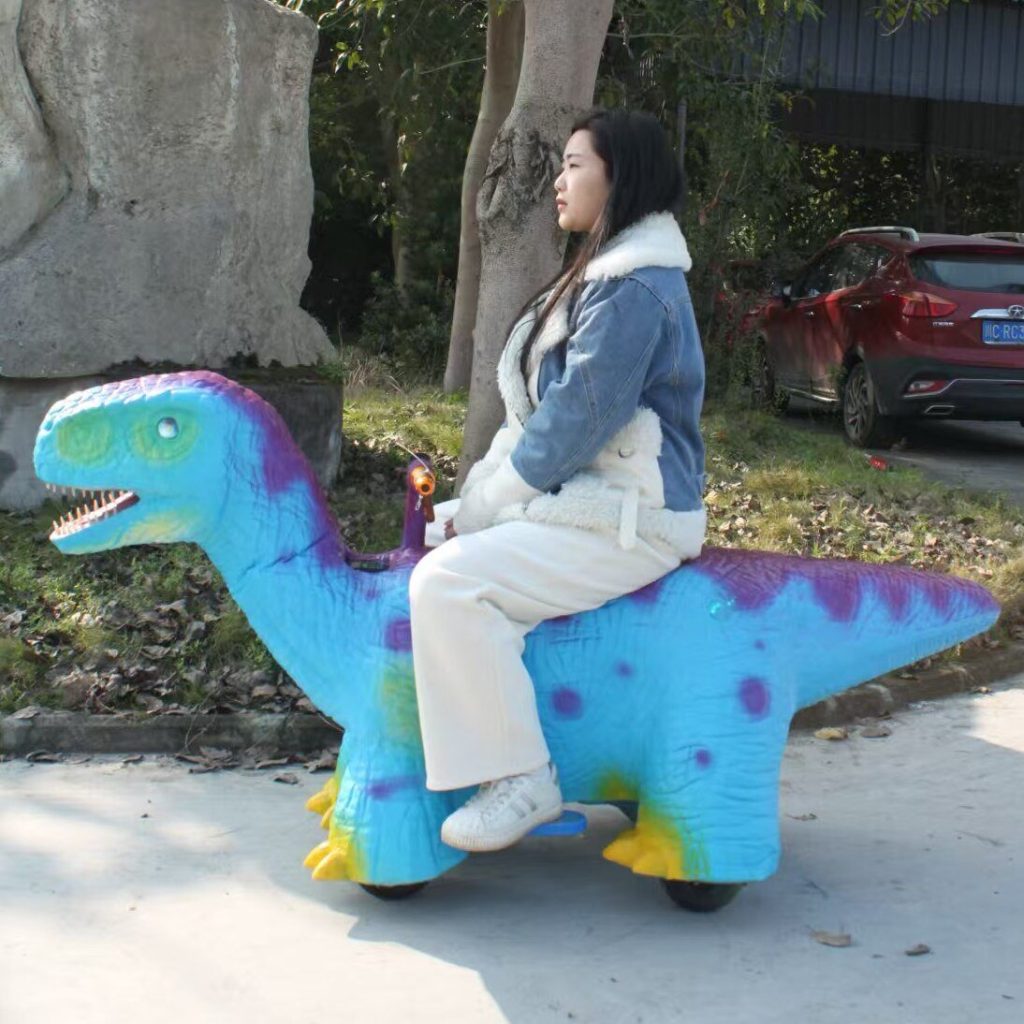
The T-Rex is the one every child asks for, and the one operators are most nervous about — a big head, a heavy tail […]
View Product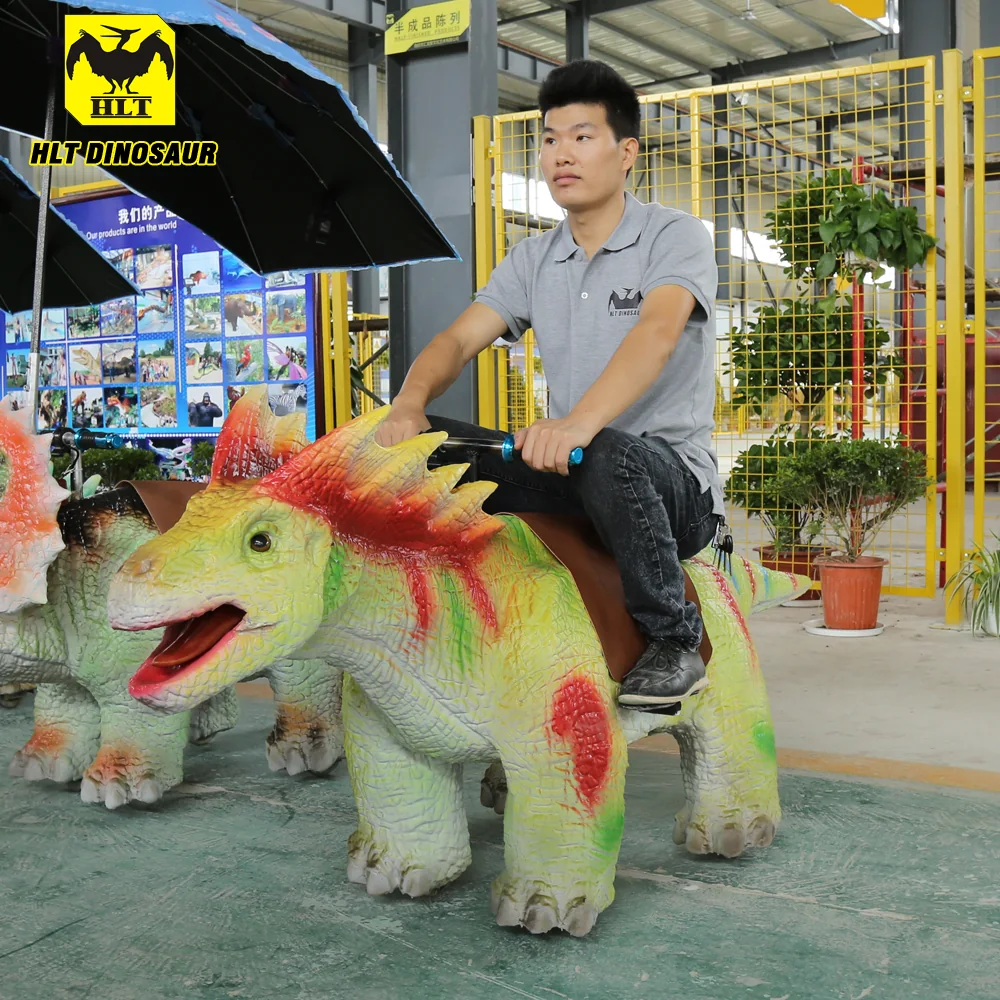
A single-seat kiddie ride earns per child and queues per child. A four-seat unit earns four times per cycle on the same footprint and […]
View Product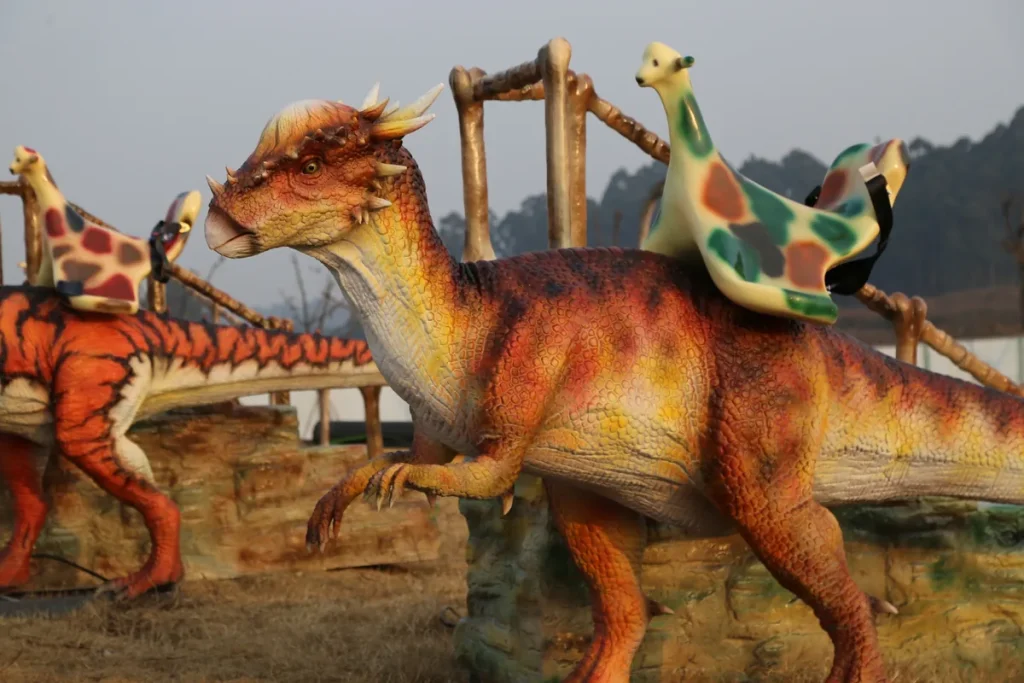
The Pachycephalosaurus is the quiet one. A low-noise drive, a soft-skinned body and a motion set that rocks rather than swings — this is […]
View ProductThree things buyers usually want settled before they ask for a drawing — what drives the number, how the piece is actually built, and what to check between suppliers.
What Animatronic Products Are Actually Used For Buyers come to animatronic products with one of two jobs in mind, and the job determines almost […]
Read the guide →Which drive system actually suits an animatronic dinosaur? A factory-side comparison of force, precision, noise, maintenance and weather.
Read the guide →If you are planning a museum exhibition, theme park attraction, or shopping mall event, you have probably asked this question: How much does a life […]
Read the guide →Send your dimensions, movement requirements and installation site. You get a realistic budget range and a dated build schedule.
Or email info@hltdino.com — we reply within one business day.