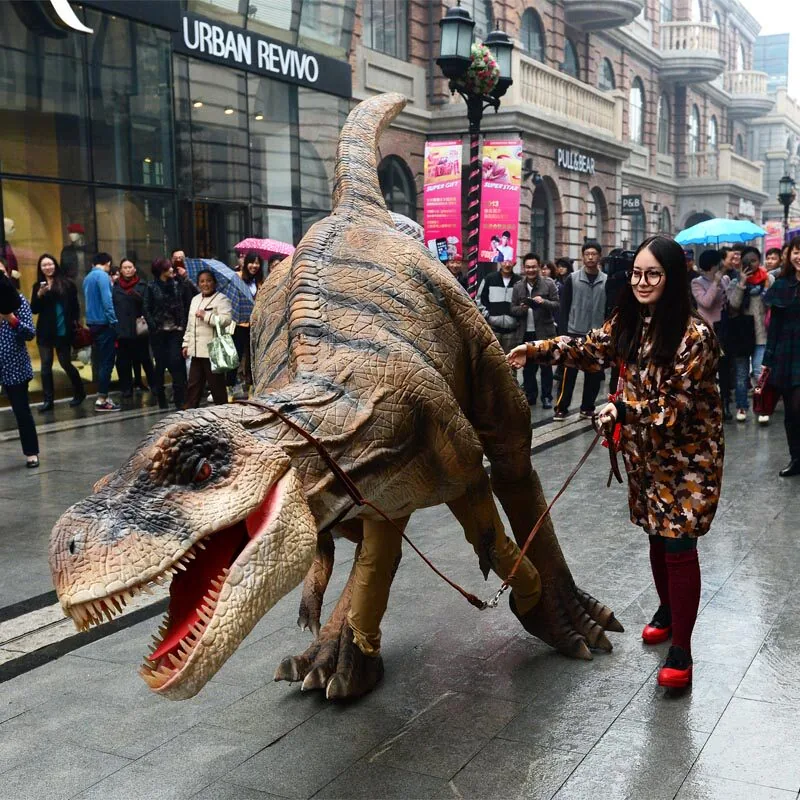
A child waves at a dinosaur outside a shopping centre. The dinosaur turns its head, looks at the child, opens its jaw and roars. The queue behind them cheers, and nobody in it is thinking about frames, paint or motors. They are thinking that the animal noticed them.
That moment is the commercial argument for an interactive dinosaur costume. A walking suit that only walks is a photo prop: it works once, and then the crowd moves on. A suit that can answer — a nod, a head turn, a blink, a roar on cue — is something a host can build a segment around. The same piece of equipment then earns its place at a festival launch, a themed lesson, a street parade and a small private party, for four quite different reasons.
One clarification before the uses, because buyers often assume the wrong thing. “Interactive” here means performer-led. There is no camera in the skull and no sensor deciding when to react. A trained operator inside the suit works the head, jaw and sound from triggers hidden in the sleeves, and a handler walking beside the animal reads the crowd and calls the cues. That is a deliberate choice, and it is why the act still works in a noisy hall, in direct sun, or three metres from a child holding a balloon. If you are still deciding which wearable build to buy, the weight, vision and heat questions belong in our walking dinosaur costume event performer guide. This article is about what you do with one after it is booked.
What “Interactive” Actually Means in a Wearable Dinosaur
A performer inside a full-body suit has a limited but very readable vocabulary. Used well, it is enough to hold a conversation without a single word of recorded dialogue.
- Head turn and tilt. This is the “I see you” signal. A slow turn towards a raised hand reads as attention; a tilt reads as curiosity. It is the most useful trigger in the whole suit and the one audiences remember.
- Jaw open and close. A nod, a yes, a mock threat, a laugh. Because the jaw runs on its own drive rather than a seam in the fabric, the movement reads at close range and from the back of a room.
- Roar or sound cue. Fired from inside the chest, it punctuates a moment — the answer to a quiz question, the start of a countdown, the reveal at a launch.
- Body language. Stepping towards a group, backing away from a shy child, turning to face a camera, or holding still for a photograph. None of this needs a motor. It needs an operator who can see and a handler who can judge distance.
The handler is the part buyers underestimate. A performer inside a suit has a restricted field of view; the handler is the one who sees the child about to run forward, spots the photographer, and gives the cue at the right second. On most of the uses below the act is really a two-person job, and the booking should be planned that way.
This is also why a wearable suit and a sensor-driven static exhibit solve different problems. A fixed animatronic responds to whoever walks into its zone, all day, without staff. A costume responds to a specific person at a specific moment, with timing and judgment. Neither replaces the other. The costume is the one you use when the value is in the exchange rather than the repetition.
Festival Campaigns: The Costume as the Face of the Event
At a festival, a season launch or a shopping-centre campaign, the buyer is not really hiring a dinosaur. They are hiring something that can carry a message through a crowd: open the stage, pull people towards a sponsor’s stand, stop in front of a media wall, and give a presenter someone to talk to. A static model can anchor a corner. It cannot walk the crowd over to the corner.
Interaction is what turns the walk into a campaign appearance. The host asks the animal a question and the suit answers with a head turn; the countdown ends and the jaw opens on a roar; a group of children is invited to wave and the animal turns to each of them in turn. Each beat gives the photographer a frame and gives the presenter another thirty seconds of programme. Nothing in that sequence needs a scripted show — it needs an operator who can take a cue and a handler who can keep the animal where the camera wants it.
Two practical decisions follow. First, the silhouette has to read from a distance, because most of the audience sees the animal across a plaza rather than up close. A life-size animatronic T-Rex costume built for malls and festival floors is the usual choice for this reason: the shape is recognised before the detail is. Second, paint is a campaign asset, not a finishing detail. The skin is finished by hand, so a colour scheme can be matched to a brand palette or a seasonal theme rather than accepted as a stock green. Ask for that at the specification stage, not after the first photos.
There is a useful split in the range here. A full-body suit covers open-floor roaming and the walk from stage to photo wall; a half-body build keeps the head and forelimbs at visitor eye level and suits a fixed meet-and-greet point where the animal never needs to travel. Campaigns with both a stage moment and a photo zone often end up specifying one of each. You can compare the formats in the dinosaur costume range.
Themed Lessons: A Dinosaur That Answers Back
In a classroom session, a museum school programme or a science-centre themed lesson, the costume has a different job: it becomes the person being asked. That changes the room. A teacher asking “did all dinosaurs have scales?” gets a show of hands. A feathered raptor being asked the same question and shaking its head gets a room that stays quiet until someone explains why.
The mechanism is simple and worth stating plainly to whoever is planning the lesson. The host asks a question with a yes-or-no answer, the performer answers through the suit — a nod, a head shake, a jaw snap, a short roar — and the host then supplies the explanation. The dinosaur never speaks and never needs to. Children remember the exchange, and the fact-checking stays with the adult, which is exactly where a museum or school will want it.
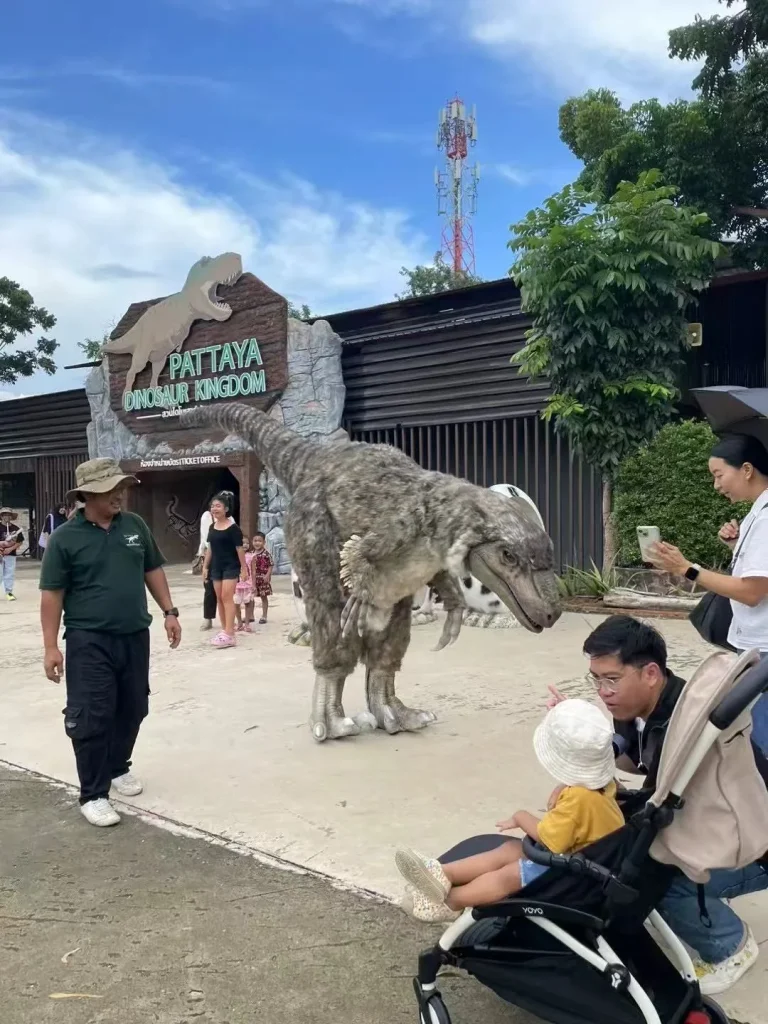
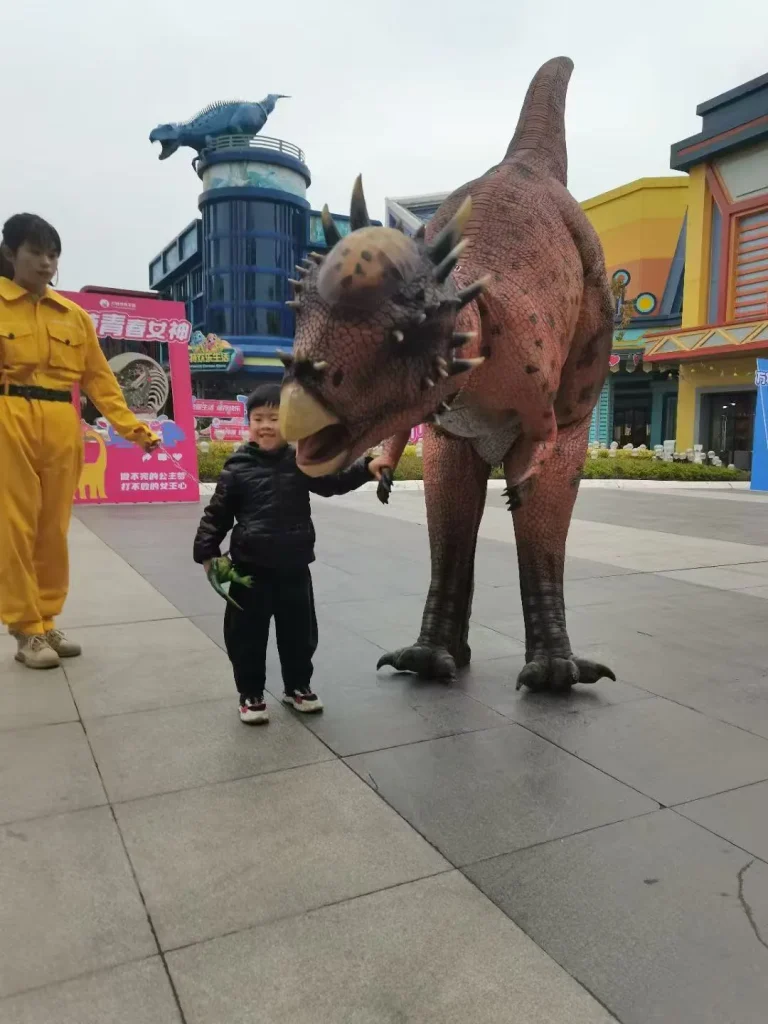
Species choice does real work in this setting. A feathered velociraptor costume is a natural prop for a session about feathers, bird evolution or how film depictions differ from current palaeontology — the animal itself is the evidence. For younger groups, or for a lesson that is more about participation than about facts, a horned, plant-eating shape is easier to keep gentle: a Styracosaurus costume for family attractions gives you an impressive animal without a predator’s teeth at a child’s eye level.
Handler-led formats matter most here. A handler beside the animal can keep a queue orderly, signal which child is next, and stop the act before it overwhelms a shy group. Plan the session in short sets with a clear break between them, and agree in advance who gives the “yes” and “no” cues — usually the host, from the front of the room, so the timing lands with the question. Written quiz cards with the cues marked on them are more reliable than improvisation, particularly when the same lesson runs several times in a day.
Parades: Holding Attention Along the Whole Route
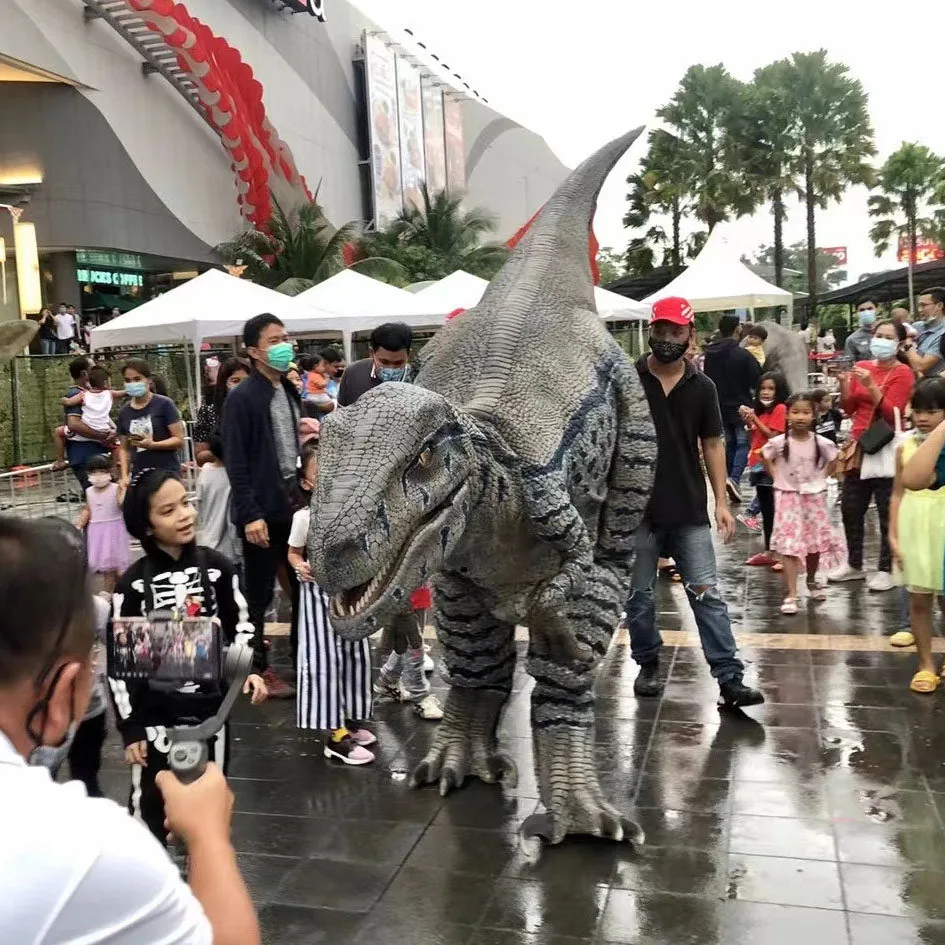
A parade is the one use where mobility is the entire point. The audience stands in two lines along a route, and anything fixed is invisible to most of them. A walking suit meets both sides as it passes: turn left, hold, turn right, answer a wave, pause at the marked stop for a jaw-open roar, then move on. The act is a sequence of small interactions repeated down the length of the street, not a single performance at one end of it.
That repetition is also what makes a parade the hardest booking for the equipment and the operator. Three things are worth settling before the route is confirmed. The first is the walking plan: how far the performer actually covers, how many stops, and where the rest rotation happens. Sessions are scheduled in blocks with a break for the performer, and a route measured in kilometres should be budgeted as several sets rather than one. The second is the surface and turning space — a full-body suit with a counterbalancing tail needs room at corners and a clear margin from barriers, kerbs and cable runs. The third is sound: the roar has to be audible to the side of the route and not just to the person walking behind the animal, so the volume is set for the venue, not for the workshop.
Silhouette decides which animal works on a moving route. A crested raptor costume built for parades and family attractions keeps a distinctive head profile at a distance and turns more easily than a heavy-browed theropod. Whichever build you choose, walk the route once with the handler and mark the interaction stops on a plan. The difference between a parade that reads as a costume walking past and one that reads as an animal working the crowd is almost always those marked stops.
Small Private Parties: One Entrance That Changes the Room
At a birthday party, a family day or a community open house, there is no stage, no professional host and no media wall. There is a room, a doorway, and a group of people who have already seen the balloons. This is where a costume earns its keep fastest: a single planned entrance — the door opens, the animal looks around, walks to the birthday child, nods, and holds still for a photograph — does more for the hour than another table of decorations.
Scale is the decision that gets got wrong. A small room does not need the largest animal in the range; it needs one that can turn around without clipping furniture and can be seen by children who are sitting down. Half-body builds and photo-zone formats are usually the better fit, and the door width, ceiling height and any stairs between the change area and the room should be checked before the booking is confirmed. If the performer cannot get through the door with the head on, the entrance does not happen.
Because there is no host, the interaction has to be self-explanatory. Agree on three beats and tell whoever is organising the party: the entrance, one named child greeted by name with a head turn, and a group photograph with the jaw open. A wearable animatronic dinosaur costume with thumb-triggered jaw and roar audio covers all three without any extra equipment in the room. Keep the set short, keep the handler in position, and leave before the novelty wears off — a small party is the one setting where less time in costume usually produces a better result.
What to Specify Before the Booking Is Confirmed
All four uses ask different things of the same product, and the differences are settled at the specification stage rather than on the day. Give the builder a short brief covering:
- The venue. Indoor or outdoor, floor surface, ceiling and door widths, whether there are stairs or a lift between the change area and the performance space.
- The audience. Age range, expected crowd density, and whether children will be at arm’s length or behind a barrier.
- The programme. Number of sets, length of each set, whether there is a host or MC, and where the interaction stops happen.
- The look. Species, brand or theme colours, and whether the animal needs to read from three metres or from across a plaza.
- The people. Who performs, who handles, and who calls the cues. A performer-led act needs all three roles named.
- The support. Where the suit is stored between sets, where charging happens, and how much space the handler needs to work in.
Those answers determine full-body or half-body, which species, how the triggers are laid out, where the speaker sits and how the venting is arranged. They also determine whether the thing you ordered can actually do the thing you planned. A suit specified for a stage appearance will not automatically be right for two hours on a street, and a suit specified for a parade is more animal than a small room needs — not a defect in either build, just a mismatch in the brief.
Common Questions
Can the dinosaur actually answer a question?
Yes, in the sense an audience cares about: the performer answers with a nod, a head shake, a jaw movement or a roar, and the host speaks the words. There is no dialogue track and no voice from inside the suit. That keeps the timing under the host’s control and avoids the act talking over the person running the event.
Do we need sensors, cameras or an operator at a control desk?
No. The interaction is performer-led, with the head, jaw and sound worked from triggers inside the costume and cues called by a handler beside it. Nothing has to be installed at the venue and nothing needs calibrating on the day. It is one of the reasons the same suit can move from a classroom to a street to a private room without a technical setup between them.
Which species suits a lesson, and which suits a parade?
For a lesson, pick the animal that carries the point — a feathered raptor for a session on feathers and bird evolution, a horned herbivore for a younger group. For a parade, pick a silhouette that reads at a distance and turns comfortably on the route. Colour can be matched to a campaign or a school theme in either case.
Can one costume cover all four of these uses?
Often, but not always optimally. A single full-body suit with a handler can serve a festival appearance, a lesson, a parade set and a party entrance if the programme is built around short appearances and sensible breaks. Venues that run a fixed photo zone all day, or a very small room, are usually better served by a half-body build. The brief decides it.
Tell us the venue, the audience and the programme and we will propose the build that fits them. Send us your event brief and we will come back with the format, species and trigger layout we would recommend.