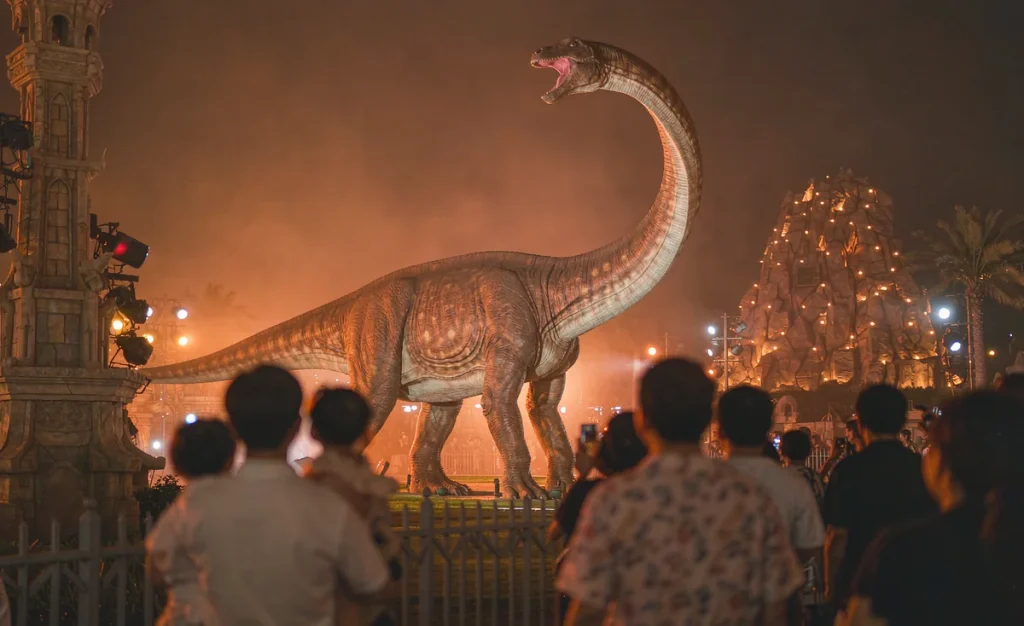
A buyer walks up to a finished animatronic dinosaur, watches it turn its head, open its jaw and roar, and says: “Good. Now make it a show.”
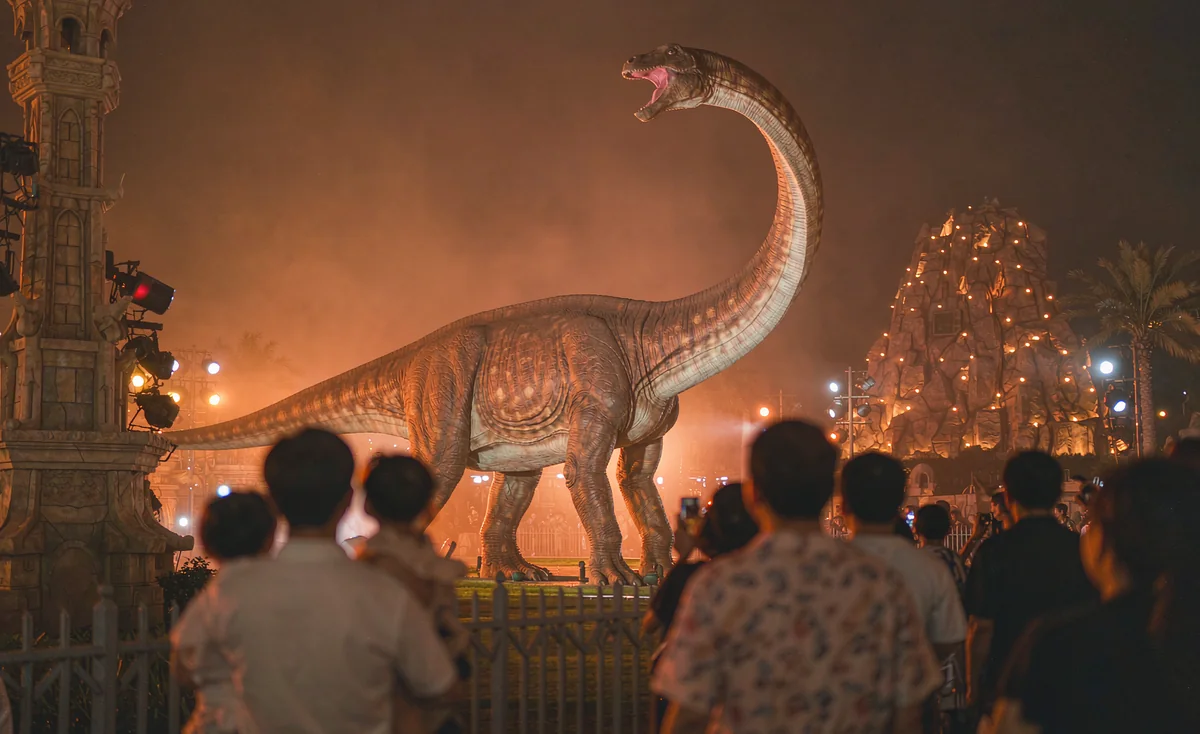
That gap — between an animal that moves and an animal that performs — is where most exhibit budgets quietly go wrong. The machine is specified, built and delivered correctly. Then it stands in a plaza running the same four motions on a loop, and by the second week visitors walk past it the way they walk past a fountain.
What closes the gap is not more hardware. It is a show design: a timeline, three lighting instruments doing three different jobs, an atmosphere layer that has to be chosen correctly the first time, and a sound bed that behaves like a mix rather than a track. This article covers how those four pieces are put together on a real animatronic exhibit, with the numbers a venue needs to plan power, ceiling load and detector zoning.
Why a Moving Dinosaur Is Not Yet a Show
A single looped motion is a mechanical demonstration. A show has three properties that a loop does not: it has a beginning that visitors can arrive in the middle of and still follow, it has at least one moment where the audience stops talking, and it ends in a way that releases them — so they move on and the next group can step in.
Those three properties are all timing decisions, not engineering ones. A 6-metre theropod with four servo groups can carry a genuinely good three-minute show. A 13-metre flagship with fourteen axes can be duller than a statue if every axis fires at once, continuously, forever.
The practical consequence: budget for show programming as a line item separate from motion hardware. On most projects it is one to three days of a technician’s time on site, plus a day of re-tuning after the first weekend of real visitors.
Choreography: Building a Ten-Minute Timeline
Show programming starts from a beat map, not from the joint list. The joint list tells you what the animal can do; the beat map tells you when it should do it. Most exhibits run a cycle somewhere between six and twelve minutes — long enough that a visitor who arrives mid-queue still sees a full arc, short enough that the animal is not silent for so long people assume it is broken.
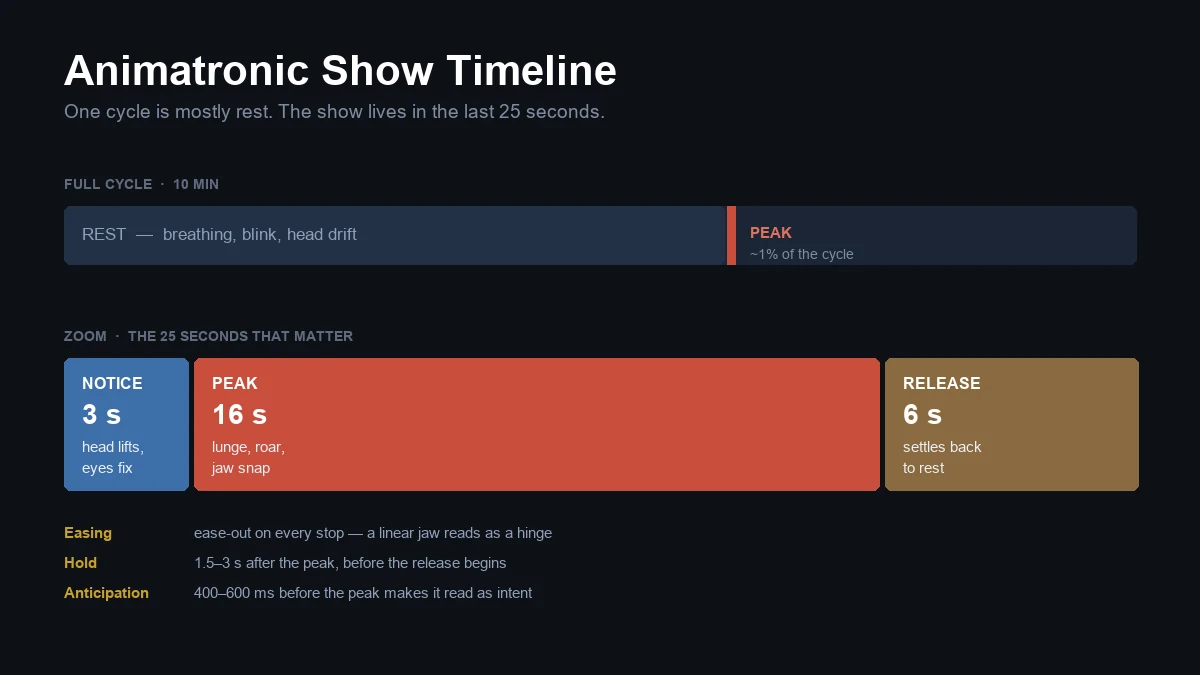
The four states every show needs
Rest. The animal is alive but not performing: slow breathing, an occasional eye blink, a head drift of a few degrees. This is the state visitors see most of the time and it is the one most often skipped. Without a rest state there is no contrast, and without contrast the peak reads as noise.
Notice. Something changes — the head lifts, the eyes fix on a direction, the tail stops. This is a two-to-four second beat and its whole job is to make people look up from their phones.
Peak. The full motion: lunge, roar, jaw snap, the loudest cue in the sound design. Twelve to twenty seconds is usually right. Longer than that and the audience habituates inside the same beat.
Release. The animal settles back into rest over five to eight seconds, without a hard cut. This is the part that tells visitors the moment is over and they can move on. Cutting straight from peak to rest reads as a malfunction.
Why the pause after a lunge matters more than the lunge
A lunge that ends and immediately resets reads as a machine cycling. A lunge that ends, holds a beat with the head still extended and the jaw open, and then settles, reads as an animal that has just decided something. The hold is usually 1.5 to 3 seconds, and it costs nothing but programming time.
The same logic applies at the front of the peak. Adding 400–600 milliseconds of anticipation — a slight backward shift, a jaw closing before it opens — makes the following movement read as intention rather than as actuation. This is the single cheapest improvement available on an existing exhibit.
Programming a sequence: joint, timing, easing
Every joint movement is stored as a small parameter set rather than as a keyframe animation:
- Joint — jaw, neck yaw, neck pitch, tail, eyes, forelimbs
- Action — open, close, hold, sweep
- Start and end angle — in degrees from the neutral pose
- Duration — in seconds, per movement, not per sequence
- Easing — linear, ease-in, ease-out, or ease-in-out
- Sound cue — optional file and offset tied to that movement
Easing is where most of the realism lives. A jaw that opens linearly looks like a hinge. A jaw that opens fast and decelerates into its end position looks like a muscle. Servo-driven builds hold position closed-loop, so a slow movement does not drift — which is what makes long, slow beats practical in the first place. The mechanical side of that is covered in the six systems inside an animatronic dinosaur.
Lighting: Three Instruments, Three Different Jobs
Exhibit lighting gets specified as one line item — “lighting” — and then fails, because three instruments are being asked to do three unrelated things. A wash makes the animal readable. A laser draws geometry in the air. A projector puts an image on a surface. They are not interchangeable and they do not share a control philosophy.
Wash light: making the animal readable
The wash is the least glamorous and the most important. Its job is to get the face and the silhouette legible from the visitor path, at night, without flattening the skin texture. Two or three fixtures at 30–45 degrees off the viewing axis will model the head better than a single fixture straight on, because the shadows fall where the sculpt reads them.
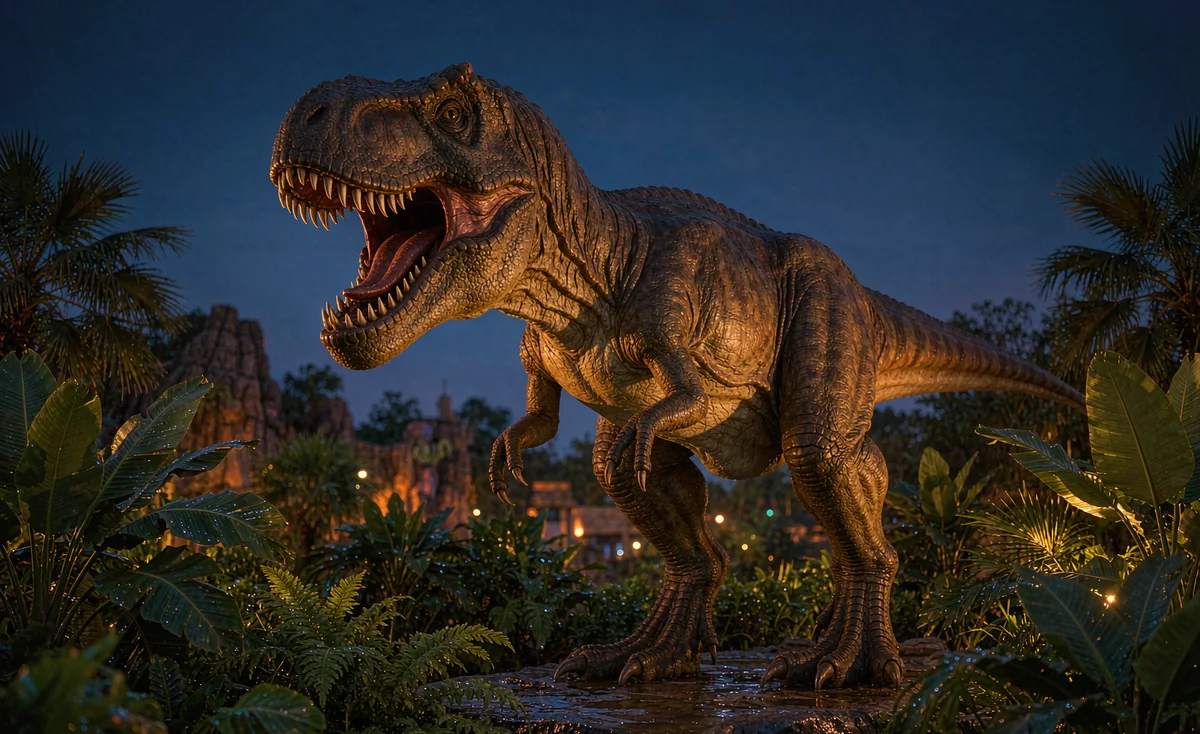
Colour temperature matters more than colour. A warm wash at 2700–3000 K reads as sunset and flatters silicone skin; a cool 6000 K wash reads as clinical and shows every seam in the mould. If the exhibit runs day and night, the wash should be on a scene that fades up as ambient light drops rather than switching on at a clock time.
Laser: what it reads at distance, and where it fails
A laser is the only instrument on this list that is still visible at fifty metres and in humid air. That is its entire value: it draws in the volume of the space rather than on the animal. For a gate figure viewed from a car park, an aerial laser pattern reads where no wash will.
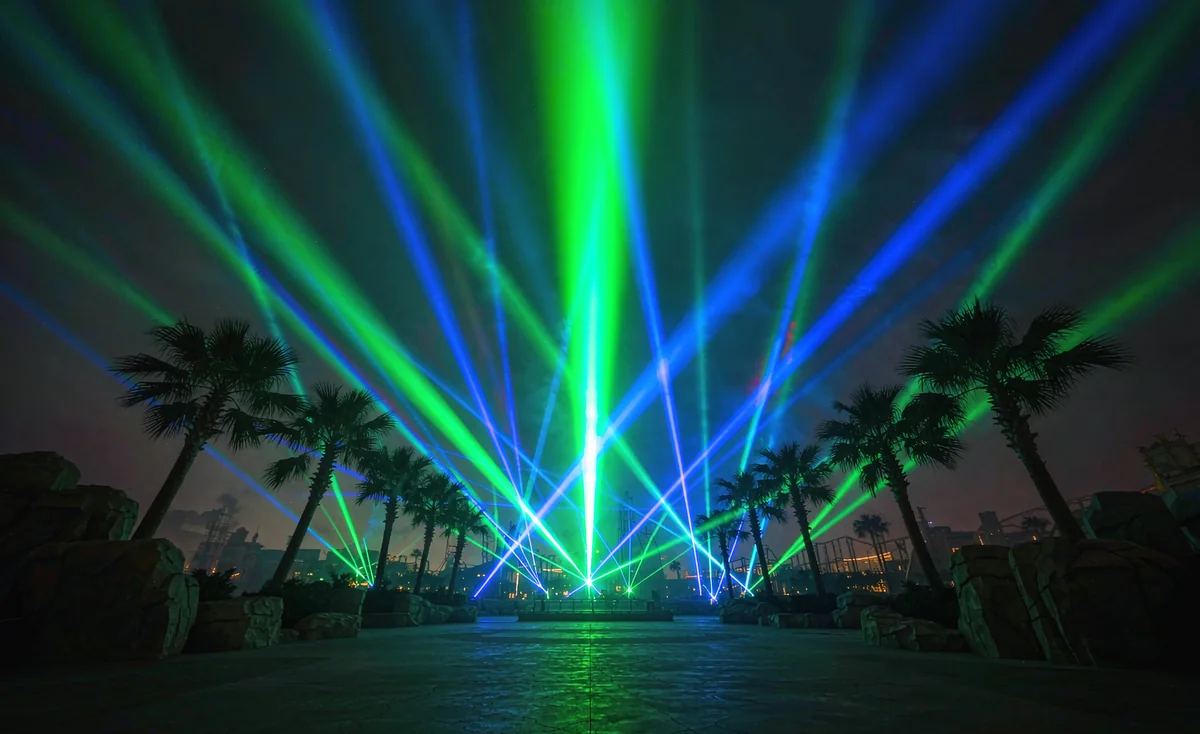
It also fails predictably in three situations. In a lit plaza, ambient light drowns the beam. On a small site, the geometry cannot develop before it hits a wall. And near a visitor path at eye level, it becomes a safety problem rather than an effect — audience-scanning laser is a licensed activity in most markets, and fixed overhead patterns aimed above head height are the practical default for a permanent exhibit.
If the site is bright, an aerial laser is money spent on nothing. The same budget in a haze layer and a stronger wash will read better, because haze is what makes any beam visible in the first place.
Projection: the registration problem on a moving surface
Projection mapping onto a static building is a solved problem. Projection onto an animatronic is not, and the difficulty is not brightness — it is registration. The moment the head turns five degrees, every mapped pixel slides off the feature it was placed on. Skin that flexes adds a second error on top.
Three approaches actually work in practice:
- Project onto the ground and the backdrop, not the animal. The moving silhouette then plays against the projected environment. This is the cheapest reliable option and it survives any motion programme.
- Project onto a fixed element beside the animal — a rock, a gate, a wall of the enclosure. The dinosaur is lit conventionally; the projection supplies the world it stands in.
- Track the head and re-map in real time. This works and it is a specialist integration with its own budget and its own failure modes. It should not be specified casually as “projection mapping on the dinosaur.”
For most permanent exhibits the first option delivers more atmosphere per unit of budget than any attempt to map the animal itself.
Atmosphere: Fog, Haze and Water Mist Are Three Different Purchases
These three are routinely bought as if they were one product. They are not, and choosing wrong is expensive because each needs different power, different fluid, different maintenance and a different conversation with the fire authority.
| Fog machine | Haze machine | Water mist system | |
|---|---|---|---|
| Droplet size | Coarse, opaque | Very fine, translucent | 1–15 microns |
| Hang time | 2–5 minutes | An hour or more | Evaporates in 3–5 seconds |
| Sight lines | Can obscure the animal | Leaves sight lines clear | Leaves sight lines clear |
| Residue | Glycol film on surfaces | Light residue, fluid-dependent | None |
| Outdoors | Poor in any wind | Workable | Designed for it |
| Best at | One dramatic moment | Making beams and lasers visible | Continuous atmosphere and cooling |
| Fluid cost | High per hour of density | Low per hour | Water only |
Fog machines: density and drama, short-lived
A fog machine heats a glycol- or glycerin-based fluid and pushes out a dense, opaque cloud. It is a local effect: a burst at a gate, a low-lying layer across a path, a plume behind a lunging animal. The cloud is heavy, it hugs the ground, and it dissipates within a few minutes.
This is the right tool when the show has a moment — a roar that arrives inside a burst of fog. It is the wrong tool for continuous atmosphere, because maintaining density means running it constantly, which consumes fluid fast and fills the space with something visitors have to walk through.
Haze: making beams visible without blinding anyone
A hazer produces a much finer, translucent mist that stays suspended far longer — the same volume that a fog cloud fills for a few minutes can hold haze for well over an hour. Particle size is smaller, so it scatters light without obscuring sight lines.
This is the instrument that makes lasers and moving-head beams exist. Without haze in the air, a beam is invisible from the side no matter how powerful the fixture. Most permanent exhibits that “tried lasers and they did not work” were missing haze, not laser power.
Haze fluids come in water-based (propylene glycol or glycerol) and oil-based (mineral oil) formulations, and they are not interchangeable — putting the wrong fluid in a unit damages the pump and heater. For an indoor family venue, water-based is the usual default: lower residue, no oil film settling on exhibits and handrails.
Water mist: 1–15 micron droplets, no wet clothing
A high-pressure misting system is a different machine again. Water is pressurised to roughly 50–100 bar and forced through nozzles with 0.15–0.5 mm orifices, breaking it into droplets of about 1–15 microns. Droplets that small evaporate in three to five seconds, which is why a correctly specified system does not leave visitors wet and does not leave standing water on the path.
Typical numbers for planning:
- Pressure — 50–70 bar for landscape-grade systems, up to about 100 bar at the higher end
- Droplet size — 1–15 microns; staying at or under 10 microns is the usual threshold for “will not wet clothing”
- Coverage per nozzle — roughly 3–15 m² depending on mounting height and wind
- Host unit — 1.5–7.5 kW; a 2,000 m² area typically needs around 7.5 kW and 200–300 nozzles
- Water use — on the order of 15–20 litres per hour per 1,000 m²
- Noise — around 65 dB(A) at one metre, which is quieter than most crowd noise
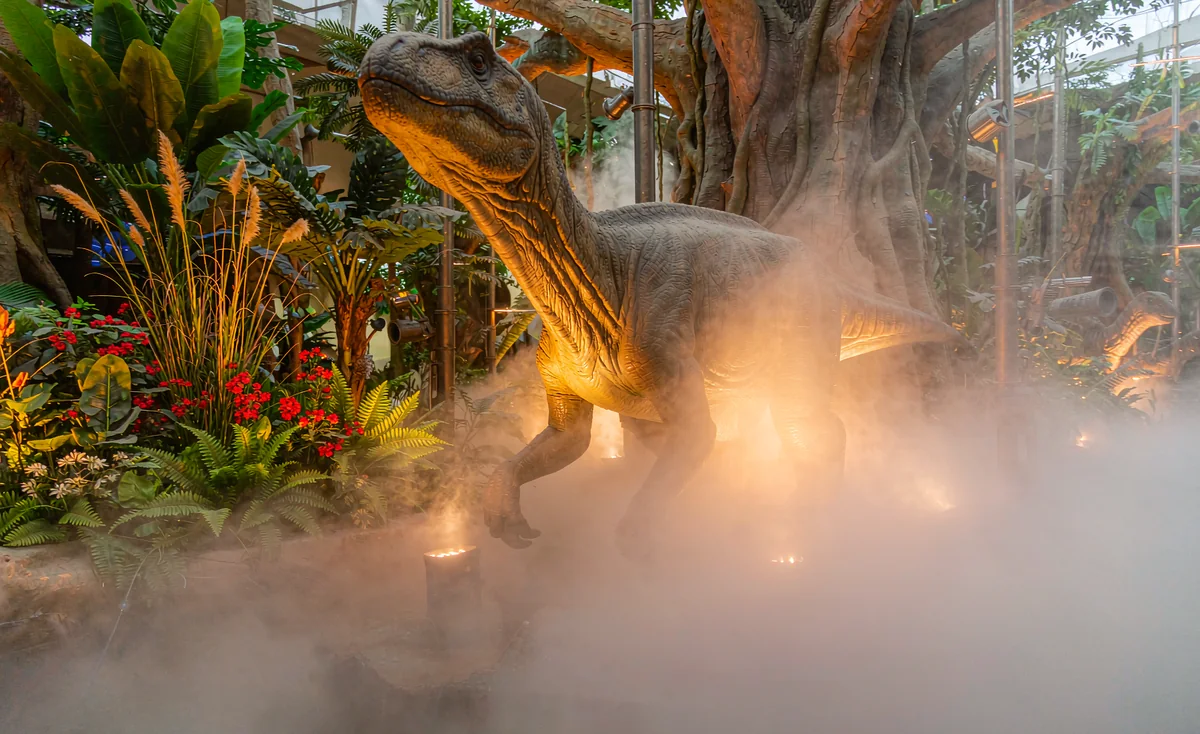
Where water mist wins over fog and haze: it works outdoors, it does not need fluid drums, it drops local temperature by several degrees (a genuine dwell-time benefit on a hot site), and it leaves nothing behind. Where it loses: it does not create the dense, low, dramatic cloud a fog machine makes, and it is invisible unless light hits it.
Two site conditions cause most of the failures. Hard water deposits calcium in the nozzles — a softener or a filtration stage is not optional in hard-water regions. And in freezing climates the lines have to be drained down for the winter, or the first hard frost splits a nozzle body and the whole zone stops.
What smoke detectors do when you turn these on
Optical smoke detectors respond to airborne particles regardless of what produced them. A dense fog plume is much more likely to trigger an alarm than a low-density haze, but both can, and this is the single most common reason an atmosphere effect gets switched off permanently two weeks after opening.
The workable sequence is: decide the effect before the detector layout is finalised; test it in the space with the detection system live, not after; and agree the zoning with the local fire authority rather than assuming a supplier’s datasheet settles it. Where a building has to keep its existing detection, an effect can often be restricted to a zone with dedicated detection, or run at a low density that the detectors tolerate — but which of those is available is a local decision, not a product feature.
Sound: Three Layers, Not One Track
Exhibit audio usually ships as a single looping file. That file is the reason an exhibit sounds cheap, because a single track cannot respond to anything. A show needs three layers mixed live.
The roar, the ambience and the music
Ambience is the bed: wind, distant birds, low forest hum, or an indoor room tone. It runs continuously and its job is to stop the space feeling empty between shows. It should sit quiet enough that a visitor can talk over it.
The roar is the event. It is tied to the peak beat, it is triggered by the show controller rather than by the sensor directly, and it is the loudest thing in the mix — but only for two to three seconds.
Music is optional and often overused. Where it exists, it should carry the build-up and then get out of the way of the roar. A roar competing with a full music bed is the audio equivalent of two people shouting.
Ducking, and why the roar should interrupt the music
Ducking is the technique of automatically pulling the music bed down by a fixed amount — typically 6 to 12 dB — the moment the roar cue fires, then bringing it back over the following few seconds. Without it the roar fights the music; with it, the roar has space and the transition sounds deliberate.
The same rule applies to ambience. Pulling ambience down 3 dB during the peak is enough to make the moment feel like the world has gone quiet to listen.
One practical constraint: the speakers are outdoors or in a hard-surfaced hall more often than not, and intelligibility drops fast with distance. A single cabinet at the animal works for visitors at the fence and turns to mush at twenty metres. Two or three smaller cabinets distributed along the viewing edge, delayed to the same source, will read better than one larger cabinet turned up.
Cueing It Together: DMX, Show Control and the Stop Button
Every element above — motions, wash, laser, haze, mist, audio — has to fire from one timeline, and in practice that means DMX512 as the common language. Lighting consoles, hazer units and misting controllers all accept DMX; the animatronic’s motion controller either speaks DMX natively or sits behind a show controller that does.
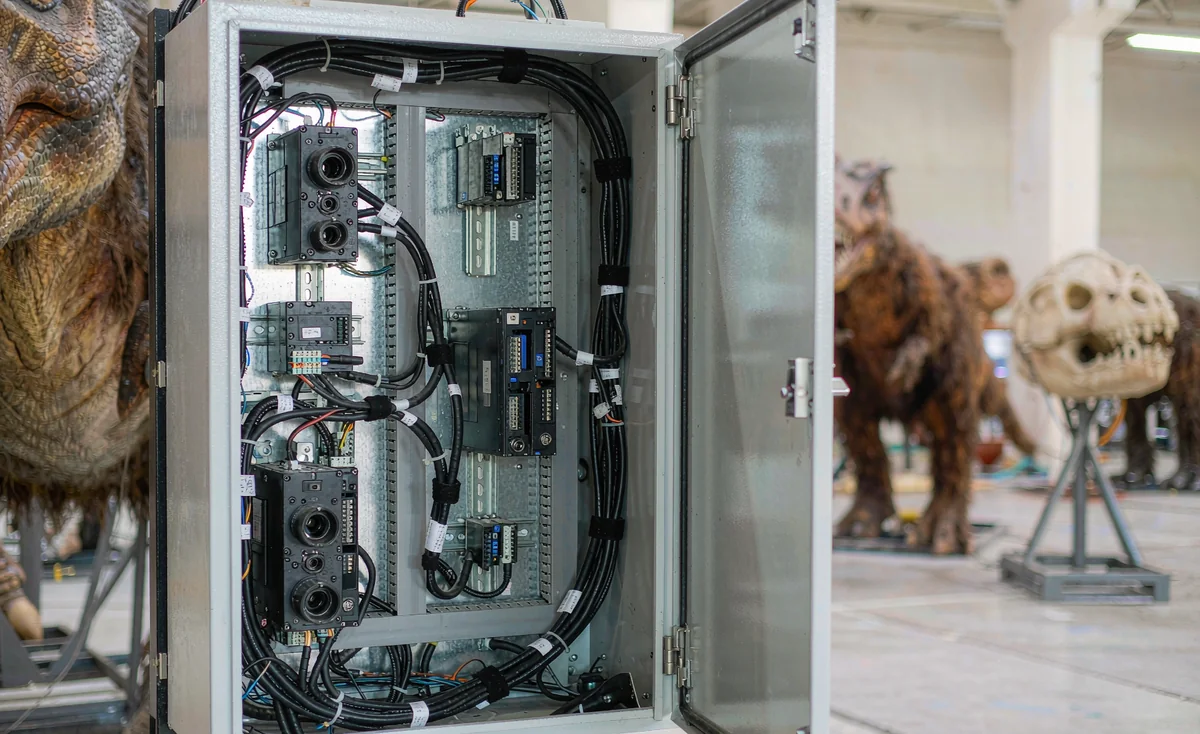
Three rules make the integration survive its first season:
One timeline owns the show. Sensors trigger the show; they do not trigger individual effects. If a passing visitor can fire the fog and the roar independently, the exhibit will be in a random state within a week. What the sensors actually read — and what they deliberately ignore — is covered in sound and light detection in animatronic exhibits.
Every effect has a defined rest state. Haze off, mist off, laser at its park position, audio at ambience level, animal breathing. Coming out of a show should return to exactly that state, and so should a power cut and restore.
The stop button is separate from the show controller. An emergency stop must cut motion and effects independently of the software that runs the timeline. If the only way to stop the animal is through the console that also runs the show, the exhibit has a single point of failure with an audience in front of it.
Power planning is usually underestimated here. Motion, heating elements in fog units and compressor loads all peak on the same cue if the show is written naively. The general load arithmetic is covered in power and air requirements for animatronic dinosaurs, and the same logic applies once lighting and effects are added to the same supply.
What the Guest Actually Commands
There is a spectrum here, and it is worth being clear about which rung of it a project is buying. At the simple end, a visitor’s presence triggers a fixed sequence — the animal reacts, but nothing the visitor does changes the reaction. One step further, a specific gesture or a handheld prop selects among a small number of pre-programmed responses, so the visitor feels agency even though every possible outcome was authored in advance.
True open-ended control — where the animal’s motion is generated from the guest’s input rather than selected from a bank — is a different engineering problem and a different budget. The sensor stack and the four control layers behind these options are covered in gesture-sensing interactive dinosaurs, and the broader exhibit design in what visitors actually do in an interactive dinosaur exhibit.
What matters for show design is that guest-triggered interaction belongs outside the main show timeline. If a guest can interrupt a roar mid-beat, the show has no arc. Standard practice is: main show runs on its own clock, guest interaction is available in the rest state, and a triggered interaction defers to the next scheduled peak rather than cancelling it.
Commissioning Week: What Gets Tuned on Site
None of this arrives finished. The show is tuned during commissioning, and the work is specific:
- Timing against real distance. A roar cue that lands correctly on a drawing lands late when the audience is standing eight metres further back than planned.
- Sound levels against real rooms. Hard surfaces, glass and a full atrium change the mix by more than any console setting. Levels set in an empty hall are almost always too loud once it fills.
- Effect density against real air. Haze behaviour depends on temperature, humidity and ventilation. A setting that reads well in the morning can be invisible by mid-afternoon outdoors, or linger too long indoors in still air.
- The first weekend’s re-tune. Budget a return visit or a remote session after real visitors have run through it. The things that break are almost never the things anyone predicted.
Document the final state: every cue number, every DMX address, the fluid type in each unit, and the detector zoning agreement. An exhibit that has no documentation cannot be repaired by anyone except the person who programmed it, which is a real operational risk for a venue that keeps staff longer than it keeps contractors. The arrival and assembly side of that same week is covered in shipping and installation.
What to Specify Before You Order
These are the lines that decide whether the show works, and they belong in the RFQ rather than in a conversation after delivery:
- Show cycle length and the number of distinct beats
- Whether guest interaction is available during the show, or only in rest state
- Which lighting instruments are in scope — wash, laser, projection — and who supplies and installs them
- Atmosphere type: fog, haze or water mist, and whether the venue already has an opinion
- Detector zoning and who owns the fire authority conversation
- Audio: number of cabinets, distributed or point source, and who tunes the mix
- Whether effects are on the same supply as motion, and the simultaneous peak load
- The documented rest state, and what happens on power loss and restore
- Commissioning days included, and whether a post-opening re-tune is in the price
An exhibit specified on these nine lines can be commissioned in days. One specified on “make it impressive” will still be getting adjusted in month three.
Frequently Asked Questions
How long should a show cycle run? Six to twelve minutes is the practical range for a permanent exhibit. Shorter and visitors who arrive mid-cycle miss the arc; longer and the animal spends too much time in rest for a passing audience to catch a peak.
Can we add lighting and effects to an existing animatronic? Usually yes, and it is often the highest-value upgrade available. The constraints to check first are spare capacity on the motion controller’s show timeline, available power at the animal, and whether the existing detection zoning tolerates haze.
Is water mist safe around visitors? A correctly specified high-pressure system produces droplets small enough to evaporate in seconds, so clothing does not get wet and the path does not pool. The two failure modes are undersized droplet size control and hard water blocking nozzles — both are specification issues, not inherent risks.
Will haze set off the fire alarm? It can, and dense fog is more likely to than low-density haze. This has to be tested in the actual space with detection live, and agreed with the local fire authority. It is the most common reason atmosphere effects get disabled after opening.
Why does our laser look weak? Almost always because there is no haze in the air. A beam is only visible where it scatters off particles; in clear air even a powerful fixture reads as a dot on the wall.
Do we need a dedicated show controller, or can the animatronic run it? If the show is motion-only, the motion controller is enough. As soon as wash, haze, mist and audio have to fire on the same timeline, a show controller that speaks DMX to all of them is the practical answer — and it keeps the emergency stop independent of the show software.
If you are planning a new exhibit or retrofitting atmosphere and lighting onto an existing one, the useful first step is a site plan with viewing distance, ceiling or rigging height, available power and detector layout. Those four things decide most of the design before any product is chosen. Send us the plan and we will tell you what is realistic for the space — including where an effect will not work.