If you are planning a museum exhibition, theme park attraction, or shopping mall event, you have probably asked this question: How much does a life size animatronic dinosaur actually cost?
The short answer is that the number moves with three things: how large the animal is, how much of it moves, and how far the build is customised. Two projects of the same species can be specified at completely different levels. This guide breaks down exactly what drives the cost, what changes in the build at each level, and how to plan the investment for your venue.
At HLTDINO, we have manufactured and installed life size animatronic dinosaurs for clients in over 50 countries. This guide is based on real project data from our factory in Zigong, China.
What Affects the Cost of an Animatronic Dinosaur?
Before looking at price ranges, it is important to understand the five main factors that determine the final quote.
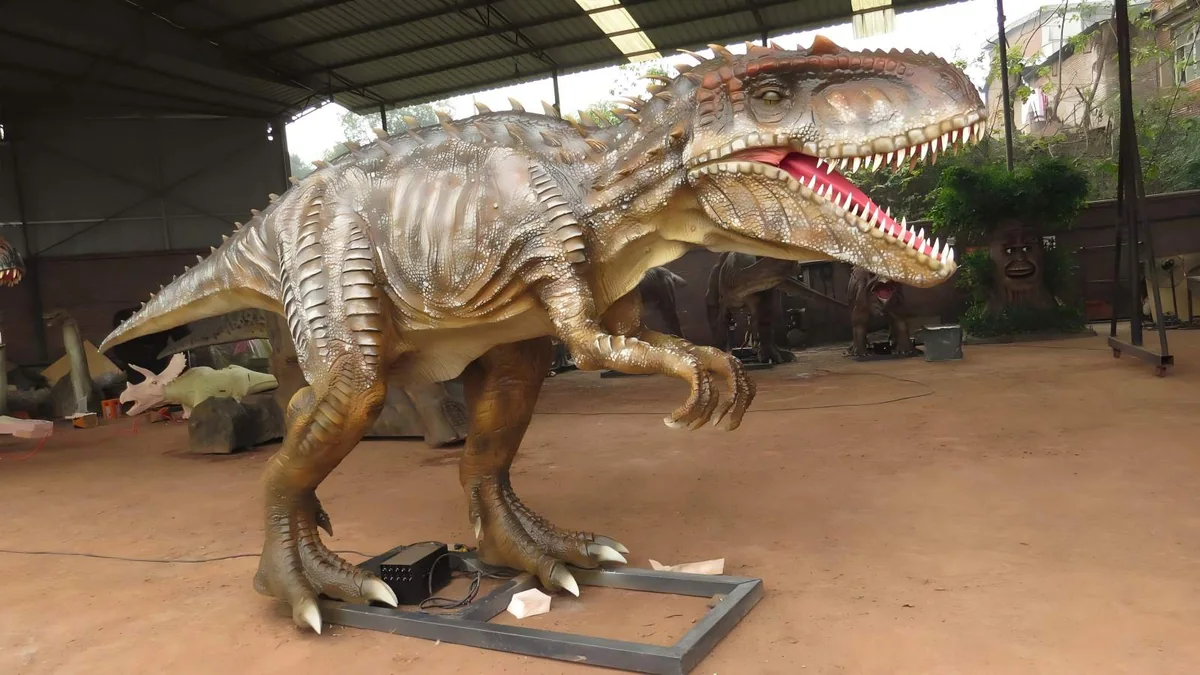
1. Size (Length & Height)
Size is the single biggest cost driver. A 3-meter baby dinosaur and a 25-meter Argentinosaurus require vastly different amounts of structural material, surface work, and engineering.
| Size Category | Typical Dimensions | Complexity |
|---|---|---|
| Small | 3–5 meters | Basic frame + static pose |
| Medium | 8–12 meters | Full animatronic movement |
| Large | 15–20 meters | Advanced mechanics + sound |
| Giant | 25+ meters | Custom engineering required |
2. Movement & Animation Level
Not all animatronic dinosaurs move the same way. The more lifelike the animation, the higher the engineering cost.
- Static Model: No movement. Used for background scenery or photo opportunities.
- Basic Animation: Head turning, tail swaying, jaw opening. Ideal for mid-budget projects.
- Full Animatronic: Multiple synchronized movements (head, neck, tail, claws, eyes) + breathing motion. Best for flagship exhibits.
- Interactive: Motion-sensor triggered responses, touch-activated roars, or app-controlled actions.
3. Materials & Skin Quality
Premium animatronic dinosaurs use an internal frame with a sculpted body core and custom-moulded hand-finished surface. The quality of the surface texture, the painting, and the durability directly affect cost.
At HLTDINO, we use patented surface finish technology that resists UV damage and extreme temperatures, making it ideal for both indoor museums and outdoor theme parks.
4. Sound System
A basic roaring sound module costs less than a multi-channel system with:
- Species-specific vocalizations
- Environmental background audio
- Volume control based on visitor proximity
5. Customization & Scene Design
Off-the-shelf models cost less than fully custom designs. Customization includes:
- Unique color patterns or feather details
- Branding or signage integration
- Matching scenery (rocks, plants, fog effects)
- Educational display panels
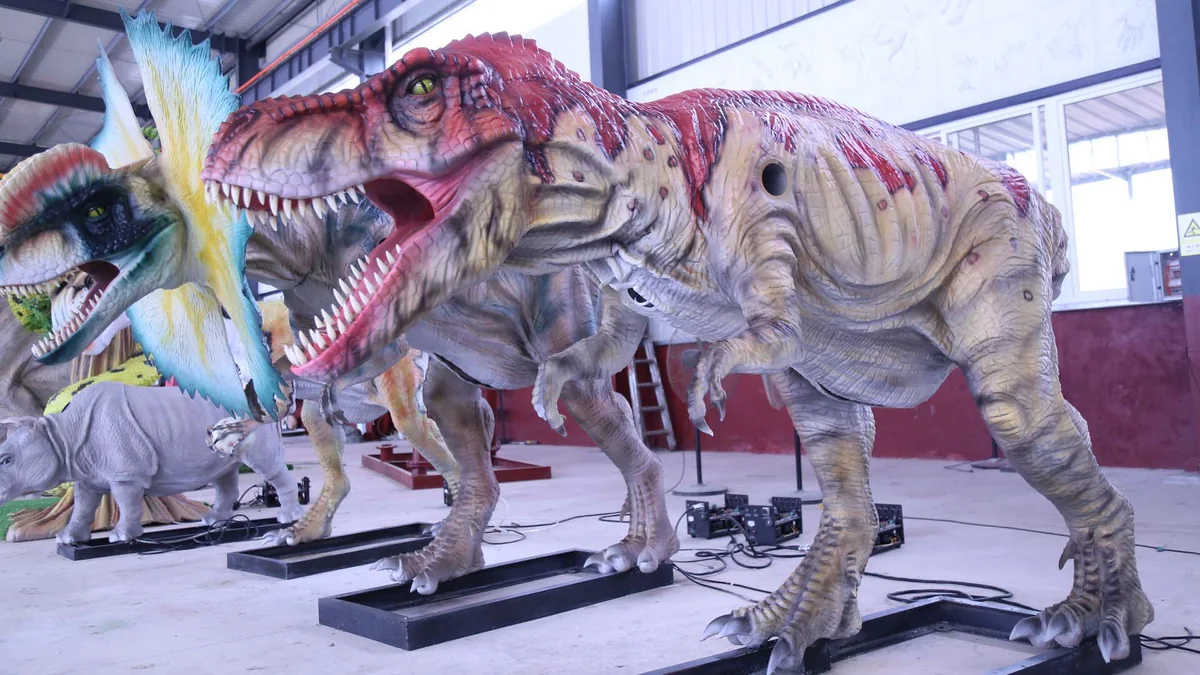
How Size Changes the Budget
Size drives cost through work volume, not through raw material alone. A taller model needs a stronger frame and heavier actuators to move the same mass; a longer neck or tail needs more pivot points and more programming time to keep the motion natural; and a larger skin surface means more sculpting and finishing hours per piece. That is why two models of the same species at different scales are rarely close in price even when the movement list looks identical.
The practical way to size a project is to start from viewing distance rather than from a target figure: a piece viewed from 4 metres can carry fine surface detail and subtle movement, while one viewed from 25 metres needs bigger, slower gestures and a bolder silhouette to read at all. Spend the budget where visitors actually stand.
Movement Levels: Static, Animated and Interactive
Movement is the second major cost driver, and it comes in three tiers that change both the build and the quotation:
- Static models — sculpted and finished but not mechanised. The lowest build cost, and often the right choice for background scenery and long route stretches.
- Animated models — jaw, head, neck, tail and breathing motion driven by motors and a control system, with synchronised sound. This is the standard for a hero dinosaur at a route entrance.
- Interactive models — sensors or gesture control added so the creature responds to visitors approaching or waving. The highest build cost, and the strongest engagement per piece.
More movement means more actuators, more wiring, more programming and more maintenance access — which is why we map movements against viewing distance before quoting. A subtle eye and jaw movement on a close-viewed model can be more effective than a full-body animation seen from across a plaza. For the mechanics behind these choices, see our guides to animatronic technology systems and hydraulic versus pneumatic movement.
What to Prepare Before Requesting a Quote
Quotations get accurate in proportion to how specific the brief is. Before you request pricing, gather six things:
- Species and quantity — including any secondary pieces for the same route.
- Target size or viewing distance — whichever you know first.
- Movement level — static, animated or interactive, per model.
- Indoor or outdoor placement — outdoor builds are engineered for wind, rain and nightly seasonal operation.
- Electrical and certification requirements — voltage, and the certification marking your market requires. Building compliance in is cheaper than retrofitting it.
- Opening date — because fabrication and sea freight schedule backwards from it.
Send those six and the reply you get is a proposal rather than a form letter. Our complete buying guide for theme parks, museums and zoos covers the full process, and the 2026 cost planning guide shows how each of these factors feeds into a quotation.
Comparing Quotes Fairly
Animatronic quotations are hard to compare side by side because suppliers describe different scopes with the same words. Before comparing totals, check whether each quote covers the same five things:
- The movement list, model by model. “Animated T-Rex” can mean a moving jaw or a full neck, tail and breathing sequence — a large difference in build work.
- Control and sound system. Whether the controller, programming and synchronised audio are included or quoted separately.
- Transport configuration. Whether sectional design and export packing are built into the price or added later.
- On-site support. Installation technicians, drawings and commissioning — or an assumption that your team handles it.
- Certification. Whether UL or CE marking for your market is included in the quote.
Comparing like for like usually narrows the field quickly. Our supplier comparison notes and the most popular animatronic dinosaurs guide show what buyers typically end up specifying — and what to ask before signing.
What Changes in the Build at Each Level
Note: The four levels below describe what changes in the build as a project scales — not price points. As a custom manufacturer we specify and cost every project from its own brief.
Small Animatronic Dinosaurs (3–5 Meters)
Build level: entry — single animated unit, stock motion programme
What You Get:
- Internal frame with a sculpted body core
- Static or limited movement (head turn, jaw open)
- Basic sound module
- Suitable for: retail stores, small museums, private collections
Popular Models: Velociraptor, baby T-Rex, small Triceratops
Medium Animatronic Dinosaurs (8–12 Meters)
Build level: mid — multi-axis motion, custom sound design
What You Get:
- Full animatronic movement system (head, neck, tail, claws)
- High-quality hand-finished surface with detailed texture
- Multi-sound audio system
- Suitable for: theme parks, science centers, shopping malls
Popular Models: Adult Triceratops, Spinosaurus, Stegosaurus
Large Animatronic Dinosaurs (15–20 Meters)
Build level: large — full-body articulation, interactive sensors
What You Get:
- Advanced pneumatic or electric movement systems
- Realistic skin with hand-painted details
- Interactive sensors or remote control
- On-site installation support
- Suitable for: major museums, large theme parks, city exhibitions
Popular Models: Adult T-Rex, Brachiosaurus, Allosaurus
Giant Animatronic Dinosaurs (25+ Meters)
Build level: landmark — engineered structure, multi-unit scene, site works
What You Get:
- Custom-engineered structural design
- Full animation suite with programmable sequences
- Premium hand-finished surface with weatherproofing
- Dedicated project management and installation team
- Suitable for: landmark attractions, international expos, mega-resorts
Example: A life size Argentinosaurus at 30+ meters requires custom structural engineering and months of production.
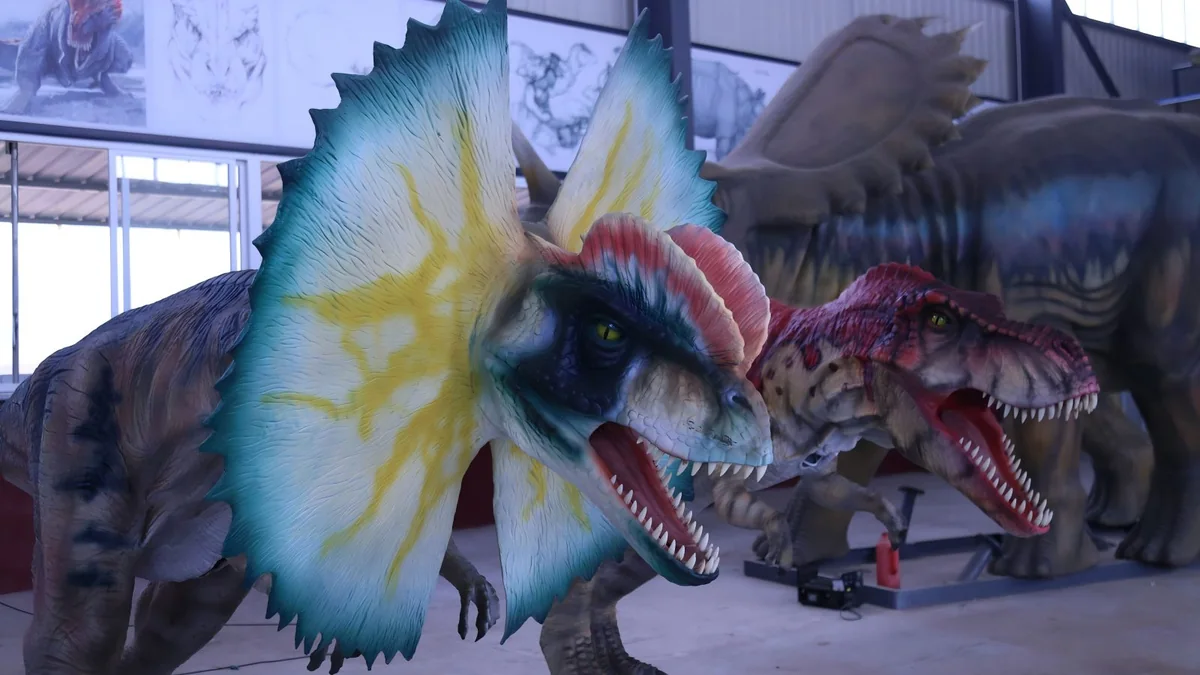
Real Case Study: Museum-Grade T-Rex Exhibit
One of our clients, a natural history museum in Europe, commissioned a 12-meter adult Tyrannosaurus Rex for their new Jurassic wing.
Specifications:
- Length: 12 meters
- Height: 4.5 meters
- Movement: Head, neck, tail, arms, jaw (6 independent motors)
- Skin: UV-resistant surface finish with hand-scaled texture
- Sound: 8-channel audio with motion-triggered roar
- Installation: On-site assembly over 5 days
Timeline: 8 weeks production + 1 week shipping + 5 days installation
This project fell into our medium-to-large category, delivering a centerpiece attraction that draws over 200,000 additional visitors annually.
What Else Belongs in the Project Plan
When planning an animatronic dinosaur, four items sit outside the figure itself:
| Project Element | What Drives It | Notes |
|---|---|---|
| Shipping (sea freight) | Volume, weight and destination port | Crating is quoted with the project |
| Import duties & taxes | Destination country tariff code | Your customs broker confirms the applicable rate |
| On-site installation | Crew size, days on site, technician travel | Our technicians travel with the shipment |
| Maintenance (annual) | Number of moving axes and daily operating hours | Motor lubrication and surface inspection |
| Scene/scenery | Scale of the setting and lighting design | Rocks, plants, lighting, signage |
Frequently Asked Questions
How long does it take to build a life size animatronic dinosaur?
Production typically takes 6 to 12 weeks, depending on size and complexity. Custom designs or giant models may require up to 16 weeks.
What affects how long an animatronic dinosaur serves an exhibit?
Service life depends on duty cycle and how the figure is maintained — a figure in daily operation is serviced more often than a seasonal display. Our team supports every exhibit with a maintenance schedule built around your operating calendar.
Do you ship animatronic dinosaurs worldwide?
Yes. We have shipped life size animatronic dinosaurs to over 50 countries including the USA, UK, Germany, UAE, Australia, and Japan.
Can the dinosaur be used outdoors?
Absolutely. We offer weatherproofing options including rain covers, UV-resistant coatings, and temperature-resistant motors for outdoor installations.
Is the sound volume adjustable?
Yes. All our animatronic dinosaurs include volume control. For venues with noise restrictions, we also offer silent-mode operation with visual-only animation.
Get a Custom Quote for Your Project
Every project is different. The best way to get an accurate price for your life size animatronic dinosaur is to tell us:
- What species or design you need
- The target size (length / height)
- Indoor or outdoor installation
- Required movement features
- Your target delivery date
At HLTDINO, we manufacture every animatronic dinosaur in our Zigong, China facility using traditional craftsmanship combined with modern robotics. From a 3-meter Velociraptor to a 30-meter Argentinosaurus, we deliver museum-quality exhibits direct from our Zigong workshop.
Response within 24 hours. No obligation.