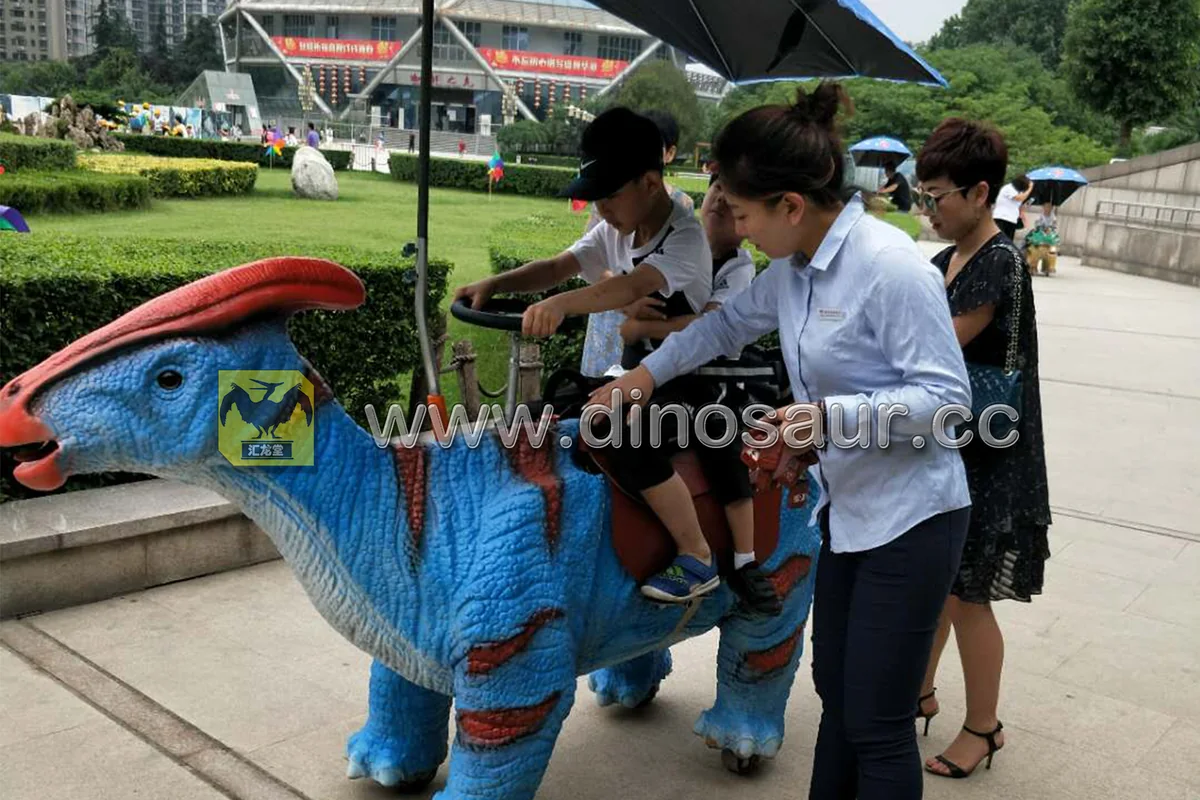
Dinosaur Rides
A kiddie ride has about forty seconds to justify itself. A child gets on, the machine runs, the child gets off — and whether they ask for another one depends on whether anything happened in those forty seconds. A horse on a pole bobs; a dinosaur that turns its head and opens its jaws at the child does something.
This is the single-seat version: about 1.7 m long, built for ages three to ten, with an animated head, jaw and illuminated eyes on a moulded saddle over a welded steel subframe.
| Species | Generic theropod — species styling to order |
| Era | Cretaceous styling, fictional-friendly |
| Type | Single-seat coin-operated kiddie ride, attendant or coin control |
| Size | About 1.7 m long × 0.7 m wide; saddle height 0.8–0.9 m; 60 kg saddle rating |
| Material | Welded steel subframe, foam body, patented silicone skin (ZL 2022 1 0224489.5); saddle in moulded composite with a soft pad |
| Surface | Hand-painted UV-resistant pigment, scuff-resistant saddle finish, child-safe non-toxic |
| Animation | Head turn, jaw open and close, LED eye illumination, gentle body sway |
| Sound | Directional speaker, roar and ride jingle, volume capped at commissioning |
| Power | 110/220 V AC, single drive unit, standard socket with earth |
| Installation | Level floor, no anchoring for supervised indoor use; one technician, about two hours |
| Customisation | Species styling, colour, ride duration, coin or attendant, seat belt, signage |
| Support | 12-month warranty; drive unit, saddle pad and coin mechanism field-replaceable |
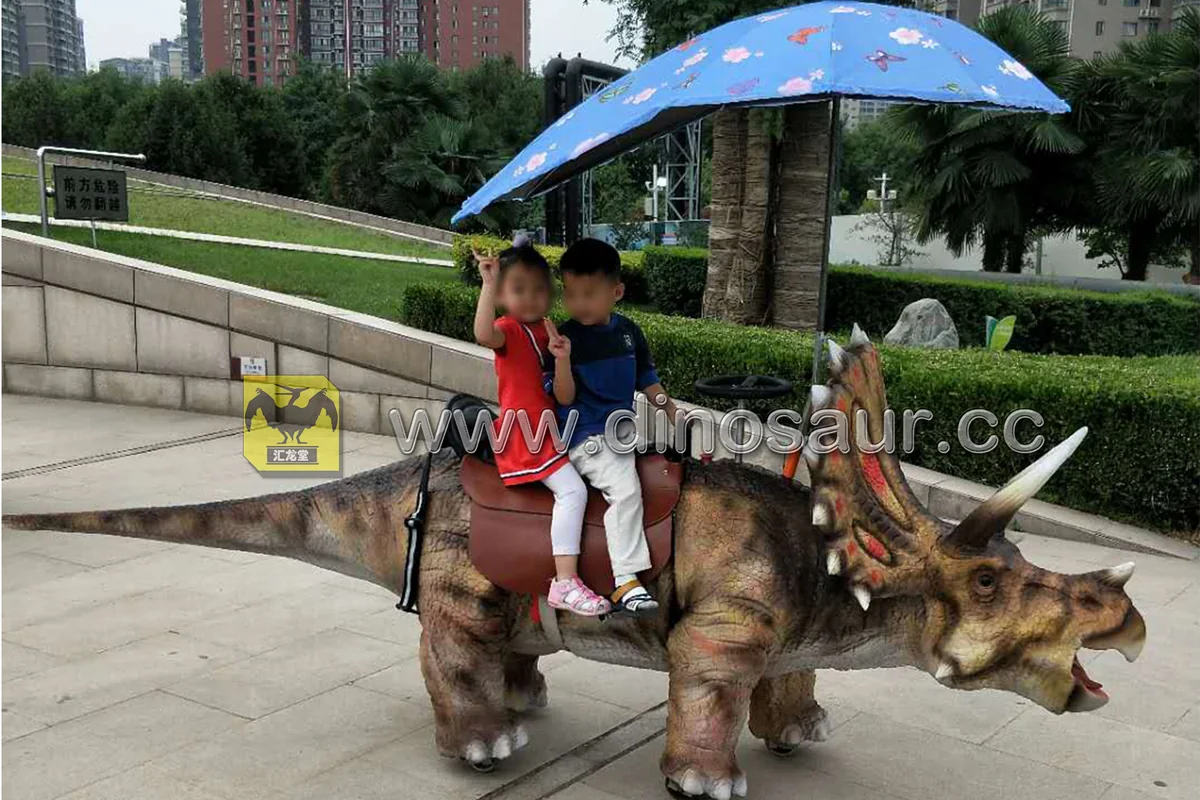
Sixty kilogrammes covers most children up to about ten years and it is not a margin to be stretched. Above that weight the saddle load path and the drive unit are both outside design, and the failure mode is a stalled drive rather than a snapped frame — but it is still a failure.
Where a site regularly sees older children, the four-seat machine is the correct product rather than a beefed-up single. Where the audience is genuinely three to ten, the single seat wins on footprint and on the number of units a site can run.
The head turns, the jaw opens, the eyes light, and the body sways gently under the saddle. That is the set, and it is deliberately restrained — a kiddie ride that moves a lot feels unsafe to a small child, and a parent watching from a metre away will stop the ride before the child does.
The jaw is the part children watch. It cycles through the ride rather than opening once, and the eye illumination is timed with it so the head reads as active throughout rather than settling into a pose.
A lap belt on every saddle, a saddle with a raised front lip, footrests a child’s foot cannot slide past, and control circuits at low-voltage DC. Those four are fixed regardless of what else the buyer specifies.
Add to that: speed and head travel limited at commissioning and capped inside the controller, so a setting cannot be changed from outside the machine. On a ride used by small children, that cap is the difference between a supervised attraction and an unsupervised one.
It suits a position with a parent-sized waiting area beside it — a mall concourse, a family queue line, a retail entrance. A ride with nowhere to stand gets one ride; the same unit beside a bench gets three, because the parent is comfortable.
It also suits a site that wants several units rather than one. Three singles at three locations usually out-earn one four-seat machine on the same total floor area, because the ride is where the family already is rather than where the operator put the machine.
The standard build is for indoor or covered positions. An outdoor version with a sealed skin and weatherproof enclosure is available, but it is a separate specification — putting a covered-use unit outside shortens its life and falls outside the warranty terms.
Yes, at the controller. Coin mechanisms usually run a fixed cycle set by the mechanism; attendant operation allows any duration. Decide the operating model first, because it determines which controller is fitted.
The sealed silicone surface wipes with mild detergent and water. Avoid solvents on painted areas and keep water out of the head joint — that is the one place where water causes a problem.
Yes. The body and mechanism are the same; species styling is a sculpting and paint change. Where a site is themed around a particular dinosaur, that is usually worth doing because the ride then matches the signage around it.
Same factory and the same build standard. What changes is size, movement set and how the exhibit is meant to be used on site.
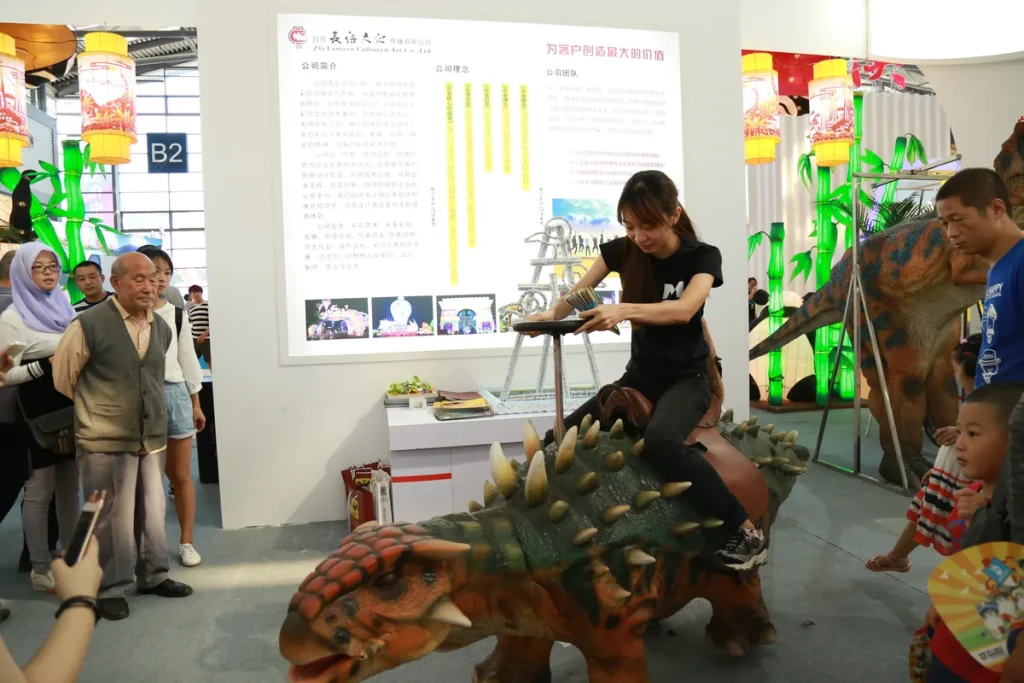
The Ankylosaurus is the smallest build in this range and the one that fits where nothing else does. At 1.8 metres it works in […]
View Product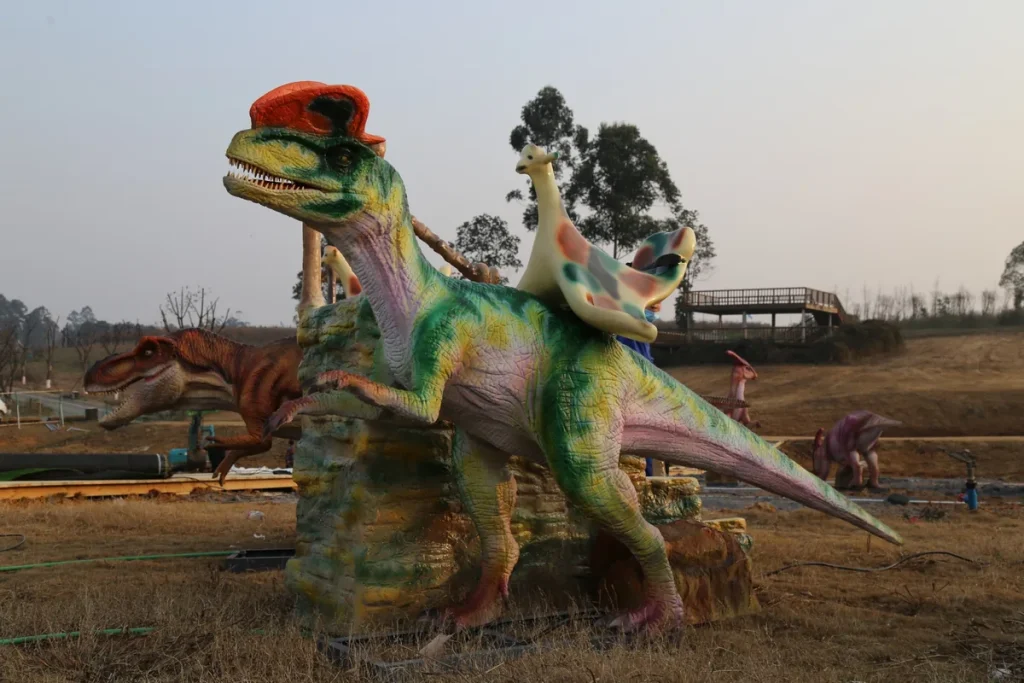
The Dilophosaurus is the unit that gets filmed, and not because of the twin crest. It is the spray. A mouth-level atomiser that puffs […]
View Product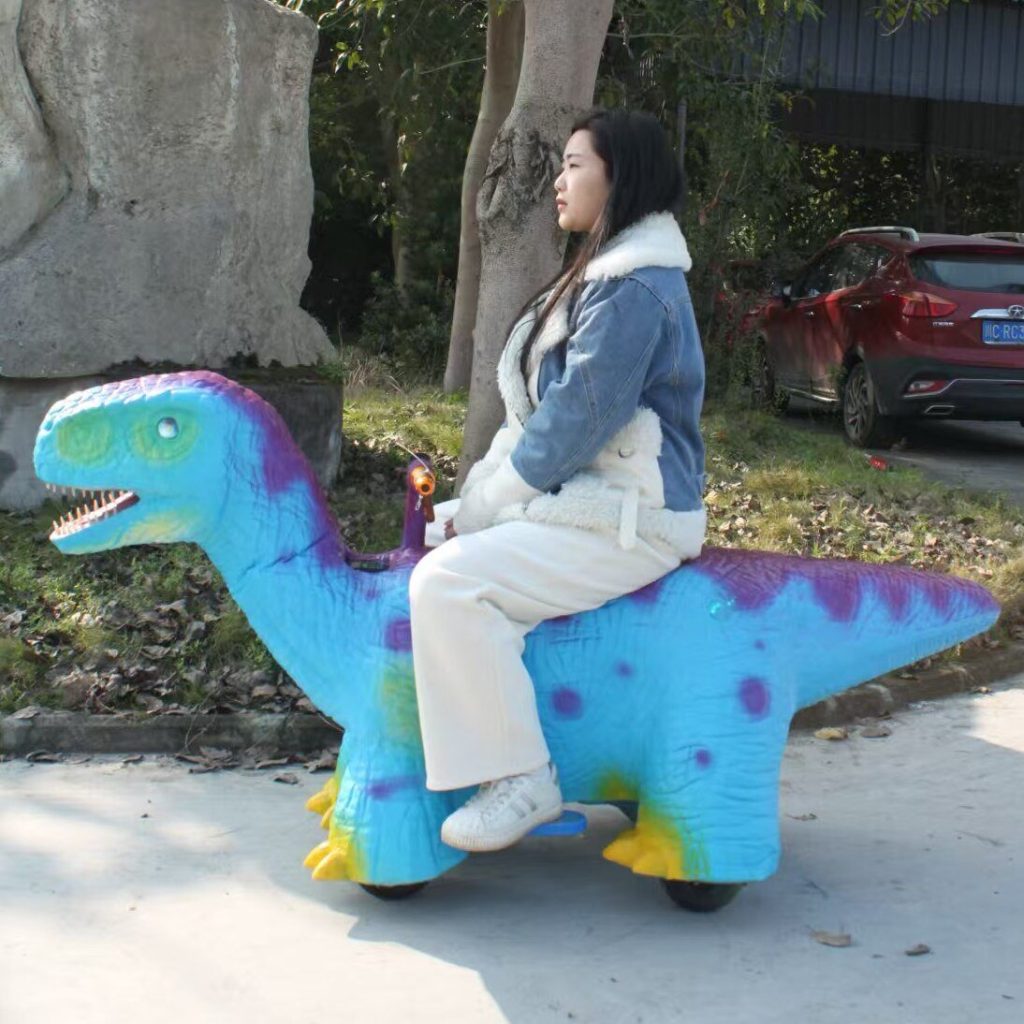
The T-Rex is the one every child asks for, and the one operators are most nervous about — a big head, a heavy tail […]
View ProductThree things buyers usually want settled before they ask for a drawing — what drives the number, how the piece is actually built, and what to check between suppliers.
What Animatronic Products Are Actually Used For Buyers come to animatronic products with one of two jobs in mind, and the job determines almost […]
Read the guide →Which drive system actually suits an animatronic dinosaur? A factory-side comparison of force, precision, noise, maintenance and weather.
Read the guide →If you are planning a museum exhibition, theme park attraction, or shopping mall event, you have probably asked this question: How much does a life […]
Read the guide →Send your dimensions, movement requirements and installation site. You get a realistic budget range and a dated build schedule.
Or email info@hltdino.com — we reply within one business day.