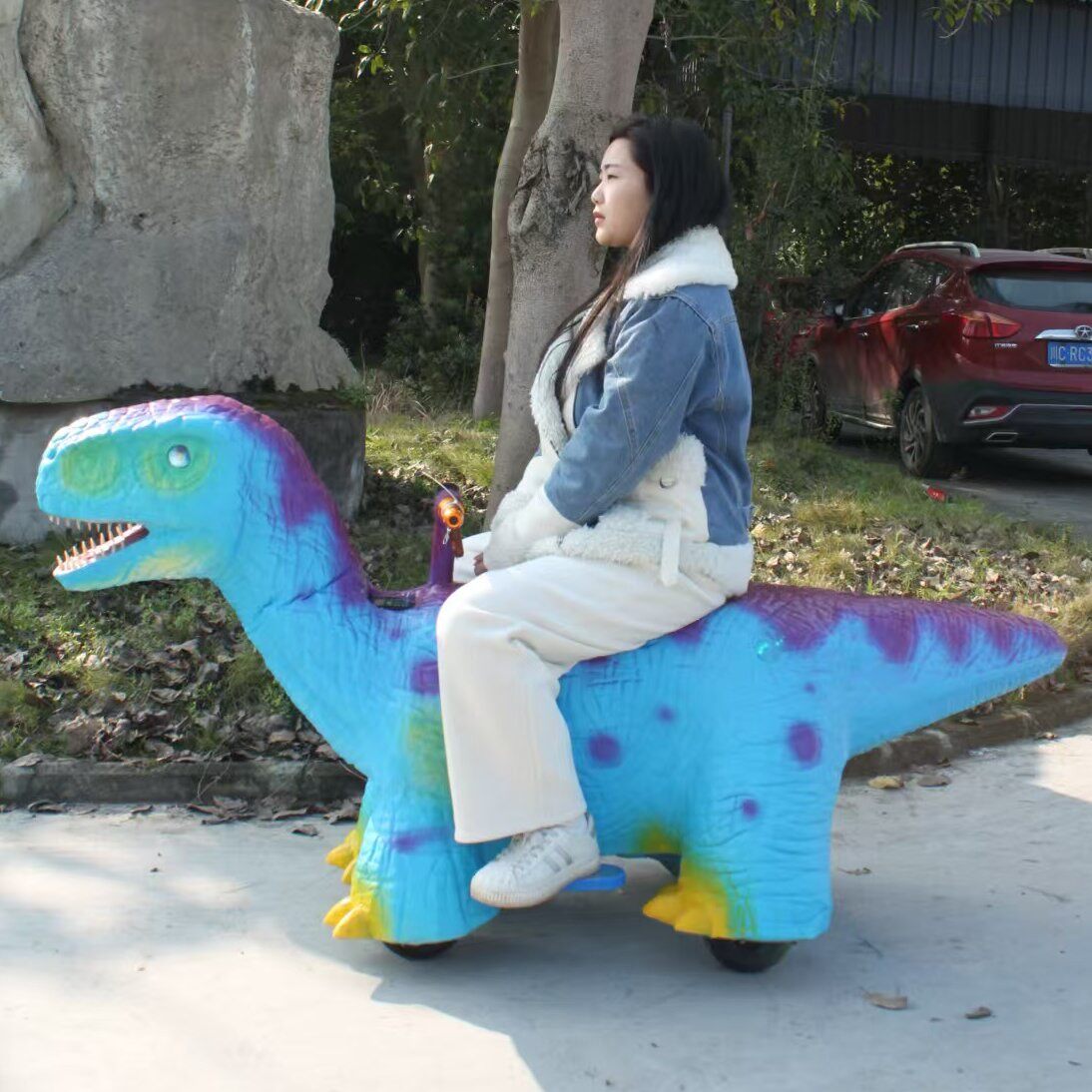
Dinosaur Rides
The T-Rex is the one every child asks for, and the one operators are most nervous about — a big head, a heavy tail and a rider sitting high enough to matter. This build answers that with a ride-scale body rather than a scaled-down exhibit: shorter, lower and balanced, so the walk cycle stays steady with an adult in the seat. It is the loudest thing on any floor it stands on, which is exactly the point.
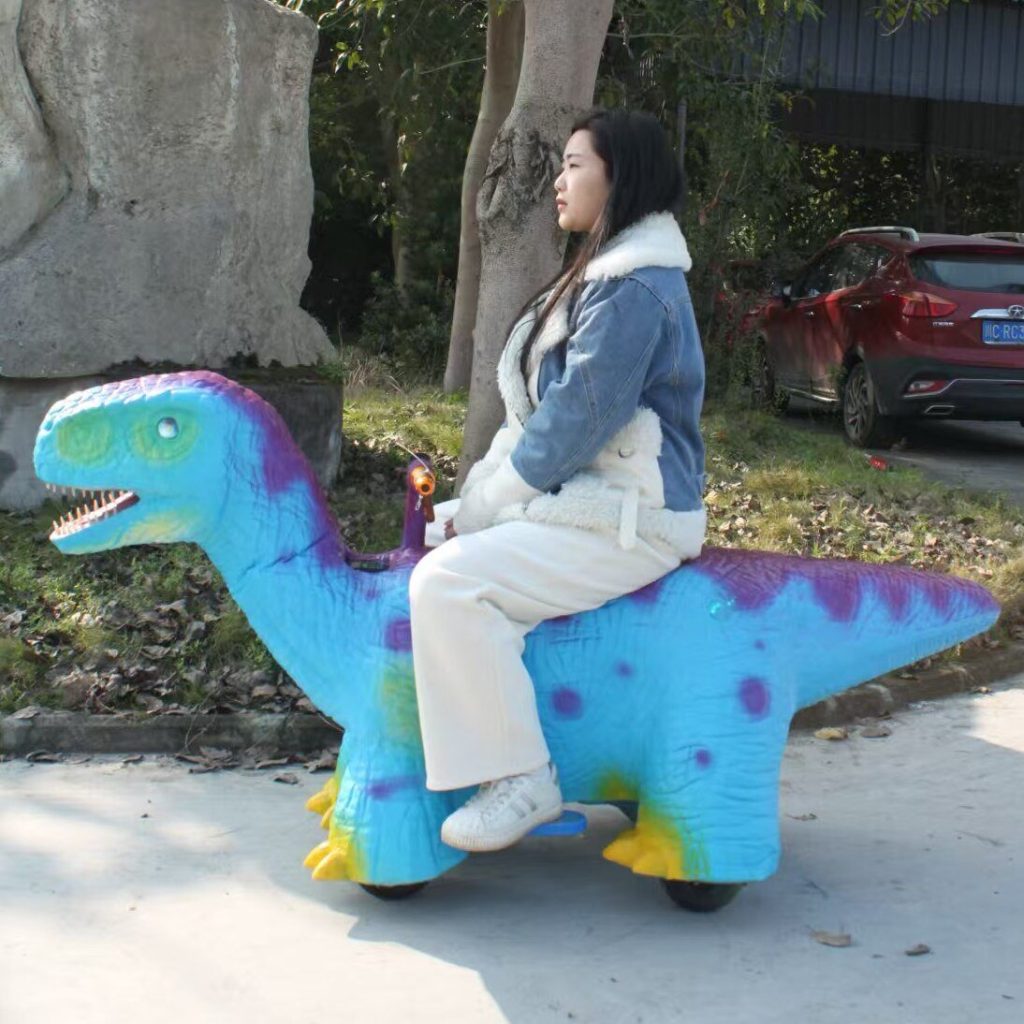
| Overall length | Built to order — typically 1.5 to 2 metres for the ride-scale pose |
|---|---|
| Overall height | Set by the pose and confirmed on the approval drawing |
| Rider capacity | Single seat as standard; two-seat frame on request |
| Rider load | Frame rated to the rider mix specified at order — 100 kg single seat, 150 kg two-seat |
| Walk speed | Adjustable 3–6 km/h, set and locked at commissioning |
| Power | 12V 20AH rechargeable battery pack, charged off-shift |
| Surface | Level, hard paving recommended |
| Duty | Outdoor or indoor specification, decided at order |
Dimensions are confirmed on a drawing before production starts. Send the site plan and the rider mix, and what comes back is the drawing with the turning circle and the standing clearance marked on it.
Most of the attraction sits above the rider’s knees. The head is the largest in the range and the first thing a queue sees, so the sculpt gets the most time: jaw line, brow, the angle of the eye sockets. Teeth are moulded and painted individually rather than cast as a single block, because that is where wear shows first.
The tail runs on its own drive stage and swings through a limited arc — deliberately slower than an exhibit unit would move. A heavy tail swinging at queue height is a hazard that does not need to exist on a ride.
Ride cars live in buildings with tenants. The drive is a brushless motor tuned for quiet running: what a rider hears is the footfall cycle and the soundtrack, not the gearbox. That single decision is usually what gets a unit past a landlord.
Power is a 12V 20AH battery pack — no mains feed, no floor work, no second circuit to sign off before opening day. A full charge covers a trading day and the swap takes minutes, so the unit is never taken out of service for a charging window. On a fixed site with long hours, a spare pack on rotation is the sensible add-on.
National-standard steel skeleton, moulded silicone skin, acrylic paint colour finish — the same specification as the exhibit range, on a frame rated for riders. Silicone takes contact better than filled resin: hands grab the snout, bags brush the flank, and the surface flexes instead of cracking.
Rider-contact areas — the snout, the back plates where hands go, the seat itself — carry a harder topcoat and are repainted on a service interval, not on failure.
A T-Rex ride needs less room than it looks like it should. The ride-scale pose keeps overall height down, there is no long neck to duck, and the turning circle fits an atrium. For covered family zones it is usually the right first order, and it runs without the fuel and exhaust restrictions that apply to outdoor units.
Can the jaw and tail motion be locked? Yes. Motion can be disabled at the control box without removing parts, which is normally the right setting for tight indoor queues.
What is the weight limit? Set by the frame rating. We quote against your rider mix — adult with child, or two children — rather than publish a single number.
How long does a charge last? A full 12V 20AH charge covers a standard trading day. A spare pack swaps in seconds, so there is no charging downtime.
Does it need a prepared surface? Level, hard paving is ideal. Other surfaces can be run with a different drive setting, but wear on the feet goes up.
Can it run outdoors? Yes — the outdoor specification seals the electrical enclosures to the same −20°C to +60°C rating as the exhibit range.
Materials. National-standard steel skeleton, moulded silicone skin, acrylic paint colour finish.
Related. the dinosaur range, mall installations, maintenance and service.
The power decision is made once, and on this model it is a simple one: battery. What matters at order is where the pack charges and who swaps it. A fixed site with a back room can charge overnight; a unit that moves between floors needs a charge point at each stop, or a second pack in rotation.
Ground is the other half. The T-Rex walks on level hard paving without argument; on loose gravel, wet grass or a slope it needs a different drive setting, and the wear on the feet goes up either way.
Delivery is the easy part. The unit arrives part-assembled, the sections bolt together at numbered joints, and the first run happens with our technician and whoever will operate it standing in the same place.
Commissioning is mostly setting two numbers: the walk speed and the trigger distance for the sensor start. Both are set against your actual surface and your actual queue, not in a workshop, and both are then locked. Operator training happens in the same session: start, stop, emergency stop, the daily check, the battery swap, and what to do when a unit refuses to start.
Nothing leaves the site until the animal has run a full cycle in front of the people who will run it every day.
| Frame | Q235 national-standard steel, welded in-house, corrosion-protected |
|---|---|
| Skin | Moulded silicone, acrylic paint colour finish |
| Drives | Brushless silent motor, tuned per movement set |
| Control | Sensor trigger · remote · coin-op · QR payment · single operator |
| Weather | −20°C to +60°C, sealed electrical enclosures |
| Size | Custom — built to your drawings |
| Lead Time | 30–45 days after drawing approval |
| Warranty | 12 months with maintenance support |
Same factory and the same build standard. What changes is size, movement set and how the exhibit is meant to be used on site.
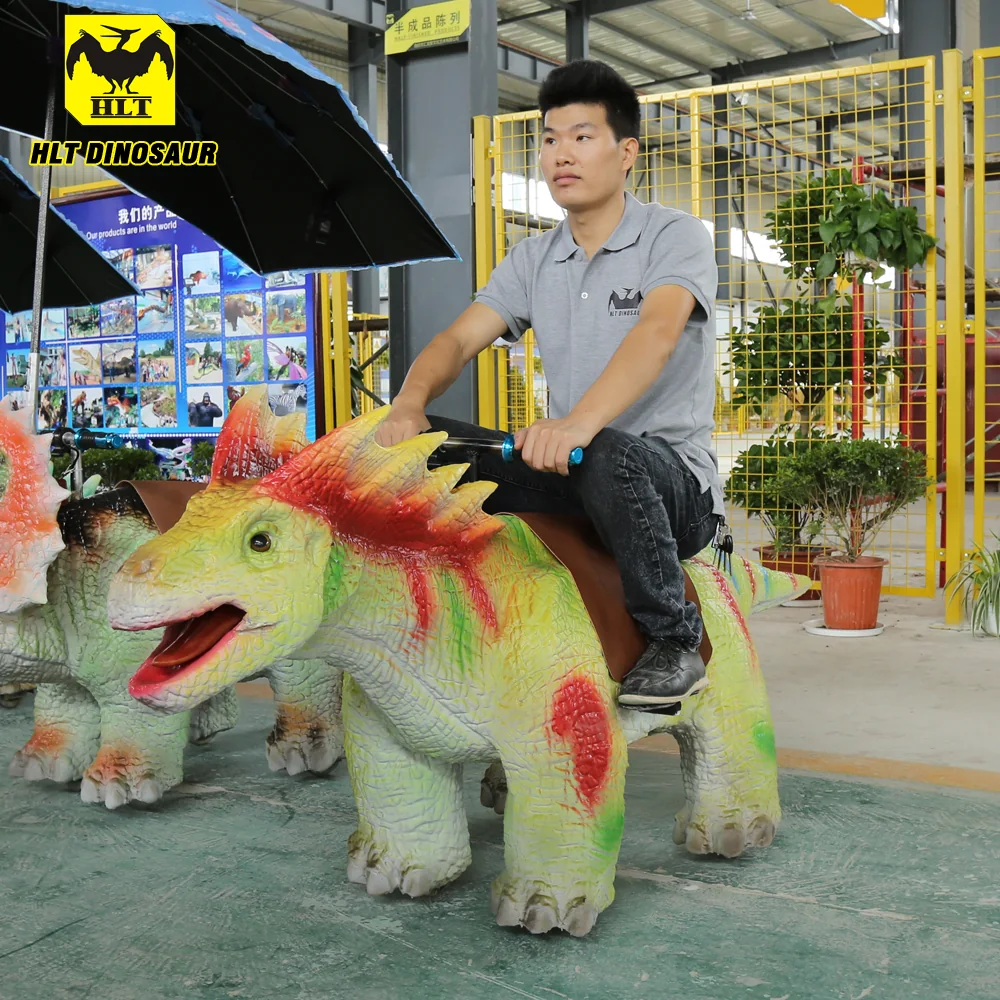
A single-seat kiddie ride earns per child and queues per child. A four-seat unit earns four times per cycle on the same footprint and […]
View Product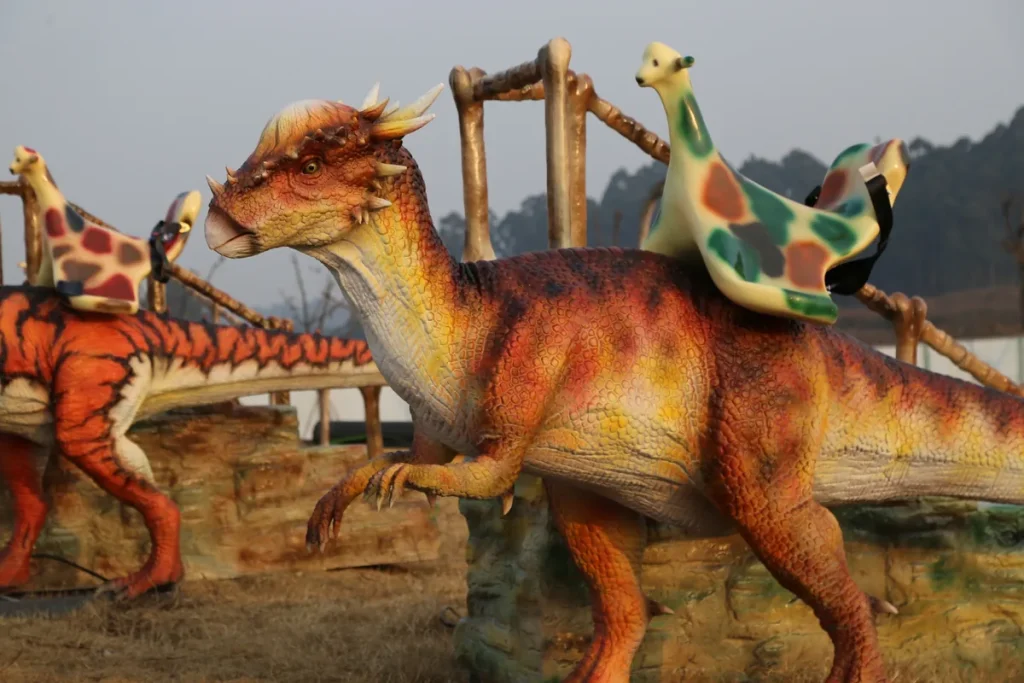
The Pachycephalosaurus is the quiet one. A low-noise drive, a soft-skinned body and a motion set that rocks rather than swings — this is […]
View Product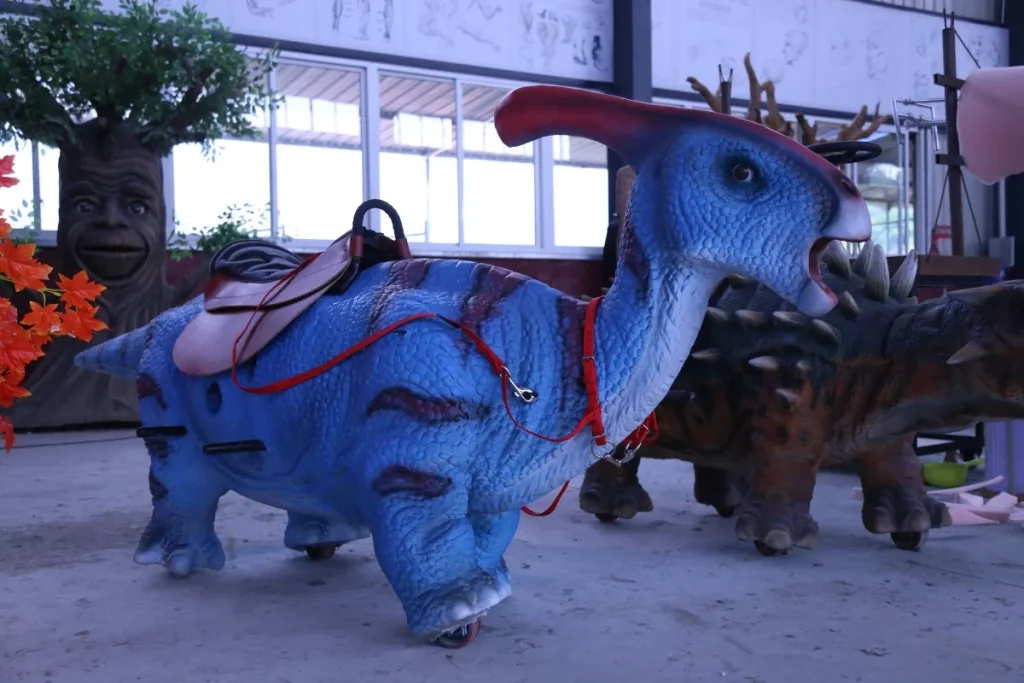
This is the small one in the fleet, and in a shopping mall it is usually the unit that earns. A 1.6-metre Parasaurolophus on […]
View ProductThree things buyers usually want settled before they ask for a drawing — what drives the number, how the piece is actually built, and what to check between suppliers.
What Animatronic Products Are Actually Used For Buyers come to animatronic products with one of two jobs in mind, and the job determines almost […]
Read the guide →Which drive system actually suits an animatronic dinosaur? A factory-side comparison of force, precision, noise, maintenance and weather.
Read the guide →If you are planning a museum exhibition, theme park attraction, or shopping mall event, you have probably asked this question: How much does a life […]
Read the guide →Send your dimensions, movement requirements and installation site. You get a realistic budget range and a dated build schedule.
Or email info@hltdino.com — we reply within one business day.