Short answer: yes, an animatronic dinosaur can live outdoors all year — but not the same build that goes into a museum hall. The silicone skin is almost never what fails. What fails is the seam where two skin panels meet, the gland where a cable enters the body, the vent path that lets a servo bay breathe, the plinth that lets water sit against the belly, and the control cabinet somebody bolted to the sunny side of the frame. This article covers those details in the order they actually break, plus the IP ratings, wind loads and winter limits you need to write into a specification.
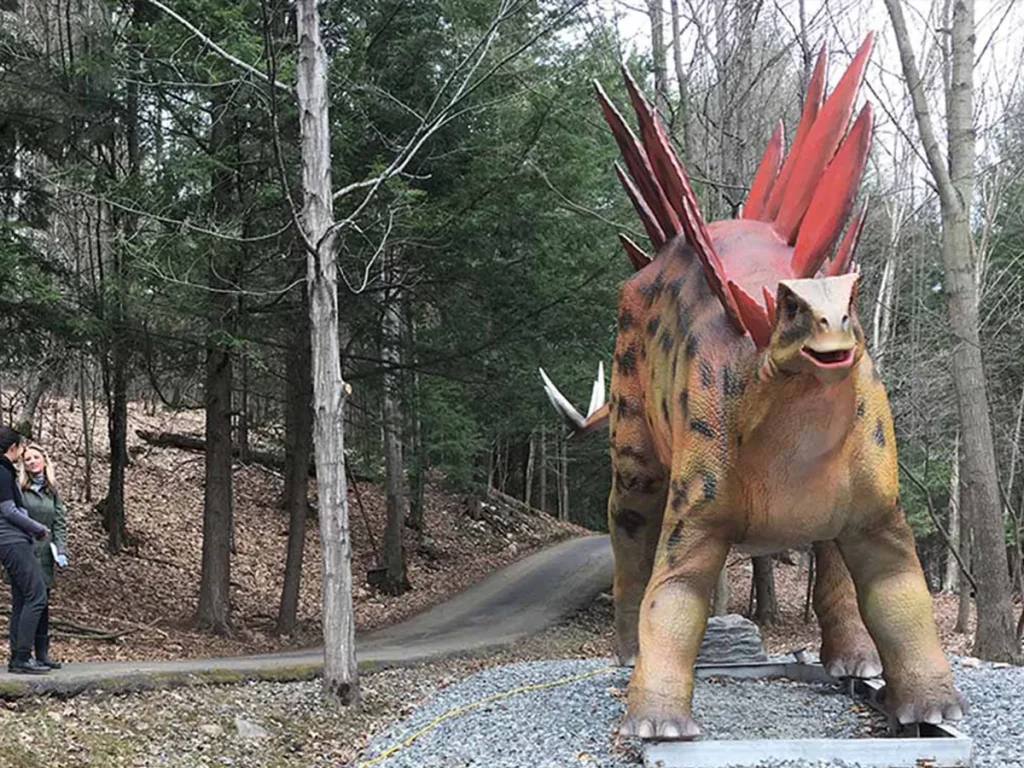
Why Outdoor Units Cost More Than Indoor Ones
The mechanism does not change much. A servo-driven neck is a servo-driven neck whether it stands in a shopping mall or a safari park. What changes is everything around the mechanism: sealing, drainage, coating, anchoring, and the enclosure that holds the electronics.
In practice an outdoor specification adds cost in five places. Gland plates and sealed connector bulkheads instead of open cable runs. A cabinet rated IP66 with filtered ventilation and a heater rather than a plain steel box. Marine-grade or hot-dip galvanised fasteners instead of zinc-plated. A mechanical anchor design signed off for wind load. And a topcoat system that gets re-applied on a schedule, because the paint on any outdoor figure fades long before the skin underneath gives up.
Buyers often ask for “the same model, but waterproof”. That is not a coating you add at the end. Sealing decisions have to happen while the frame is being built, because the cable routing, the actuator bay layout and the base plate all determine whether water can be kept out.
What Actually Fails First
Across outdoor exhibits, the failure order is remarkably consistent. Skin panels themselves rarely fail. The joints between them do.
Seams. A molded silicone skin is assembled from panels. Where panels are bonded, the adhesive line is the weakest point in the whole envelope — not because the adhesive is bad, but because that line sees constant flexing as the neck or tail moves. A seam placed along the top of a neck collects water and works it into the bond with every movement cycle. A seam placed low and running downward sheds water instead. Seam orientation costs nothing to change at the design stage and is almost impossible to fix later.
Cable entries. Every cable that enters the body is a hole in the envelope. Open grommets and silicone sealant smeared around a cable will pass a hose test on the day of commissioning and fail within a season, because silicone sealant does not bond reliably to PVC cable jacket and the cable moves. Proper IP-rated cable glands, mounted on a gland plate with a drip loop before the entry, are the difference between a dry actuator bay and a bay full of condensation.
Actuator bay ventilation. A sealed bay sounds like the right answer and is not. Servo drives generate heat, and a fully sealed body traps it. Moist air that enters during a temperature drop condenses on the coldest metal inside — usually the frame, directly above the electronics. Outdoor builds need a controlled vent path with a desiccant breather or a filtered vent that equalises pressure without admitting liquid water.
The base detail. Water does not need to enter from above. A figure standing directly on a concrete slab wicks moisture up through the skin edge and holds a damp film against the underside for months. The fix is a raised plinth or a stainless standoff of 100 to 150 mm, with a drain path so that water running down the body exits at the lowest point and does not pool in the belly cavity.
Fasteners and dissimilar metals. Zinc-plated bolts on a stainless bracket, or a mild steel base plate on a coastal site, will show corrosion within a year. Specify galvanised or A2/A4 stainless throughout, and isolate dissimilar metals with nylon washers where they must meet. This is a few dollars per unit at build time and a scaffold and a crew day to fix later.
IP Ratings Without the Marketing
The IP code has two digits. The first is solids, the second is water. Most of the confusion comes from reading only the second digit.
| Rating | Solids (first digit) | Water (second digit) | Where it belongs |
|---|---|---|---|
| IP44 | Objects over 1 mm | Splashing water | Sheltered installations, covered walkways, indoor water features |
| IP54 | Dust protected | Splashing water | Covered outdoor positions, under a canopy or inside a building envelope |
| IP65 | Dust tight | Water jets from any direction | Actuator housings and connector bulkheads on fully exposed figures |
| IP66 | Dust tight | Powerful water jets | Control cabinets outdoors, washdown areas, coastal sites |
| IP67 | Dust tight | Temporary immersion to 1 m | Low-level components in flood-prone ground, buried junction boxes |
Two things the rating does not tell you. First, an IP rating applies to a single enclosure tested as a unit — it says nothing about an assembly made of six separately rated parts joined with unbonded seams. Second, ratings are certified in a laboratory with clean water at ambient temperature. Chlorinated pool water, salt spray and freeze-thaw cycling are not in the test.
For a permanently exposed outdoor figure, a workable specification is IP65 on the actuator housings and connector bulkheads, IP66 on the control cabinet, and IP67 on anything within 300 mm of the ground. Anything marketed as “fully waterproof” without a code is a claim, not a specification.
Water: Drainage Is a Design Decision
Keeping water out is half the job. Letting it out is the other half, and it is the half people forget.
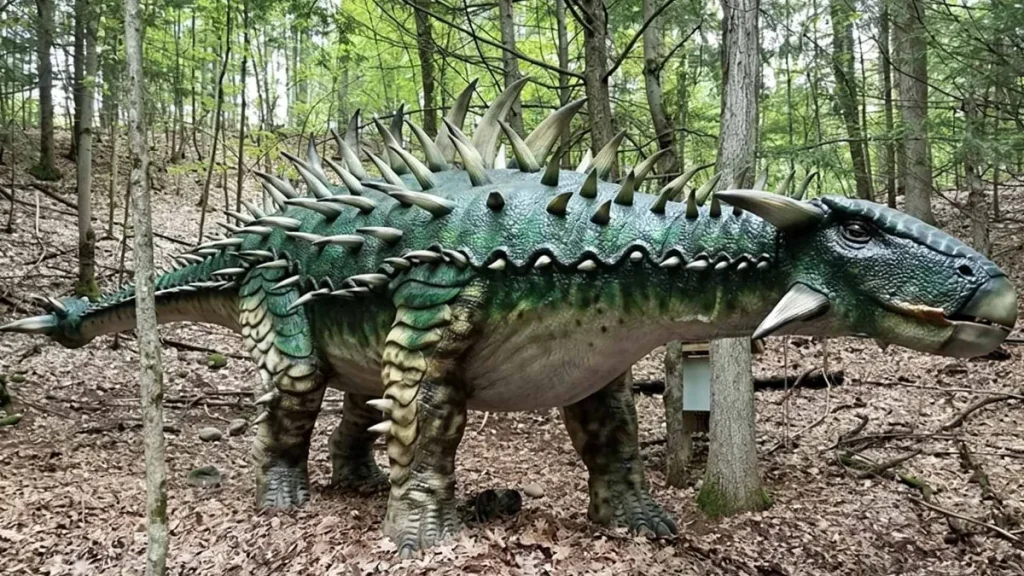
Every hollow section of a large figure — belly, neck, tail base — will collect condensate even if no rain ever enters. Condensate forms on the inside of the skin as the outside surface cools at night, runs down, and finds the lowest point. That lowest point needs a drain: a small filtered port at the bottom of each cavity, positioned so that it drains when the figure is on its plinth rather than when it is lying on its side in the workshop.
On the outside, the details that matter are the ones where two surfaces meet at a shallow angle. The top of the back, the inner curve of a raised neck, the gap between an open jaw and the upper skull. Water sits in shallow angles. A small deliberate fall away from the seam, or an open gap wide enough to drain rather than a tight joint that holds a film of water by capillary action, solves most of it.
Sites with irrigation or sprinkler systems nearby need their spray direction considered too. An irrigation head that arcs against the same seam twice a day for six months does more damage than a year of rain.
Sunlight, Heat and Cold
Silicone is genuinely good outdoors. It resists UV and ozone far better than natural rubber or EPDM, which is one reason we mold skins in silicone rather than coating a foam carving. It also stays flexible across a very wide temperature band, so it does not crack at -20 °C or go tacky at 50 °C.
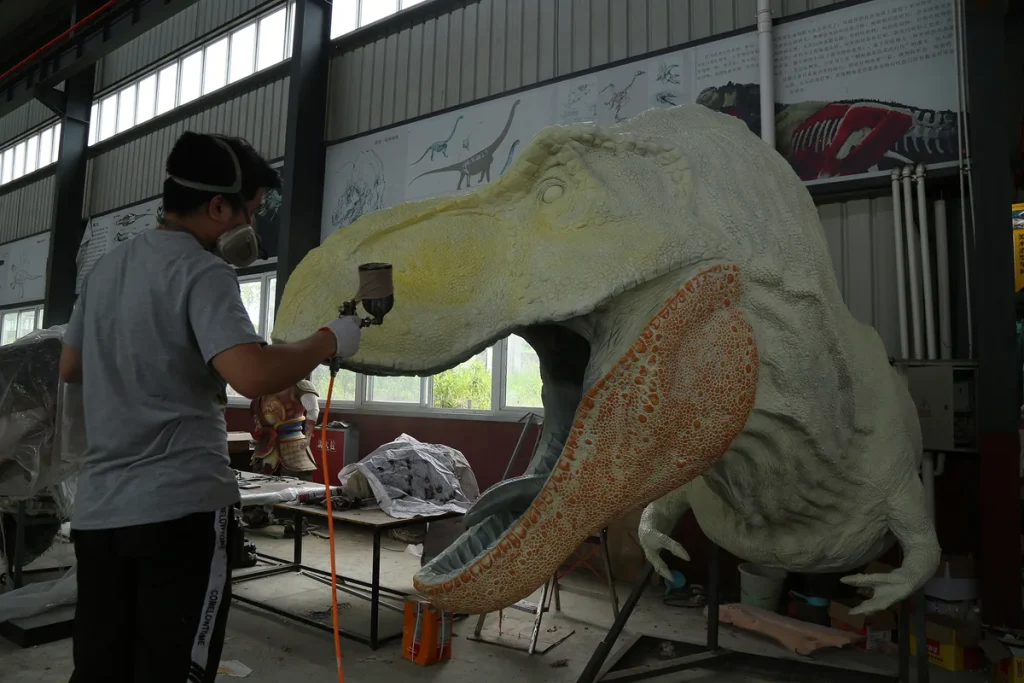
The part that ages is not the skin. It is the surface finish on top of it. Pigments fade under UV, and a translucent topcoat that yellows slightly will shift the colour of the whole figure over three to five years. This is normal, cosmetic, and correctable with a recoat — but it needs to be planned for, not treated as a defect.
Heat matters more than most buyers expect, and it is an electronics problem rather than a skin problem. A dark-coloured figure in direct summer sun with a control cabinet mounted inside the body cavity can see internal temperatures 25 to 30 °C above ambient. Servo drives derate in heat, batteries age faster, and seals soften. Shade the cabinet, or move it out of the body entirely to a separate ground-level enclosure.
Cold is a cabling and lubrication problem. Silicone skin is fine well below freezing, but standard PVC cable jacket stiffens and becomes brittle around -15 °C, and the grease in a gearbox thickens enough to raise starting torque. If a site expects operation below -10 °C, specify cold-flex cable and low-temperature grease at the order stage. Retrofitting either after installation means disassembling the figure.
Wind Load and Anchoring
This is the item that most often gets skipped and most often matters, because a large figure is effectively a sail.
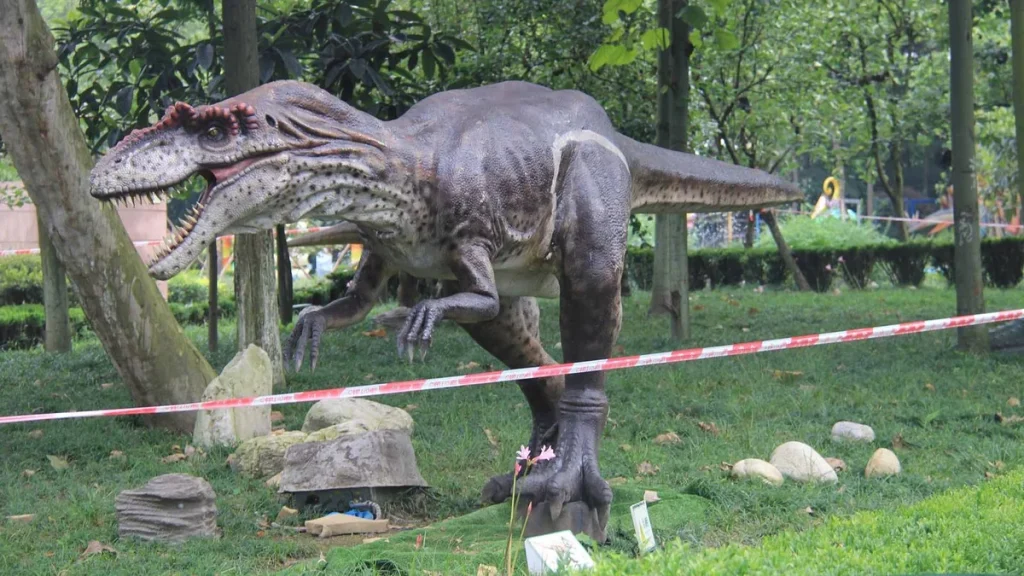
Wind pressure rises with the square of speed, so the difference between a breezy day and a storm is not linear. The dynamic pressure is 0.5 × air density × velocity squared. At 30 m/s — about 108 km/h, a strong storm — that works out to roughly 560 Pa. Multiply by the projected area of the figure and a drag coefficient of about 1.2 for a bluff body, and a 5 m tall figure with around 8 m² of exposed side area is carrying on the order of 5 kN of horizontal force at its centre of pressure. That is roughly half a tonne pushing sideways at head height, with a lever arm to the base.
On a permanent installation, the base plate and anchors have to be designed for that load, and the design should come from the structural engineer of record for the site, working from the figure’s actual dimensions and its centre of pressure. Chemical anchors into a reinforced concrete plinth are the usual solution; ground screws work in some soils; a steel sub-frame cast into the plinth is the most robust option for anything over about 4 m.
For temporary installations — festivals, seasonal displays, touring shows — the anchor design changes entirely. Guy wires or ballast frames are normal, and the operating procedure should include a wind-speed threshold above which the figure is switched off and, if the forecast warrants it, laid down or partially dismantled. A figure that is designed to be taken down twice a year should have a documented procedure for it, with the lifting points marked.
Snow and Ice
Snow is a load problem and an icing problem, and they need separate answers.
Load first. Ground snow load varies enormously by region, from under 0.5 kN/m² in mild coastal climates to well over 2 kN/m² in northern inland areas. What matters for a figure is not the ground figure but the accumulation on upward-facing surfaces — the top of the back, the curve of a raised neck, the inside of an open mouth. Those surfaces collect snow and hold it. Ask for the site’s ground snow load and check the horizontal projection against the design; a figure that passes in Spain may need additional internal ribs in Norway.
Icing is different and simpler to handle: do not run a figure that has ice in its joints. Frozen water in a jaw hinge or a neck bearing will strip a gearbox in one movement command. The operating procedure should say that after any icing event, the figure stays off until it has thawed naturally, and that no one attempts to free a joint by forcing it or by applying heat directly to the skin.
The Control Cabinet Is the Weakest Link
The single most common cause of an outdoor exhibit failing in its first year is not the dinosaur. It is where somebody put the cabinet.
A cabinet bolted to the sunny south side of a frame, with a vent that points into the prevailing wind, will overheat in summer and take water in a storm. Four rules cover most of it: mount it in shade or under its own sunshield; vent it through a filtered path that faces down; fit a thermostatically controlled heater to keep the interior above the dew point; and keep it off the ground by at least 300 mm, on a bracket rather than a plinth that holds water.
Where possible, put the cabinet in a separate ground-level enclosure or a nearby plant room. This costs a cable run but removes the heat, water and access problems in one move, and it is the design we default to on permanently installed outdoor figures.
Seasonal Shutdown and Restart
A site that opens seasonally needs two documented procedures, and they are not the same as “switch it off”.
For shutdown: run the figure to its park position, disconnect and lock off the supply, cover the cabinet vent with the supplied cap, inspect and clear the drain ports, and record the condition of every seam and cable gland in the log. If the site is exposed to snow, confirm the park position does not present upward-facing surfaces that will hold load all winter.
For restart: do not command a full movement cycle on the first power-up. Check the drain ports again, inspect for insect or rodent ingress in the actuator bays, run each axis slowly through its full range one at a time while listening, and only then run a complete sequence. Most of the damage that appears at the start of a season happened during the winter and shows up in the first movement.
What to Write Into the Specification
If you are tendering or comparing quotes, these eight lines do more to protect you than any warranty clause.
1. IP rating per zone: housings, cabinet, and anything below 300 mm.
2. Seam orientation on neck and tail, and the bonding method.
3. Cable entry type — glands on a gland plate, with drip loops.
4. Plinth height and the drain path, including drain port positions.
5. Fastener material throughout, and the isolation method for dissimilar metals.
6. Site ground snow load, and confirmation the design accounts for it.
7. Wind design: the figure’s projected area, drag coefficient and the anchor load it implies.
8. Operating temperature band, and the cable and grease specification that supports it.
None of these are exotic. They are the same eight items that decide whether an outdoor figure is still running in year five or has been patched twice.
Frequently Asked Questions
Can an animatronic dinosaur stay outside all year round?
Yes, if it is built as an outdoor unit from the start. Sealing, drainage, cabinet placement, coating and anchoring are all decisions made during fabrication. An indoor figure moved outdoors will work for a season and then start failing at the seams and cable entries.
Does rain damage the silicone skin?
The skin itself handles rain well — silicone is hydrophobic and UV stable. What degrades is the topcoat and pigment over several years, and what fails early is the bond line at panel seams if water is allowed to sit on it. Keep the seams draining and plan a recoat every three to five years.
What IP rating should I specify for an outdoor exhibit?
IP65 on actuator housings and connector bulkheads, IP66 on the control cabinet, and IP67 on anything within 300 mm of ground level. Treat a supplier who says “fully waterproof” without quoting a code as having no rating at all.
Can it operate below freezing?
The skin and frame can. Standard PVC cable jacket becomes brittle around -15 °C and gearbox grease thickens well before that, so if the site regularly runs below -10 °C you should specify cold-flex cable and low-temperature grease when ordering. Once ice has formed in a joint, keep the figure off until it thaws naturally.
Do I need a concrete foundation?
For any figure above about 3 m on an exposed site, yes — a reinforced plinth sized for the wind load, with the anchor design from a structural engineer working from the figure’s projected area. Small figures on sheltered sites can use ground screws or a ballasted frame, but the load case still needs to be checked.
How often does an outdoor unit need servicing?
Operator checks weekly, a full inspection of seams, glands and drains quarterly, and an annual service covering lubrication, fastener torque, seal replacement and a cabinet clean-out. Outdoor units see roughly double the wear of indoor ones because of thermal cycling, so the schedule should be built around that, not around the calendar.
Planning an outdoor installation and want the sealing, anchoring and cabinet details checked against your site? Send us the site conditions and the figure dimensions and we will tell you what the build would need to change. For the structure underneath the skin, read the six systems that make an animatronic dinosaur work; for the skin itself, see how molded silicone skins are made.