Cost and Budgeting
What moves the number, and why two quotes for the same species can differ by half.
How much does an animatronic dinosaur cost?
There is no single price, because three variables move independently: size, skin process and electromechanical specification. A 6-metre T-Rex and a 10-metre T-Rex are not the same product — frame steel, skin area, motor torque and shipping volume all scale with length, and not linearly. The most useful thing you can send us is the species, the length and where it will stand; that is enough for a real number instead of a range.
What actually drives the price up or down at the same size?
At a fixed size, two things dominate: the skin process and the drive specification.
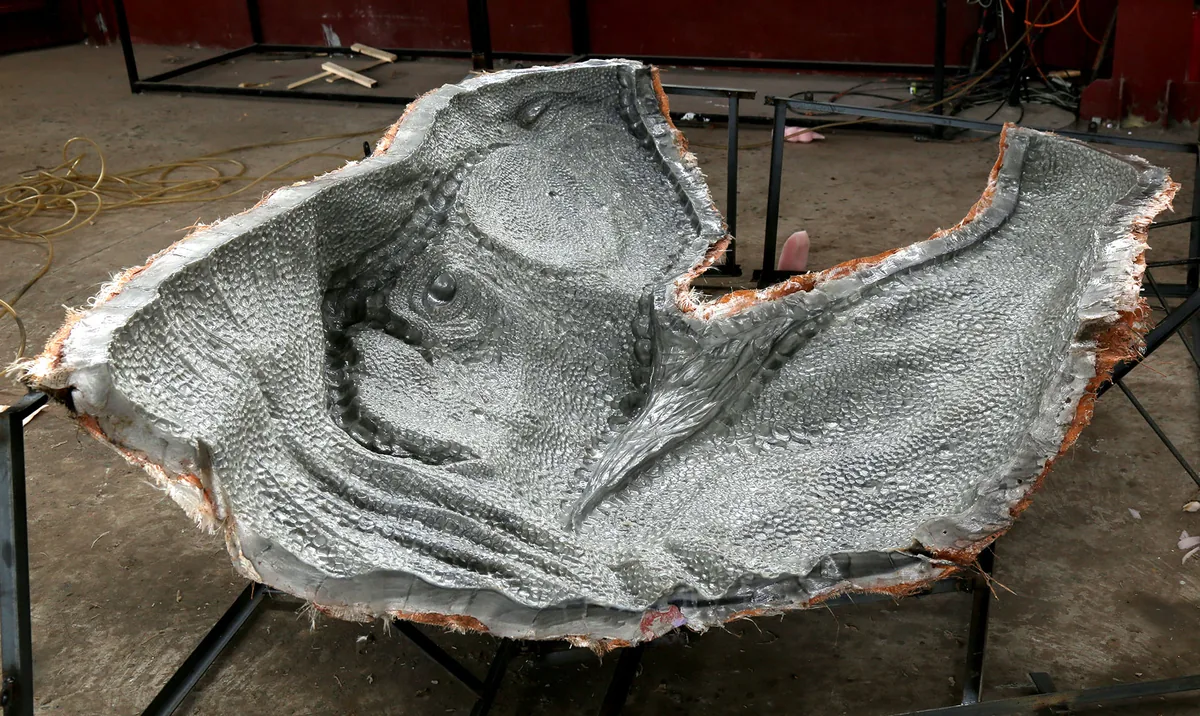
Skin process. The common industry method is a steel frame wrapped in high-density foam, sculpted by hand, then coated with silicone skin. It is fast and it is what most factories quote. The alternative is a moulded silicone skin — a master mould is made from the sculpture and each skin is cast from it. Moulded skins give consistent surface detail and repeatable colour across multiple units, and they cost more because the mould is a one-off investment.
Drive specification. A standard brushless motor with a basic controller is the entry point. Stepping motors, or electric cylinders on the larger joints, cost more and hold position more precisely. On the control side, our own control cabinet and an imported PLC system sit at very different price points — the PLC brings programming flexibility and third-party serviceability, the in-house cabinet brings a lower price and direct factory support.
Why is one quote half of another for the same species?
Almost always because the two quotes are not describing the same build. The gap usually sits in three places: foam-sculpted skin versus moulded silicone skin, brushless motors versus stepping motors or electric cylinders, and an in-house control cabinet versus an imported PLC. Movement count and range are the fourth variable — a unit with head and tail motion is not comparable to one with mouth, eyes, neck, forelimbs and tail. When comparing quotes, ask each supplier to state the skin method, the motor type, the controller brand and the number of moving axes. Once those four are on the table, the prices usually converge or the difference explains itself.
What is included in the quoted price, and what is not?
Included: design and drawings, frame fabrication, sculpture and skin, electrical assembly, run-testing before crating, export packing, and the documentation needed for shipping. Technical support after delivery continues for the life of the unit — questions about operation, adjustment and fault diagnosis are answered by the same engineers who built it.
Not included by default: import duty and local taxes, inland transport at the destination, site civil works such as foundations and power supply, and on-site installation labour unless it is quoted separately. We itemise these so there is no surprise at the port.
Is there a minimum order?
No. Single units are built to order, and a large share of our work is one-off — a single centrepiece for a mall, one specimen for a museum gallery. Multiple units of the same species cost less per unit because the sculpture and mould work is shared, which is worth knowing if you are planning a trail or a herd.
Can I buy one unit for a small venue?
Yes, and it is common. A small mall, a single-room museum or a resort lobby usually takes one unit in the 3–6 metre range with a reduced movement set — head, mouth and tail rather than a full body rig. Smaller does not mean a toy build: the frame and skin specification stay the same, and the difference comes from size and axis count.
Ordering and Payment
From first enquiry to a signed drawing — the sequence, and what you can still change at each stage.
What does the process look like from enquiry to delivery?
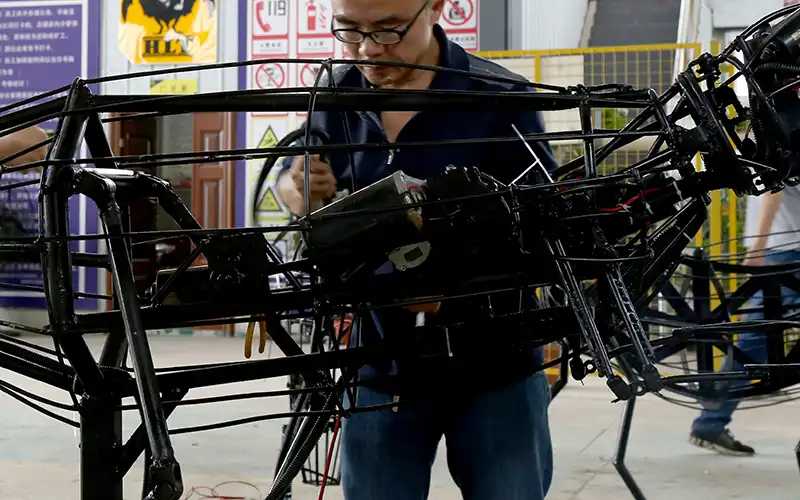
Six stages, and each one ends with a document you approve. Enquiry and requirement gathering (species, size, placement, movement list) — concept and drawing — quotation against the drawing — contract and deposit — production with photo and video updates — pre-shipment inspection, crating and booking. Installation, where included, is scheduled against your venue's opening date rather than ours.
What payment terms do you work with?
Terms are agreed in the contract for each order, typically a deposit to release production and the balance before shipment. The exact split depends on order value and build complexity, and it is confirmed in writing before anything starts. We do not ask for full payment upfront.
Can I follow production progress?
Yes. You receive photographs and short videos at fixed milestones — frame complete, sculpture complete, skin applied, electrical test, and the final run test before crating. If something in the drawings needs to change mid-build, the photo stage is where it is cheapest to catch.
Can I visit the factory before ordering?
You are welcome on the floor in Zigong. Buyers who visit see the steel line, the sculpture and skin shops, the electronics bench and the outdoor test ground, and can watch a unit from their own order run-test before it ships. If a visit is not practical, we do a live video walkthrough instead.
What happens if I change the design after the deposit?
Small changes — colour, pattern, a movement added or removed — are usually absorbed if they arrive before the skin stage. Changes after the skin is applied mean reworking the surface, which is quoted as additional work. Structural changes after the frame is welded are the expensive ones, which is why the drawing approval stage matters more than any other step.
Lead Time, Shipping and Customs
Real production windows, the three shipping routes, and who pays duty at the destination.
How long does production actually take?
Standard builds run 30 to 45 days from drawing approval and deposit. Large units, multi-unit orders and builds with imported control systems run 45 to 60 days. Add transit: roughly 25–35 days by sea to Europe or the US East Coast, 12–18 days by rail to inland Europe, and 5–8 days by air. The number that matters for an opening date is production plus transit plus installation, not production alone.
Sea, rail or air — which shipping method should I choose?
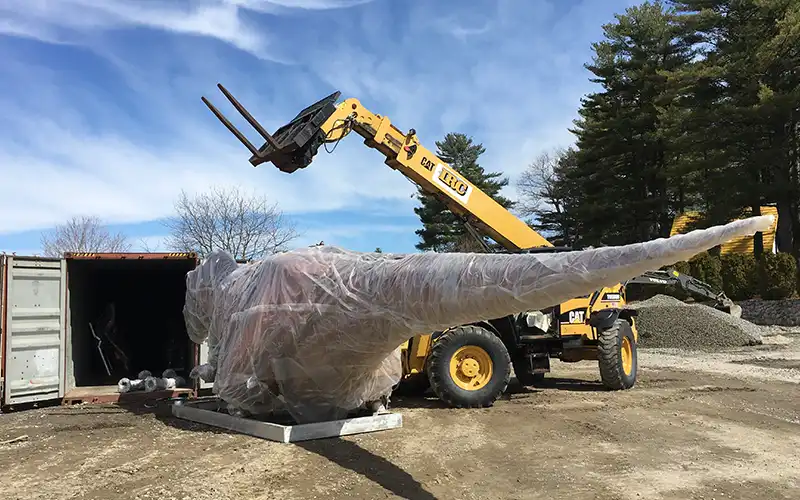
Sea freight for anything full-size, because volume is what you are moving and air freight scales badly with it. Rail is competitive for inland European destinations and avoids some port congestion. Air is realistic for costumes, puppets, spare parts and small models, and occasionally for a single urgent unit where the opening date cannot move. We quote all three against the same order so the comparison is honest.
Who handles customs clearance and import duty?
It depends on the trade term in the contract. On FOB, your freight forwarder handles everything after the goods leave the Chinese port. On CIF or DDP, we arrange more of the route. Import duty and local taxes are the buyer's responsibility under every term except DDP, and the rate depends on your country's tariff classification for the product — we supply the HS code and the commercial documents your broker needs.
What happens if the unit arrives damaged?
Every unit is inspected and photographed before crating, and the inspection record travels with the shipping documents — that is the baseline for any claim. Crates are built for the route, with the frame braced and the skin protected. If damage does occur, photograph the crate before opening and the damage itself; marine insurance claims need that sequence. Replacement parts for anything short of structural damage usually ship within days.
Can you deliver to a venue with no loading dock?
Yes, with planning. Full-size units ship partly disassembled so no single crate exceeds what a forklift or a small crane can handle. For a mall or a museum with only a passenger lift, we plan the split at the drawing stage — the largest section has to fit the narrowest opening on the route, and that dimension should be measured before production, not after.
Installation and Site Preparation
What to prepare on site, whether you need a concrete base, and the clearance a moving unit really takes.
Do you send technicians to install?
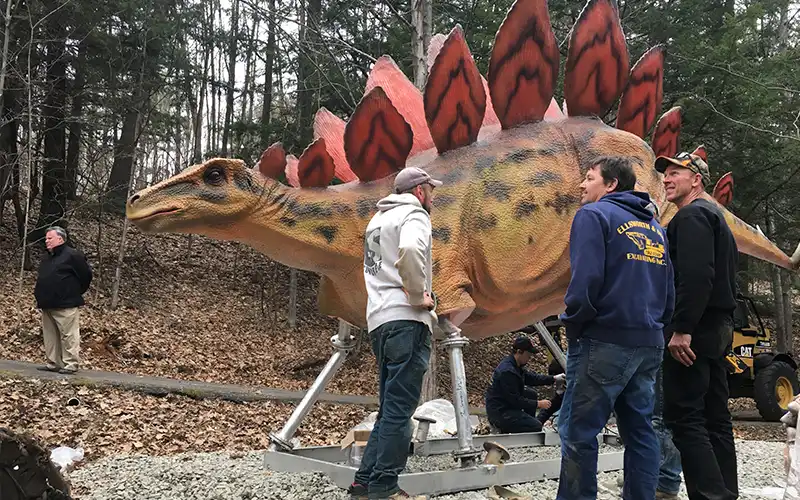
Yes. Installation by our own technicians is quoted per project and covers assembly, alignment, movement calibration and operator training. We have installed in more than 40 countries. For buyers with technical staff, a supervised installation — our technician directing your team — is a cheaper option that leaves your people trained on the machine.
What must I prepare before the unit arrives?
Four things: a level standing area, a power supply of the correct voltage and rating, a route from the delivery point to the standing area, and any local permits for a temporary or permanent structure. We send a site preparation sheet with the drawings, and we ask for photographs of the location before the unit ships so the installation team arrives with the right tools and fixings.
Can it be installed without a concrete foundation?
Usually yes, but the answer depends on size, weight and soil. Small and mid-size units can be anchored to a paved surface or ballasted with an internal weight frame. Large units, or units with a walking motion that shifts load, need either a concrete pad or a designed ballast base. Send photographs of the ground and we will say which applies — guessing here is how units end up leaning after the first winter.
How much space does it need, including tail swing?
The footprint in the drawings is the standing footprint, not the operating footprint. A unit with a moving tail sweeps an arc behind it, and a unit with a neck that reaches down needs clearance in front. As a working rule, allow the body length again behind the unit for tail motion, and a metre of clear space on all other sides for maintenance access. Venue layout should be settled before production, because the answer sometimes changes the movement set.
What power supply does it require?
Voltage and rating are stated per unit, and it varies with the drive specification — a large unit with electric cylinders draws considerably more than a small unit with brushless motors on head and tail only. Most builds are available in 110 V or 220 V. Outdoor units need a weatherproof connection point within reach of the unit's cable, and we recommend an RCD-protected circuit regardless of the local code.
Maintenance and After-Sales
Service interval, what the warranty covers, spare part speed, and what actually fails first.
What maintenance does an animatronic need, and how often?
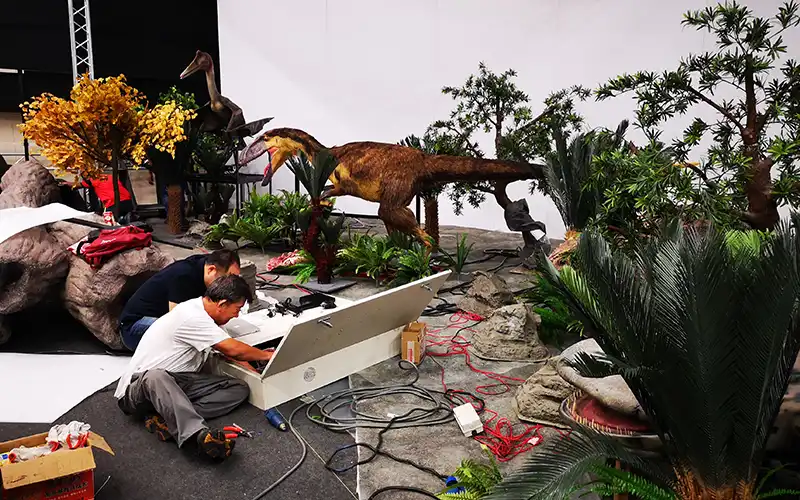
Less than most buyers expect. Routine work is cleaning the skin with a pH-neutral agent, checking fasteners and joint play, lubricating the joints that carry load, and inspecting cable entries for water ingress — monthly in a public outdoor setting, quarterly indoors. An annual deeper service covers skin seams, seal condition and a backup of the control program. Everything on that list can be done by a venue technician with the handover document we provide.
What does the warranty cover?
Every unit carries a 12-month warranty. It covers drives, controls and skin workmanship — the parts and the labour on them. Consumables, and damage from misuse, accident or unauthorised modification, are outside it. Support does not stop when the warranty does: technical assistance on operation, adjustment and fault diagnosis continues afterwards, and it is the same engineering team answering.
How fast can spare parts reach me?
Stock parts — motors, reducers, driver boards, cylinders, valves, limit switches, receivers — leave Zigong in three to five working days by air. Parts that must match your unit's original sculpture, such as skin panels, eye assemblies and jaw mechanisms, take two to four weeks because they are made from the retained mould. Units are designed modular for this reason: you replace the module, not the machine.
Can the skin be repaired on site?
Yes for seams and local damage up to roughly a hand's width. A technician carries the compound and the pigment formula for the original colour, so the repair does not read as a patch. Large sections — a torn flank, a full re-skin — are a workshop job, and for those we either send a skin panel made from the original mould or bring the unit's skin section back.
What causes most failures in the first year?
Not the mechanics. The three most common causes are electrical connections working loose in transit, water ingress at a connector on an outdoor unit, and a limit or encoder position drifting after the first weeks of running. All three are adjustments rather than failures, and all three are covered by remote diagnosis — a video of the fault and the controller's error code is usually enough to identify them without a site visit.
Understanding Supplier Types
What you are actually contracting for, whether the quote comes from a factory or a trading company.
How do I compare a factory quote with a trading company quote?
Both models exist in this industry and both serve buyers well in different situations — the useful question is not which is better, but what you are actually contracting for. A factory quote usually includes design changes made on the floor, direct access to the people building the unit, and a lower price at the same specification. A trading company quote often bundles services a factory does not offer: local language and time zone, consolidated sourcing across several product types, customs and logistics handling, and a single point of contact for a multi-supplier project. Many trading companies are long-term partners of factories rather than competitors, and some of the best-run projects we have been part of were led by one.
How do I find out who actually builds the unit?
Ask for three things and check that they agree with each other: the production address, a video walkthrough of the workshop made to your request rather than taken from a brochure, and the name of the technician responsible for your build. Then ask a technical question a sales office cannot answer from a spec sheet — what shore hardness the skin is, or which joint carries the highest load. The answer tells you who you are talking to.
Can you show the certifications and patents behind the claim?
Yes, and they are available as documents on request. We hold ISO 9001 (No. 29018Q00171-05R0S) and CE certification (No. C20131022003), eight national patents including the silicone skin process (ZL 2022 1 0224489.5) and a blinking-eye mechanism (ZL 2016 1 0669209.6), and more than 2,100 copyright registrations covering original sculpture and design work. The patents matter for a simple reason: the skin chemistry is ours, so a repair years later can be matched to the original formula.
Who actually builds my unit — your team or a subcontractor?
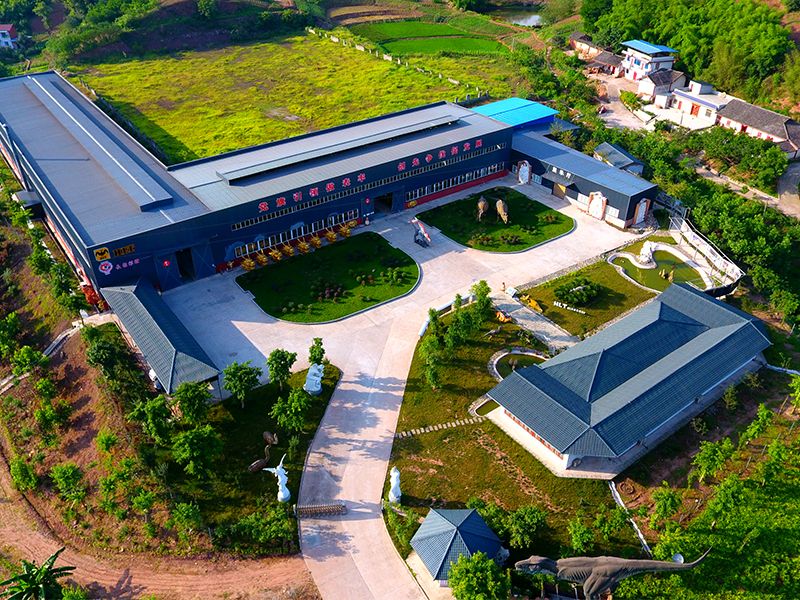
Our own team, in our own workshop. The 8,000 m² plant in Zigong runs the steel line, the sculpture and skin shops, the electronics bench and the outdoor test ground under one roof, with 76 people including 11 technicians who have been with us more than ten years. Nothing is drop-shipped or subcontracted, which is why we can tell you the name of the person welding your frame.
Do you have references in my country?
We have delivered more than 5,000 exhibits to over 40 countries since 2012, including projects in the US, UK, Italy, Singapore, Malaysia, Ukraine, Oman and Morocco. For a specific market we can share the project list and, where the client agrees, put you in contact with a venue that has operated our units through several seasons — which is a more useful reference than a photograph.
Still a question that is not here? Send it with your species list and venue type — we answer technical questions directly, whether or not there is an order behind them.
Ask Our Engineers →