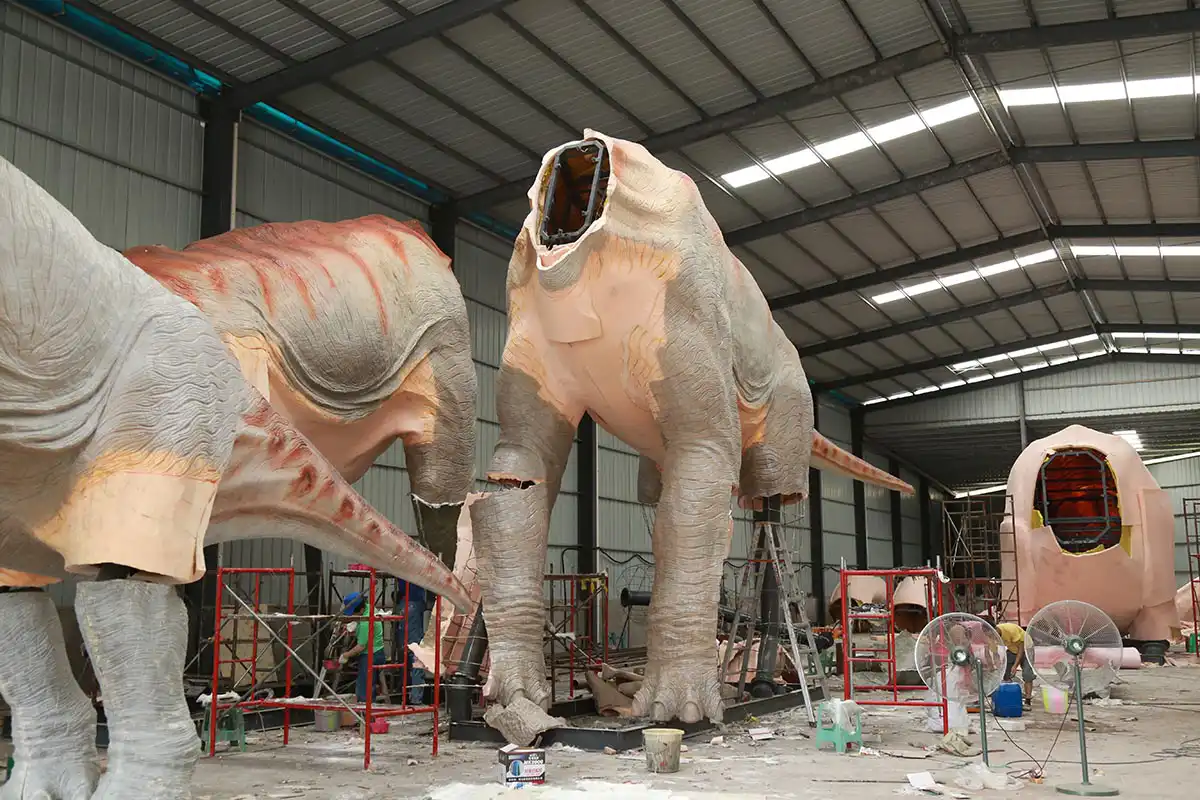
Short answer: most animatronic dinosaurs are electric. Hydraulic drives win on raw force for very large, heavy figures; pneumatic drives are cheap and fast for simple repeat actions; but servo, brushless and stepper electric drives dominate modern exhibits because they are precise, quiet, clean and programmable — and because a museum or mall will not tolerate an oil leak or a compressor running next to the exhibits. Here is how the three systems actually compare, from the factory side.
How Hydraulic Movement Works
A hydraulic system uses pressurized oil pushed through cylinders. A pump — usually driven by an electric motor — builds pressure, valves route it, and the cylinder rod extends or retracts to move the load. Because oil is nearly incompressible, hydraulic cylinders deliver very high force from a compact package, and they hold position under load without the motor fighting gravity.
That is why hydraulics still appear in the largest performance pieces: a 15 m figure that has to lift its own neck, a ride platform carrying passengers, a stage effect that throws weight around. The trade-offs are real: oil leaks are a maintenance and image risk indoors, pumps and valves add noise, cold weather thickens the oil, and the fluid, hoses and seals need a service schedule of their own.
How Pneumatic Movement Works
Pneumatics replace oil with compressed air. A compressor feeds cylinders or air muscles through solenoid valves, and the motion is fast — air accelerates quickly and the hardware is cheap. There is no oil to leak, and a small cylinder can snap a jaw or flick a tail with a satisfying speed.
The catch is control. Air compresses, so holding a position precisely is difficult, and motion tends to be either fully out or fully in unless you add proportional valves and position feedback. Exhaust air is noisy, compressors need a dry, filtered supply, and the system is a poor fit for slow, smooth, heavy movement. Pneumatics suit small, repeated, fast actions — a chomping jaw, a breathing chest, a snapping trap — more than they suit a walking performance.
Hydraulic vs Pneumatic vs Electric: The Comparison
| Factor | Hydraulic | Pneumatic | Electric (servo / brushless / stepper) |
|---|---|---|---|
| Force density | Highest — moves heavy loads from a small cylinder | Low to medium — fast but weak under load | Medium, raised by gearboxes and ball screws |
| Position precision | Good with servo valves and feedback | Poor — air compresses, positions drift | Best — encoder feedback, repeatable angles |
| Speed | Moderate — smooth and controllable | Fastest to actuate | Fast, and fully programmable in both directions |
| Noise | Pump and valve noise, continuous | Exhaust hiss, loud in bursts | Quiet — the reason museums and malls choose it |
| Indoor risk | Oil leaks damage floors and displays | Condensation and air quality issues | None — no fluid, no exhaust |
| Maintenance | Fluid, filters, hoses, seals on a schedule | Filters, dryers, seals; compressor service | Modular drives and controllers, swapped on site |
| Weather | Cold thickens oil; heat stresses seals | Moisture freezes in lines | Rated builds run −20°C to +60°C with sealed enclosures |
| Programming | Limited without proportional control | Mostly on/off motion | Full motion scripting, sensor triggers, show control |
| Best for | Very large, heavy, high-force figures | Small, fast, simple repeat actions | Most animatronic dinosaurs, animals and exhibit motion |
Where Hydraulics Still Win
Large-scale moving structures: a giant figure whose neck alone weighs more than a car, ride platforms with passengers, stage mechanics that must hold a pose under load for hours. If the requirement is “move something very heavy slowly and hold it,” hydraulics remain the honest engineering answer — provided the site can live with the pump room and the service schedule.
Where Pneumatics Still Make Sense
Small, fast, low-cost action: jaws, breathing, blinking mechanisms on budget builds, water-spit effects, and props where the motion is binary and repetition is high. Pneumatics are also common in costume and puppet mechanisms, where weight matters more than precision.
What Most Exhibits Actually Use
In our own production, almost every animatronic dinosaur and animal is built on electric drives — servo for precise multi-axis movement, brushless for smooth continuous motion, stepper for cost-controlled positioning. A typical mid-size T-Rex runs six to twelve axes on servo and brushless motors with sealed control cabinets, sensor or remote triggers, and motion scripting that can be re-tuned after installation.
Electric drives also make the maintenance story simple: each axis is a modular unit, spare parts ship individually, and a failed drive is swapped on site rather than draining a hydraulic circuit. That matters most to the venues that run exhibits every day — malls, museums and parks where downtime is lost revenue and a fluid leak is a headline.
Decision Checklist Before You Specify Drives
- Load: how heavy is the moving part, and does it carry people? Above a few hundred kilos per axis, ask about hydraulic options.
- Precision: does the motion need to stop at a repeatable position, or is on/off enough?
- Environment: indoors next to displays, outdoors in winter, or touring between sites?
- Operators: will staff run shows daily, or does the unit need to trigger itself?
- Maintenance access: can your team change a drive or does everything require factory service?
Frequently Asked Questions
Are hydraulic animatronics stronger than electric ones?
Per unit of volume, yes — hydraulics move heavier loads from smaller hardware. For the loads most exhibits actually carry, electric drives with gearboxes deliver the required force without the fluid system.
Why do museums prefer electric movement?
Quiet operation, no oil risk near collections, no exhaust air, and precise slow motion that reads well at close viewing distance. Electric drives also allow the subtle motion — eye blink, breathing, head tracking — that makes an exhibit feel alive.
Can a single exhibit mix drive types?
Yes. Mixed systems are common on large builds: electric for most axes and hydraulics for one heavy lift. The control cabinet then coordinates both, and the maintenance schedule covers each system separately.
Which system is cheapest to own over ten years?
It depends on duty cycle, not sticker price. Pneumatics are cheapest to install and cheapest to run only on simple, low-duty actions; hydraulics carry fluid and seal service costs; electric drives cost more upfront but need the least routine service and are modular when they do fail.
Specifying an exhibit and unsure which drive set fits the movement you have in mind? Send the movement list and site conditions — we will tell you which system we would build for it, and why. For the wider picture, read the key systems behind an animatronic dinosaur or what actually drives the cost.